
Recent history, public uses of the past, and collective action
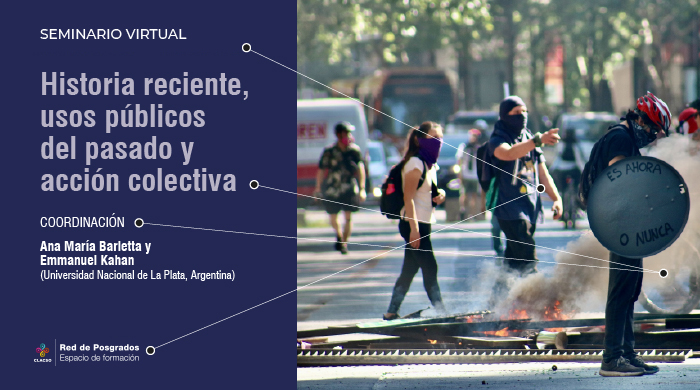
Seminar 2207
Chair: CLACSO
Coordination: Ana María Barletta and Emmanuel Kahan (Institute of Research in Humanities and Social Sciences / Faculty of Humanities and Education Sciences, National University of La Plata, Argentina)
Home: 23 / 03 / 2022 | Registration: 15/12/2021 al 22/03/2022
Workload: 12 weeks – 90 hours.
Summary:
This course aims to address and problematize a series of experiences related to how social groups remember the past in relation to present-day struggles and problems. In doing so, it seeks to reflect on how these groups remember and how these memories, linked to narratives of the contemporary public agenda, shape the horizons of expectation in the contemporary world. In this sense, these perspectives, which draw on a complex network of conceptual issues and empirical references, will attempt to reconstruct a temporal order linked to three stages of the Latin American political process: the time of rebellion, the time of repression, and the time of the restoration of democratic stability.
We understand that remembering past events is integral to building our present and future, and as such, it is essential as a political bridge for building a more egalitarian and democratic society. Therefore, we will explore the alternatives, complexities, and pluralities of different perspectives and experiences surrounding the debates over the public use of the past and its integration into collective action. One of these dimensions will, naturally, be the gender perspective and that of inclusive citizenship, which have proven highly productive and innovative in the streets of our region in recent times. This course aims to contribute to building new common understandings within the subjectivities of the present, by recovering the radical nature of truncated pasts and possible futures, in an era so threatened by the new right and the rise of regressive, discriminatory, and intolerant discourses against social movements and human rights, and consequently, against the existence of a substantive democracy for our people.
- RECENT HISTORY AND MEMORY. The cycle of rebellion, repression, democracy.
- STATE, HUMAN RIGHTS ORGANIZATIONS AND COLLECTIVE ACTION. The consensus on human rights in contemporary democracies
- Truth Commissions and Reparative Policies. Investigating the truth and making amends
- TRANSITIONAL JUSTICE - REPARATIONS. Recognition of victim status, humanitarian discourse, and different access to justice
- LEGAL PROCESSES AND HISTORICAL TRUTH. Legal processes and responsibilities surrounding human rights violations.
- FORENSIC ANTHROPOLOGY. Its role in the identification of victims of genocide.
- SITES OF MEMORY. Spaces, territories and places of memory. Teaching of “extreme histories”
- EDUCATION AND MEMORY. Historical and generational transmission.
- PUBLIC USES OF THE PAST AND COMMEMORATIONS. Tensions and debates.
- THE PAST AS REPRESENTATION. INTERVENTION AND AESTHETIC ACTIVISM. Supports, narratives, and public policy in the cultural field
|
|
Discount for one payment until 16/03 |
In one payment after 16/03 |
|
CM Plenos |
$75 |
$150 |
|
CM Associates |
$95 |
$190 |
|
No link |
$95 |
$190 |
FAQ

