
“There is a very strong issue of not wanting to know about disabilities.”
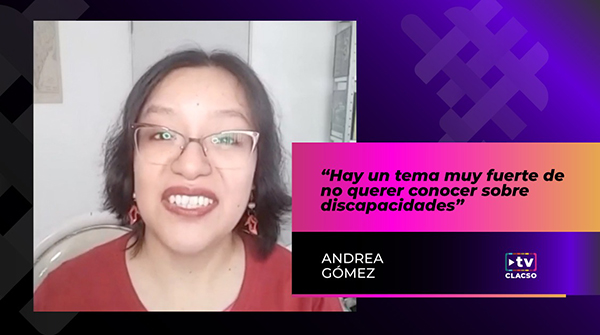
Andrea Gómez is a Peruvian anthropologist trained at the Pontifical Catholic University of Peru and at the Metropolitan Autonomous University of the Iztapalapa Unit of Mexico, she is part of the CLACSO Working Group on Critical Studies with Disability and Feminism: Resistance and Emancipation.
Interviewed by Crismar Lujano
Andrea Gómez, who will be a panelist at the 9th Latin American and Caribbean Conference from June 7-10 at UNAM in Mexico, defines herself as an autistic woman who researches autism and neurodiversity. Regarding this, she stated:
“As an autistic person, but also as an autistic woman, I’ve been exploring this topic primarily because it’s something that resonates deeply with me; I can’t function in the world without it. Speaking as a social scientist, I believe it’s the responsibility of each of us to explain how and from where we conduct science, where that production originates, where these reflections come from, and I think it would be very naive of me to omit that and tell you that everything I write, whether it’s about disability, autism, or neurodiversity, isn’t affected by it; obviously, it is.”
I think there's a serious issue in academia and the media, not just of ignorance, but of a reluctance to learn. For decades, activist movements for people with disabilities, and specifically—perhaps more recently, but with a significant track record—for autistic people both within and outside of Latin America, have been demanding more accurate representations in the media, moving beyond stereotypes and confusion. For example, when a character is labeled "crazy," it creates a confusion between mental health, mental difference, disability, intellectual disability, and psychosocial disability. It's a whole jumble of concepts that are simply ignored; the only way to portray the character is to grab attention and engage the audience, making it as scandalous and clichéd as possible. And there's no accountability for the impact of this. One of the things I've been observing—and which is actually part of a presentation I'll be giving at the CLACSO Congress #CLACSO 2022 in June—is that the mediation exerted by television productions, and specifically telenovelas, is so powerful in Latin America that the industries are aware of it and are even proud of claiming that this Latin American cultural production has such influence and impact. But when it comes to denouncing the things that the characters they're putting on TV entail, that's when they say, "But no, there isn't that much influence, is there?" With that, I think there's another issue of taking responsibility and acknowledging what isn't being done, what isn't being seen.
If you would like to receive more information about CLACSO's training programs:
[widget id=”custom_html-57″]
to our email lists.

