
"We need to build new consensus on scientific evaluation"
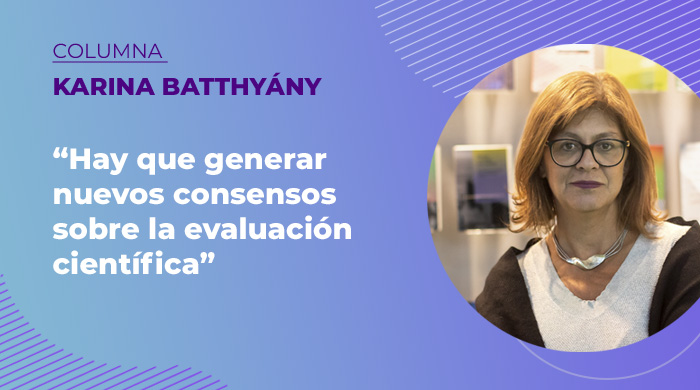
Transcript of Karina Batthyány's column
in InfoCLACSO – April 10, 2024
The International Council for Science (ISC) is promoting global knowledge dialogues in different regions of the world. This time, it's Latin America and the Caribbean's turn. Specifically, the Global Knowledge Dialogue is taking place in Santiago, Chile, to address various topics. CLACSO is playing a leading role in one of these dialogues, both in terms of organization and discussion, and due to the positions it has held within the Latin American and Caribbean region, as well as in relation to other regions of the world, regarding the future of evaluation and scientific publications in the context of open science.
First, we must frame this discussion within the broader concept of open science, remembering that 193 countries adopted UNESCO's recommendation in 2021. This recommendation aims to open up the processes of creating, evaluating, and communicating scientific knowledge to social actors beyond the traditional scientific community. Furthermore, it is essential to review research evaluation systems and systems for evaluating scientific careers to align them with the principles of open science. Since 2019, CLACSO has created and strongly promoted the Latin American Forum on Scientific Evaluation (FOLEC).
Within the framework of a panel on the Global Dialogue of Knowledge, we will discuss the role of scientific publications in these evaluation processes, bearing in mind the eight principles that the International Council for Science itself, with the active participation of CLACSO and the contributions of our advisor Dominique Babini and Laura Rovelli, has highlighted and approved in 2021.
The first of these, the rapid and global circulation of ideas, is fundamental to the scientific process. Furthermore, there must be universal, rapid, and open access to the scientific record, both for authors and readers, without any barriers to participation, particularly those related to commercial payment terms, language barriers, or geographical barriers.
Regarding the knowledge map, each time we draw it, it's a highly distorted map, where the Global South is underrepresented in terms of its contributions to knowledge. This isn't because less knowledge is produced, but because language and trade barriers prevent that knowledge from being disseminated and accessible in other parts of the world.
The second principle is linked to the fact that scientific publications should have open licenses to allow for their reuse and the extraction of texts and data. The central element is that for those of us who conduct science and research and publish our results, the generic data on which our research is based should be open. That is, if someone wants to access, use, or replicate that information, they should be able to access the microdata and the data that support the claims. In reality, we know that this is not the case in some areas of knowledge because database protection exists, which prevents the criterion of replicability.
The third is rigorous and timely peer review, which must continue to play a key role in creating and maintaining the public record of science. That is, this idea of peer review, but with certain associated elements, in its true sense, without becoming an obstacle to the dissemination of knowledge.
A new principle is the issue of data and observations, which must be accessible for scrutiny and be able to be replicated if necessary.
On the other hand, the scientific record must be maintained in a way that guarantees open access for all future generations, that is, without time limits. And the modes of publication and bibliodiversity across different disciplines and regions must be adapted to the relevant needs, but in a way that facilitates interoperability between different disciplines and regions, including procedures for multilingual communication. Languages native to our regions, such as those of the indigenous communities of Latin America, must be included so that all these multilingualisms have a possible expression in the scientific field.
We must also discuss the governance of scientific knowledge dissemination processes and how the scientific community should be held accountable for the results and processes of knowledge creation and dissemination. I would like to emphasize that CLACSO shares the International Council for Science's view of open science as a global public good.
It is necessary to incorporate the Latin American perspective into the international conversation about the future of scientific publishing. What is this Latin American perspective? It is nothing more and nothing less than the extensive experience we have in the region with different models of open scientific communication. For example, through all the Latin American and Caribbean repositories, open access databases like Redalyc, and others. These understand knowledge as a common and public good, managed by academic and university communities, and not by commercial industries that, in many cases, are behind large-scale ventures disguised as scientific or leading journals.
From FOLEC-CLACSO, we want to promote greater synergies among all the initiatives presented, as well as greater discussions from the Latin American and Caribbean experience to other regions of the world that do not have this particular perspective from our region so present.
Furthermore, today we want to lay the groundwork for a new discussion within the framework of the #CLACSO2025 Assembly and Conference to be held in Bogotá, Colombia, as was the case previously in #Mexico2022. Let us recall that at our last Conference, a series of guiding principles on FOLEC were approved, which will be discussed again. For #CLACSO2025, we will move forward with various work proposals.
– How is progress being made in addressing the changes in issues of publications, open science, and public policy?
The progress has been very significant. Since 2019, we can find concrete examples of these principles in evaluation processes, which have influenced evaluation parameters and standards. For instance, in Uruguay, different perspectives on the research output of men and women were incorporated, particularly those related to reproductive cycles, to consider the evaluation based on the different stages of a person's life cycle. That is, when evaluating the output of a female researcher in some countries in our region, it is necessary to consider whether she has become a mother or is currently engaged in caregiving responsibilities in the past year, as this directly impacts her capacity to produce knowledge.
Ultimately, what we are interested in promoting is this idea of changing the forms of scientific evaluation, and for that we need to generate new consensus around three major issues: the meaning of evaluation, the evaluation criteria, and the specific measurement indicators.
Regarding the first question, the political discussion is brought to the forefront, because we are not talking about a merely technical aspect but rather the political process that evaluation entails. Furthermore, we need that this definition of the meanings of evaluation give rise to different scenarios, actors, proposals, and forms of knowledge production, which translate into criteria and indicators that allow us to establish some organizing principles. This is what FOLEC-CLACSO proposes, for example, the critical inquiry into reality and the plurality of perspectives, articulating different types of knowledge and expertise, and fostering discussion around the impacts, uses, and transformative potential of this knowledge and expertise on social reality.
Furthermore, we must discuss the hegemonic internationalization of cooperation and regional integration practices in research, teaching, and outreach. Finally, we must incorporate the premises of the main transformative movements of our time, such as women researchers, the women's movement, and feminism. In other words, we need to incorporate the differential participation of men and women in scientific and academic spheres based on concrete instruments.
If you would like to receive more information about CLACSO's training programs:
[widget id=”custom_html-57″]
to our email lists.

