
“Migration must be understood as a human right.”
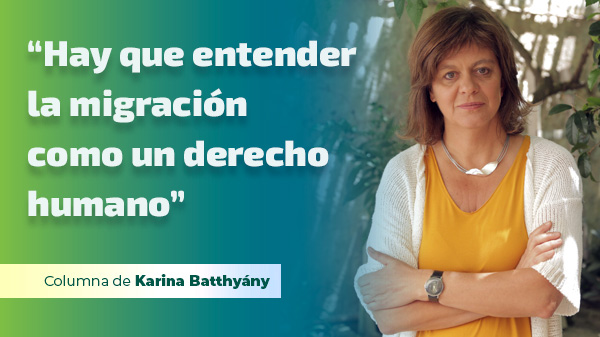
(Transcription of Karina Batthyány's column)
(In InfoCLACSO – April 19, 2023)
Many people who migrate or leave their homes do so under conditions of extreme vulnerability. The International Organization for Migration (IOM) estimates that since 2014, more than 40.000 people have died during their migration journeys. This is a stark indicator that migration is far from being a regulated, safe, and universally recognized right.
The main causes of this are the expulsion and anti-immigrant policies of many countries that are considered recipients, that is, attractors of people who migrate and evidently push the migrant population to transit within the framework of illegality.
The United Nations Office on Drugs and Crime (UNODC) estimated that around 2.500.000 people are victims of migrant smuggling each year: an industry that moves billions of dollars annually, more precisely 7 billion dollars annually.
Another activity operating in this area is human trafficking. The International Labour Organization (ILO) says that more than 40 million people are victims of trafficking for exploitation, of whom more than 80 percent are women or girls.
According to the most recent estimate, in 2020 there were approximately 281 million international migrants worldwide, representing 3,6% of the global population. This is the latest figure available on the number of migrants worldwide.
Furthermore, the estimated number of international migrants globally has been increasing over the past five decades. For example, if we look at the estimated total of 281 million people living in a country other than their country of birth in 2020, this number is almost 130 million higher than the same figure in 1990. That is, in 30 years there was an increase of 128 million migrants. If we go back to 1970, the current total of 281 million people living in a country other than their country of birth is three times the 1970 figure.
It also shows us, quantitatively and in aggregate numbers, the magnitude and importance of migration worldwide. We must understand that humans have always migrated; it is a movement that, while increasing, is inherent to the human condition. The question is under what conditions this migration takes place and under what rights.
I will mention the top five destination countries for international migration. The United States is the leading destination for international migrants: since 1970, the number of foreign-born people residing in the country has quadrupled, and today the figure is approaching 51 million. Second is Germany, which has also experienced an increase over the years and now hosts approximately 16 million migrants. Third is Saudi Arabia, with an increase of 13 million international migrants. It's worth noting that Saudi Arabia's population is comprised of 80% migrants, a characteristic of the country's makeup. Fourth is the Russian Federation, which currently has 12 million international migrants. And fifth is the United Kingdom, with 9 million international migrants residing there.
If we look again at the IOM, the latest estimate says that approximately 90 million people were forcibly displaced from their places of origin by political, social or armed conflicts during 2021, and of that total more than 26 million are considered refugees.
The IOM also shows us that in recent years the number of people displaced by environmental disasters has increased to over 30 million. Furthermore, if we look at Latin America and the Caribbean, it is estimated that 30 million Latin Americans and Caribbeans have migrated to other regions, with approximately 25 million going to North America and another 5 million to Europe.
Mexico has the largest number of emigrants in Latin America and the Caribbean, and ranks second in the world. In other words, the Mexican diaspora is the second largest on the planet, with more emigrants than India. Currently, approximately 11 million Mexicans reside abroad.
In third and fourth place within our region are the Bolivarian Republic of Venezuela and Colombia, with more than 5 million and 3 million migrants, respectively. The displacements caused by migration from Central America and Venezuela are currently the most significant challenges facing Latin America and the Caribbean. This is because migration, originating in and through Central America, is driven by a combination of factors linked to economic insecurity, violence, crime, and also environmental issues and climate change.
In the case of Central America, at the end of 2020, Honduras, Guatemala, and El Salvador had nearly 900.000 forcibly displaced people, of whom more than 500.000 had crossed borders in what are called migrant caravans: the cross-border movements of large groups of people traveling by land have increased in number and frequency since 2018. And of course, they have faced the restrictions imposed by receiving or destination countries at the migratory level, especially the United States, but also the restrictions imposed in many cases by Mexico.
A particular case is the border between the United States and Mexico, because it is considered the deadliest land border in the world according to IOM data from 2021.
Furthermore, we come from two years of pandemic, where border closures, visa requirements, health-related requirements and vaccination have increased this problem, forcing many people to undertake irregular migrations under very difficult conditions.
The example that is usually given is the crossings through what is called the Darien Gap, between Colombia and Panama, where in 2021 they skyrocketed to a record high of almost 134.000 people compared to the previous decade, which reached just over 110.000.
Between January and October 2022, nearly 32.000 children crossed the dangerous Darién Gap jungle between Colombia and Panama. Along the way, access to basic services and rights for all people, and especially for children, is disrupted. This includes the right to education, which is interrupted during this journey. Furthermore, they are exposed to countless threats, violence, and discrimination. Children also migrate with their families and join the migrant caravans that cause us so much concern. Ultimately, migration and mobility must be understood as a human right, which means being able to carry it out safely and with respect for all rights, not in conditions of extreme vulnerability and with the loss of life. Moreover, within the violence and insecurity that occur during these migration processes, women and children are the most affected.
Regarding arrivals at their chosen destinations, there are also processes of labor market integration for adults and reintegration into the education system for children. Another important issue is income. The majority of migrant groups in our region are low-income individuals who migrate in search of better opportunities, a better quality of life, and greater well-being. It is these individuals who experience the cumulative effects of inequality in migration processes and their reintegration into their destinations.
If you would like to receive more information about CLACSO's training programs:
[widget id=”custom_html-57″]
to our email lists.

