
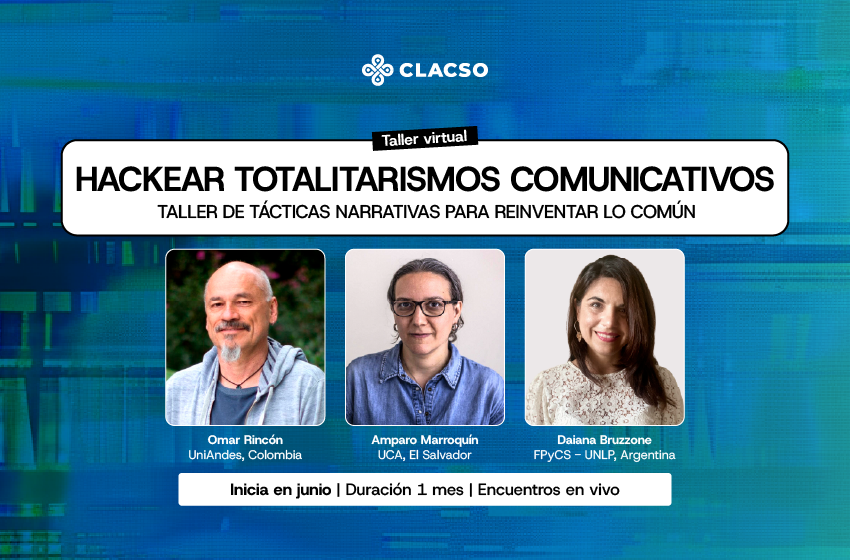
Hacking communicative totalitarianisms. A workshop on narrative tactics to reinvent the common.
EXECUTIVE
Amparo Marroquín (UCA, El Salvador), Omar Rincón (UniAndes, Colombia) and Daiana Bruzzone (FPyCS – UNLP, Argentina)
Home: 18 / 06 / 2026 | Registration: 16/04/2026 al 17/06/2026
Modality: Virtual with live classes and exclusive materials
Workload: 50 hours long.
Duration: 1 month
Culture battles are, above all, symbolic and communicative disputes over public opinion, the construction of political hegemony, and the establishment of a narrative order. In this scenario, right-wing sectors maintain that the “hegemony of the 21st century” belongs to feminisms, progressive movements, and rights movements, and they organize a global counteroffensive against what they call “woke capitalism” and the institutions that reproduce it (culture, science, universities, public policy).
The battleground for these conflicts is the media and digital networks. Here, tactics are based not on arguments or reason, but on emotional manipulation (provocation, mockery, hatred, contempt) and disinformation to generate conflict, chaos, and the destruction of the other. The goal is clear: to conquer the masses' "common sense."
Leaders like Javier Milei and Nayib Bukele effectively rely on these strategies: they simplify conflicts, appeal to intense emotions, produce easily shareable content, and play by the visibility rules imposed by the platforms. This doesn't mean our spaces lack ideas or political legitimacy, but rather that we often continue to communicate as if the dispute were taking place in a space governed by rational argumentation and deliberative exchange.
As a result, the contemporary communication ecosystem is characterized by tension, polarization, and fragmented narratives. Thus, the radical right gains ground by speaking the languages of desire, fear, and moral values; they win hearts with compelling stories and disruptive aesthetics. Meanwhile, progressive and left-wing communication remains stuck in rational, pedagogical registers, trapped in denouncing injustices or the controversies that the right puts on the agenda. The result: some seduce, others explain.
This workshop proposes exploring tactics, formats, and communication strategies to fight the cultural battle from and with rights. To that end, we invite you to create situated narratives that move beyond reacting to the right wing and position themselves as an alternative; narratives that break free from the manuals that segment audiences, that shatter bubbles, and that foster connection.
Over six sessions, we aim to challenge these narrative totalitarianisms. We will engage with culture and politics through the rhythms, bodies, desires, and joys of the common people. We will explore practical answers to these questions: How can we break free from algorithmic bubbles to spark conversations? How can we stir emotions and mobilize shared understandings from a rights-based perspective? How can we craft narratives that resonate with everyday emotions, desires, and experiences?
Today, public discourse is encapsulated in multiple narrative bubbles that rarely intersect. Thus, the culture war involves a struggle over the very conditions that allow certain narratives to exist, circulate, and become credible. In times of polarization and information overload, voices are no longer silenced by prohibitions, but rather censorship occurs in the modulations of visibility that digital platforms grant or diminish.
In this scenario, the right wing seems to have appropriated the language that attracts attention and resonates with a large segment of the popular population. Meanwhile, the left wing and progressive movements appear to be anchored in moralizing or explanatory discourses that distance them from everyday conversations, while at the same time they must deploy strategies to communicate effectively in territories characterized by the hyper-concentration of media ownership and algorithms.
We are thus faced with a context of communicative totalitarianism where narrative skills and the possibilities for reach or engagement are increasing, creating a gap that is political, economic, and technological, and exacerbating inequalities. These communicative regimes—political, media-driven, or algorithmic—which concentrate power over the production, circulation, and validation of meaning, condition the perception of reality and reduce the plurality of voices. Contemporary censorship is no longer characterized by prohibition, but rather relies on the logic of saturation and information manipulation.
We face a predatory power that threatens our ways of thinking, feeling, and narrating; and the problem isn't that we can no longer speak, but rather that we fail to influence the prevailing meanings and what society believes. From this workshop, we understand communication as a field of symbolic struggle where emotions, political sentiments, and the very forms of democracy are at stake today.
In this way, we propose a pedagogical and aesthetic intervention that reactivates the narrative power of the left, progressive movements, and social movements. We invite you to work on the narrative self who conceptualize communication as a performance of disputed identities and narratives, exploring political meanings through the symbolic and emotional journey of the characters who embody power in our region today.
It is along this path that this space proposes the challenge of creating militant, popular, and affective narratives capable of contributing to public discourse. We hope that, collaboratively, teachers and participants will experiment with languages, plots, and formats. We challenge you to think about and tell stories outside of established methods, to step outside of your comfort zones—moral, political, and communicative—in order to generate symbolic alternatives that activate citizenship through enjoyment, emotion, and collective experience.
To this end, the contributions of Latin American critical communication are revisited, and in particular the reflections of Jesús Martín-Barbero (1987) to address mediations and popular cultures; the contributions of Marita Mata (2023) on communicational indiscipline, understood as a situated and emancipatory political practice; the notions of culture y yopitalism which Omar Rincón (2024) brings us to challenge contemporary subjectivities; the narrative strategies to counteract the spectacularized communication of the new right wing, as presented by Amparo Marroquín (2024); and the contributions of an epistemology of mud and hope, as proposed by Florencia Saintout (2018), to make our media integrate the projects of cultural sovereignty.
Thus, it is an invitation to revalue languages, reappropriate plebeian aesthetics and use tactics linked to digital technologies as narrative allies to recover the sensitive dimension of politics, to reinvent the everyday, to communicate with, from and for rights.
GENERAL PURPOSE
Designing ideas, formats, communicative, symbolic and popular tactics for the cultural battle from and with rights.
SPECIFIC OBJECTIVES
That students acquire skills and abilities to:
- Analyze the communication strategies and styles of left-wing and progressive narratives.
- To explore forms of political, artistic, and media narrative from the perspective of the popular, the contradictory, and the affective. This means thinking about politics through storytelling, emotion, performance, and community building.
- Reappropriating technological, aesthetic, and political tools from a tactical and situated perspective.
- To produce ideas, formats, and tactics that engage through humor, irony, remix, one's own voice, and the power of collective storytelling.
- CLASS 1: THE CULTURAL BATTLE AND COMMUNICATIONAL TOTALITARIANISM
Teacher in charge: Omar Rincón
Modality: synchronous
Conceptual summary of the class
ideas: The cultural battle we inhabit. What is being fought for? Why? How? Who sets the rules? Who is winning? Why are they winning?
Concepts: Political meanings, narrative, popular culture, cultural sovereignty, activation. Digital media and networks for politics.
Workshop:
- Conversation: Why don't left-wing and progressive movements inspire love? What does it mean to be politically seductive in the digital age?
- Analysis narrative, aesthetic and popular aspects of right-wing tactics.
- Analysis narrative, aesthetic and popular tactics of rights.
- First original production.
- CLASS 2: BUKELE, MILEI AND OTHER SPECIES
Teachers in charge: Amparo Marroquín | Daiana Bruzzone
Mode: asynchronous
Conceptual summary of the class
The cases of Bukele and Milei are analyzed as communicative and symbolic “success models” in the public consciousness, along with their war against human rights. The aim is to examine how these politicians interpret a transformation and narrate it without being tedious or overly explanatory. Storytelling, humor, irony, and unconventional teaching methods are employed.
Workshop: Critical analysis of right-wing vs. progressive campaigns. Analysis criteria: storytelling, aesthetics, emotions, common sense, call to action.
Ideas Lab: Narrating with desire and without guilt, dissolving moral superiority. Progressive narratives that activate pleasures, contradictions, laughter, and vibrancy. Enjoyment as political power.
- CLASS 3: DIGITAL POPULARITY
Teacher in charge: Daiana Bruzzone
Mode: asynchronous
Conceptual summary of the class
It presents itself as THE POPULAR in territory and neighborhood resists. And as THE POPULAR goes digital.
Workshop 1: Popular communication experiences for rights activation.
Workshop 2: Popular digital experiences for rights activation.
- CLASS 4: IDEAS LABORATORY
Teachers in charge: Omar Rincón | Daiana Bruzzone | Amparo Marroquín
Modality: synchronous
Conceptual summary of the class
This section is designed to generate ideas, formats, concepts, and campaigns from a rights-based perspective. Each participant brings a proposal. Groups are formed, and we have to create something in one hour. Performance, music, memes, parody, bodies, reels, texts, images, sounds, mixes.
Teacher advice.
- CLASS 5: MY PROJECT FOR THE CULTURAL BATTLE
Teachers in charge: Amparo Marroquín | Daiana Bruzzone
Modality: synchronous
Conceptual summary of the class
Workshop on the creation and design of final products: Assignment: to tell what does not yet exist, insurgent imagination, affections as a creative input, narrative made flesh.
- CLASS 6: IDEAS FAIR
Teachers in charge: Omar Rincón | Amparo Marroquín | Daiana Bruzzone
Modality: synchronous
Conceptual summary of the class
Presentation and sharing of productions. Strategies for circulating one's own work in networks, streets, media and territories.
A presentation with commentary will be given.a of the works produced during the course.
- Amparo Marroquín (UCA, El Salvador)
- Omar Rincón (UniAndes, Colombia)
- Daiana Bruzzone (FPyCS - UNLP, Argentina)
The workshop The course will be delivered virtually, combining synchronous and asynchronous components. Over the course of a month, a total of six classes will be offered: four live sessions and two recorded sessions available for asynchronous viewing. Each class will integrate critical theory, case studies, and creative production.
Live classes will be held through the Zoom platform, which will allow direct interaction between participants. In addition, students will have access to exclusive materials, available in the virtual classroom, that will complement the content covered in each session.
|
Early registration (until 05/05) |
General registration (May 6th to May 11st) |
Registration without discount |
|
|
Full or Associate Member Center |
$100 |
USD 150 |
$200 |
|
No link |
$150 |
USD 225 |
$300 |
Queries: [email protected]

