
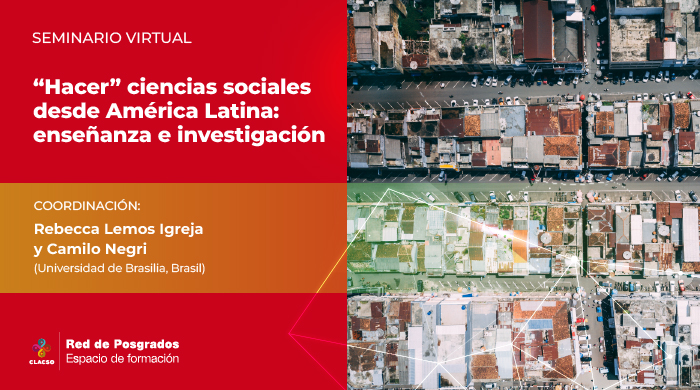
"Doing" social sciences from Latin America: teaching and research
Seminar 2209
ChairCLACSO
Coordination: Rebecca Lemos Igreja and Camilo Negri (University of Brasilia, Brazil)
Home: 20/04/2022 | Registration: 20/12/2021 to 19/04/2022
Workload: 12 weeks – 90 hours.
In this seminar, we will address the teaching of social sciences from a practical perspective, focusing on the role of the social sciences and social scientists in interpreting reality and seeking solutions to contemporary problems. This approach centers on research experiences, discussions about the development of critical thinking, and the construction of social categories within their historical, sociocultural, and economic contexts. Furthermore, as part of the seminar, we propose a reflection on job market opportunities and avenues for social scientists to engage with society. The aim is to examine the practical application of social sciences in Latin America from various disciplines, including anthropology, sociology, political science, law, and geography, among others. We will draw on the contributions of researchers who have reflected on this topic, always in connection with national and international academia, technical fields, research, and teaching. We will begin by briefly addressing the phenomena of the internationalization of the social sciences, questioning the role of Latin American social sciences in the world, their spheres of action and intervention, and the forms of scientific evaluation. We will also discuss measures of academic productivity and scientific ethics. We will then reflect on how positions of domination and asymmetry are managed among the actors involved in research, including the broader political and academic context. These constructs influence research methodology, content, results, and evaluations. The aim is to conduct this reflection based on concrete situations and case studies, questioning research methodologies and techniques. Finally, the seminar will discuss the selection and construction of social categories. The idea is to consider, based on research experiences, how social scientists reflect on the categories they use, how these evolve according to research topics and contexts, and the development of public policies.
- The internationalization of production and dissemination of knowledge
- Latin American integration – Critical proposals and practical challenges
- Research method – observing on large scales without losing the specifics
- Comparison and challenges are not internationalized
- Digital tools and international dice banks in the classroom
- Research method - Collaborative investigations - Collaborative cartographies
- Fundamental analytical categories (Social class and inequality)
- Fundamental analytical categories (Discussing “race” in Latin America)
- Fundamental categories (Ethnicity and gender)
- Fundamental analytical categories (Territory, space, migration)
- ANDRADE, Pablo A. Interdisciplinarity and Latin American Studies. ARAÚJO, Cicero & AMADEO, Javier (compilers). Latin American Political Theory. Luxembourg Editions. Buenos Aires, 2010.
- CAIXETA, MB & Rebouças dos Santos, M. C, As Ciências Sociais Na Cooperação Sul-Sul da América Latina e Caribe: Uma Aproximação Necessária, In IGREJA, RL; HOFFMANN, O.; PINTO, SR: Doing social sciences from Latin America: challenges and research experiences. 1 ed. Brasilia: FLACSO, 2019, v.1, p. 14-26.
- CANO, Ignacio. In the trenches of the method: the teaching of the methodology of social sciences in Brazil. Sociology, v. 14, no. 31, p. 94–119, 2012.
- COSTILLA, Lucio Oliver. “O Novo na Sociologia Latino-americana” in Sociologies, Porto Alegre, year 7, no. 14, July 2005.
- DA COSTA, António Firmino. Global inequalities. Sociology, Problems and Practices, v. 68, p. 9–32, 2012.
- DUTRA, D., & Bandeira, LM (2015). Gender Studies in Latin America: epistêmicas dinamicas e emancipações pluralis. Revista De Estudos E Pesquisas sobre As Américas, 9(2).
- GIMENEZ, Gilberto, Culture as identity and identity as culture,
- GRILLO, Marlene Correro et al. I teach and research with research in the classroom. UNImagazine, v. 1, no. April, p. 1–11, 2006.
- HAMEL, Rainer Enrique. 2017. Facing the strategies of empire: towards language policies in the sciences and higher education in Latin America. In Diniz, Alai G. et al (eds.). Poetics and politics of language on the path to decolonization, 229-261.
- HERNÁNDEZ, Rosalva Aída, 2013 Exile Logbook. Narrative of Women in Prison, Intramuros Revelation Collection II.
- HERRERA FARFÁN, Nicolás Armando; Lorena López Guzmán (Compilers), Science, Commitment and Social Change Orlando Fals Borda 1st edition 2013: El Colectivo Edition (Argentina), Lanzas y Letras Editions (Colombia) and Extensiones Libros (Uruguay), Read Section II. Participatory Action Research (PAR) Methodology
- IGREJA, RL; HOFFMANN, O.; PINTO, SR Doing social sciences from Latin America: challenges and research experiences.1 ed.Brasilia: FLACSO, 2019, v.1, 58-68
- IGREJA, RL; PINTO, S. The Contribution of Latin American Studies to the Production of Global Knowledge, In: IGREJA, RL; HOFFMANN, O.; PINTO, SR Doing social sciences from Latin America: challenges and research experiences.1 Ed. Brasilia: FLACSO, 2019, v.1, p. 14-26.
- IGREJA, Rebecca, Agudelo, Carlos - Afrodescendants in Latin America and the Caribbean: new paths, new perspectives in a global multicultural context in Revistas de Estudos e Pesquisas sobre as Américas, 8 n. 1 (2014)
- LISTER, Elissa, El Batey: An Approach to Its Realities and Representations from Coloniality in IGREJA, RL; HOFFMANN, O.; PINTO, SR Doing social sciences from Latin America: challenges and research experiences.1 ed.Brasilia: FLACSO, 2019, v.1, 39-57.
- MORALES GAMBOA, ABELARDO. 2018. “Fragility of cross-border corridors of temporary workers. Territories, labor markets and regulatory mechanisms in Central America”, pp. 41-66 in Odile Hoffmann and Abelardo Morales (coord.), Territory as a resource: mobility and appropriation of space in Mexico and Central AmericaSan José, Costa Rica: FLACSO-IRD-UNA
- MORLINO, Leonardo. Introduction to Comparative Research. Madrid: Alianza Editorial, 2010. (pp.25-47)
- OEHMICHEN-BAZÁN, Cristina, Indigenous Peoples and the Economy of Identity: The Maya in the Riviera Maya in IGREJA, RL; HOFFMANN, O.; PINTO, SR Doing social sciences from Latin America: challenges and research experiences.1 ed.Brasilia: FLACSO, 2019, v.1, 246 -261
- RESTREPO, Eduardo, Turn Towards Race and Racism: Notes From Anthropology in Colombia IGREJA, RL; HOFFMANN, O.; PINTO, SR Doing social sciences from Latin America: challenges and research experiences.1 ed.Brasilia: FLACSO, 2019, v.1, 195 - 207
- SCHNEIDER, Sergio; SCHIMITT, Cláudia Job. The use of the comparative method in Social Sciences. Cadernos de Sociologia, Porto Alegre, v. 9, p. 49-87, 1998.
- THERBORN, G. The extermination camps give inequality. Novos Estudos - CEBRAP, n. 87, 2010, p. 145–156.
- VALDÉS GARCÍA, F., Internationalization of the Social Sciences: Challenges, Threats, and Experiences from the Caribbean in IGREJA, RL; HOFFMANN, O.; PINTO, SR Doing Social Sciences from Latin America? Challenges and research experiences. Brasilia: FLACSO, 2019 p.289.
- VARELA HUERTA, AMARELA (2015). The “securitization” of migratory governmentality through the “externalization” of US borders to Mesoamerica. Contemporary. All of history in the present 4 (2015) July-December.
|
|
Discount for one payment until 16/03 |
In one payment after 16/03 |
|
CM Plenos |
$75 |
$150 |
|
CM Associates |
$95 |
$190 |
|
No link |
$95 |
$190 |
FAQ
The basic requirements for taking a seminar are:
- Availability of at least 4 hours per week to dedicate to the seminar course.
- Internet access.
- Reasonable handling of communication and computer tools.
- Language proficiency in the language in which the course will be taught. The official languages are Spanish and Portuguese.
The seminars last 12 weeks, plus the completion of a final project. A total of 90 hours of dedication will be credited.
A course consists of twelve classes, each accompanied by required readings, supplementary readings, discussion forums, and learning activities proposed by the teaching team, as well as partial submissions and a final project. The course is delivered online and asynchronously. Some instructors may propose synchronous activities. In these cases, the time and date will be agreed upon in advance between the teaching team and the students to ensure everyone's participation. To pass the seminar, students must participate in at least 80% of the discussion forums and activities proposed by the instructors, complete all scheduled partial submissions, and pass the final project.
|
|
Discount for one payment until 17/04 |
In one payment after 17/04 |
|
CM Plenos |
$75 |
$150 |
|
CM Associates |
$95 |
$190 |
|
No link |
$95 |
$190 |
The possible payment methods are credit card, bank transfer and bank deposit.

