
Guillermo Almeyra Casares: “I am convinced that Humanity will have a better future”
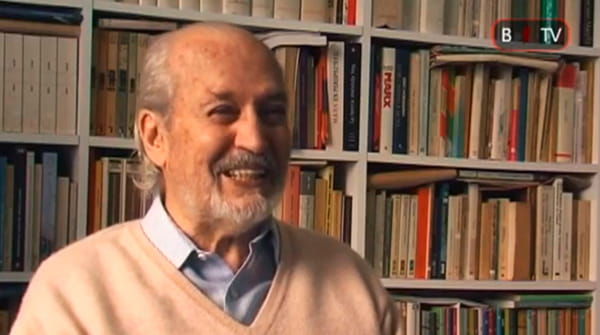
Guillermo Almeyra Casares, Argentine historian, essayist and journalist born in Buenos Aires in 1928, died on Sunday, September 22 in the French city of Marseille.
Almeyra, who defined himself as “Copernican, Newtonian, Darwinist, Marxist, Leninist, Trotskyist, but in a secular way and without abandoning criticism of the errors of the masters”, studied a doctorate in Political Science and a master's degree in History at the University of Paris VIII.
In 1943 he joined the socialist movement. As a political thinker and journalist, he lived in Argentina, Brazil, Italy, Peru, the Arab Socialist Republic of South Yemen, and Mexico, with various periods of residence and returns. At CLACSO, he directed none other than the OSAL Magazine of the Social Observatory of Latin America.
He fought on four continents; he was active in political parties and founded political magazines and newspapers in six countries, being expelled from several for his revolutionary activities. From Mexico, he was deported during the presidency of Gustavo Díaz Ordaz (1964-1970).
After returning to Mexico in 1995, he worked in the Postgraduate Studies Division of the Faculty of Political and Social Sciences at the National Autonomous University of Mexico (UNAM), as a studies coordinator. He was also a professor at the Metropolitan Autonomous University (UAM).
Along with others, he founded master's programs in social sciences at the National Autonomous University of Guerrero and developed the history and sociology degree programs for the Autonomous University of Mexico City (UACM).
CLACSO expresses its deep sorrow for this loss with the certainty that his teachings will endure among those who knew him and in new generations through his work.
SEE GUILLERMO ALMEYRA'S WORKS ON CLACSO:
https://www.clacso.org.ar/libreria-latinoamericana/pais_autor_libro_resultado.php?campo=autor&texto=380&pais=1
“My Last Battle”
In recent days he had suffered a fall, which caused a fracture in his right leg; a situation that he himself recounted on September 20 both on his Facebook account and in an article published by the Mexican newspaper The Journey titled “My Last Battle”:
“Last Wednesday I fell and broke the head of my right femur. The doctors immediately considered surgery and fitting an artificial prosthesis. Unfortunately, I suffered a respiratory crisis that made them decide against it because I could die during the operation. The intensive care doctors at La Timone hospital in Marseille reassessed my overall condition and estimated that I probably wouldn't make it through the end of the week and that, if I did, only then could surgery be considered. In a family meeting with my partner of 60 years, who has been with me through all the risky situations, and my son, a young environmentalist and anti-capitalist who is very clear in his beliefs and decisions, we decided to go with the doctors' assessment. To get through the weekend and hope for an improvement in my lungs: this could, therefore, be my last battle.”
In 1943, I joined the socialist movement, even though I was in a military academy. I would do everything I did and repeat everything I've said since then (except for some of the foolish things I did between 1962 and 1974, the years of my expulsion from the "Posadist" Trotskyist movement due to political differences I shared with my partner). I fought on four continents. I was active in political parties and founded political magazines and newspapers in six countries. I was expelled from several countries for my revolutionary activities. When I legally returned to Mexico, from where I had been expelled during the presidency of Díaz Ordaz, I worked in the Postgraduate Studies Division of the Faculty of Political and Social Sciences at UNAM, serving as coordinator of Latin American studies, and I contributed to the newspaper Uno Más Uno, then edited by Manuel Becerra Acosta. When Carlos Payán and Carmen Lira, among others, founded La Jornada, I worked there and in the postgraduate program in integrated rural development at UAM Xochimilco. During the same period, I co-founded master's programs in social sciences at the National Autonomous University of Guerrero and (again, with others) developed the history and sociology programs for UACM. I wrote—or collaborated on—about fifty books. I had a son and planted trees in Mexico and Nicaragua. I have the honor of having left a small mark on the labor movements in Argentina, Brazil, Peru, Italy, Mexico, and the Arab Socialist Republic of South Yemen.
My articles in La Jornada are reprinted by various European and Latin American media outlets. Since my adolescence, I have defended workers and the people, natural resources, civilized and peaceful relations between nations, and the struggle for democracy, which entails confronting the bureaucratic state of state capitalism or of large financial and industrial capital. There are many revolutionaries, but few aim to eliminate the system of exploitation. Although communist parties, especially in the 1930s and 40s, included selfless and courageous individuals, the policies and the way their leadership operated perpetuated the capitalist system on a national and global scale. I criticized those leaderships and those Stalinist policies that survived in governments and parties that were not Stalinist. I debate frankly and am not afraid of being in the minority, but at the same time, I seek to unite anti-capitalist revolutionaries of all tendencies with those of my own current, the revolutionary ecosocialist Marxists. As I stated in one of my books, I am a Copernican, Newtonian, Darwinist, Marxist, Leninist, and Trotskyist, but in a secular way and without abandoning the critique of the errors of the masters. Despite all this, and despite the terrible danger we face on a global scale of ecological destruction of the foundations of civilization and of nuclear war that would return the world to the Stone Age, I am convinced that humanity will have a better future and that it is possible to guarantee everyone work, education, healthcare, a healthy environment, quality food and water, democratic rights, security and respect for women, and the end of all discrimination. If I cannot win this difficult battle I am waging, may these banners be passed on to those who follow me in the race. Long live the Mexican workers! Long live proletarian internationalism! Let us all unite and build an alternative to capitalism!
If you would like to receive more information about CLACSO's training programs:
[widget id=”custom_html-57″]
to our email lists.

