
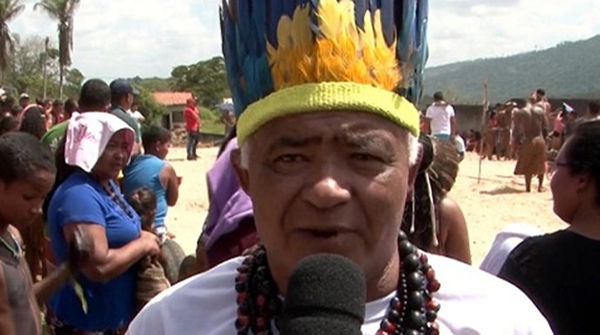
Gerson Souza Melo, Cacique dos Pataxó Hãhãhãi, dies from Covid-19
Jurema Machado1
After the longest and most arduous territorial battles of two indigenous people in Brazil, the indigenous Caramuru Paraguaçu land has been retook, in Bahia, by the loss of one of its greatest leaders, Gerson Souza Melo, a victim of Covid-19. The tragedy is a moment where the epidemic is falsely controlled in Brazil, but still not only very deadly, but causing profound impacts on indigenous people. Gerson Pataxó leaves a legacy of mourning that goes into history.
Or what constituted a great indigenous leader? At your delivery capacity in the fight? What knowledge of culture, tradition and territory? Are you concerned about the history of your work? A articulation with other parts and other fights? Because Gerson Pataxó has all these characteristics, and more a constant permanence together with his people and incessant accompaniment of two events that occur daily in his communities.
Certain events, which many times can go unnoticed, and are, supposedly, strictly domestic, can cause profound alterations in the lives of two people. A leader needs to be vigilant. It was in one of these situations, in more than 20 years of relationship with the indigenous people, that Gerson Souza Melo met, in May 1999, at the headquarters of the Federal Public Ministry, in the city of Ilhéus, south of Bahia. Months before, Gerson was very attentive to the transformations that indigenous health has undergone with “Lei Arouca” (nº 9.836/99), and promoted, together with other leaders of the Pataxó Hãhãhãi, a health diagnosis of three villages (Caramuru, Bahetá and Panelão), which então compunham parts of the Caramuru-Paraguaçu Indigenous Land. Based on this diagnosis, Gerson has a community with a large number of sterilized women in the communities, and from there you have started a process that has profound alterations in the socio-political organization of the people.
This is the first time we found the MPF headquarters in the function of two depoimentos of some sterilized women in the context of the political campaign. My ambition was to investigate the event for a final monograph of my bachelor's degree in Social Sciences, at the Federal University of Bahia. As a great leader, Gerson acknowledged that my interest could strengthen the allegations and we spent two days talking and discussing how we could pursue the investigation. He was very enthusiastic about research and researchers, encouraged and supported that parents study and become scientists, professors, doctors and historians of their country. Once, spending days at the Indian Museum, in Rio de Janeiro, selecting and reading documents from the Indian Protection Service on the Caramuru-Catarina Paraguaçu Reserve, it was interesting to awaken the Museum's team to publish a book with analytical texts on the documentation and summaries of all the documents. It was more of an important piece conquered to prove the right of his country to the land he claimed.
Gerson was from the Pataxó Hãhãhãi family, but his ethnic group, as he himself emphasized, was Kariri-sapuyá. A family that has very proud and engendered efforts to unite and record the history, from Pedra Branca, in the Recôncavo da Bahia, to the Caramuru-Paraguaçu Reserve, led by ethnologist Curt Nimuendaju, since the beginning of 1937. Its respect for the oldest and for the mourning and ancestral persistence We guarantee the “voice of tradition”, a quality that Pataxó Hãhãhãi usually refers to as “knowing how to tell stories”, to “escutou os más velhos”. It was Gerson Souza Melo and his cousin, Ilza Rodrigues, also a chief, who made an effort to make me understand what would be a social organization that uses an all-encompassing ethnonym (Pataxó Hãhãhãi), but focuses on ethnic groups (Tupinambá, Gueren, Kariri-Sapuyá, Kamacã, Hãhãhãi, Baenã) by families or famílias by ethnic groups to mark moments of mourning – as retaken.
Olympio Serra once made an analogy to the Western equivalent, regarding the role played by Gerson alongside his people, which would be something like “prime minister”, or someone who is inside and outside, also, not a representative role. It is this role that obtains just external recognition for being honored as the Human Rights Award, still in 2000. The feeling of being in Brasilia, in the company of cousin Galdino Jesus dos Santos, when he was assassinated, in 1997, burned alive in Brasilia, accentuated his sense of justice and Press on the Brazilian State. He at times narrated about the tense encounters with President Fernando Henrique Cardoso, who always made certain ironies with the indigenous leaders, suggesting that each leader would only be interested in the demarcation of his territory. One time, Gerson heard the words “do you only want to demarcate the Pataxós?”, not that he retrucous, “o senhor needs to respect the Indians of Brazil.”
“I saw Luta since I was little,” he said. During these times of small memory keeping, two relatives met in the house of their countries, both already deceased, Egídia Trajano and Diogo Souza Melo, strategically chosen to be the meeting place of Grupo Luta for Terra, created in 1974, when Gerson was still 12 years old. Cresceu, also, am very aware that fighting two Indians is possible and resistant because a group of enchanted beings, human and non-human, participate in it. I do not stop referring to my uncle, brother of Egídia, who envultava, appeared e sumia, as a way to confuse or alienate. From his coexistence and kinship with other older leaders, for example Samado Santos and Desidério dos Santos, he grew and understood the history that he carried and that he would help to build.
The Pataxó Hãhãhãi people are very proud that their fight to recover the territory has not only benefited the indigenous people. The city of Pau Brasil, for example, one of its quais is located on indigenous land, was strongly positively impacted by the conquest of two Indians, its economy grew, trade prospered and inter-ethnic relations were pacified. Despite the strong anti-indigenous sentiment that predominated for decades in the municipality, the indigenous people always thought of Pau Brasil as a place of circulation and presence of them, also, and perhaps because of this Tenham was concerned, since the late 1980s, with local politics and how it could affect them. The creation of the Workers' Party in the city was led by Pataxó Hãhãhãi, and among his followers, for example by Gerson himself.
Violence and persecution imposes hostile hair on the surrender of a life marked by threats of murder and criminalization. He managed to escape from two circles of gunmen who attacked the car in which he was, and also survived a kidnapping orchestrated by his own enemies, who offered him land and left in exchange for his departure from the fight and leadership of the Pataxó Hãhãhãi group.
In November 1999, on a trip back to the village, we participated in a special session at the Bahia Legislative Assembly, in Salvador, Gerson and his cousins, Ilza Rodrigues and Margarida Rocha, were surprised with the interruption of the trip at the post of the Federal Highway Police, in Itabuna. There were military police on 150 Batalhão that Gerson seized, ordered by the judge of the Comarca of Pau Brasil, Antônio Cândido Garcia de Oliveira. The accusation that weighed on him was that of an alleged attempted homicide of a farmer, in 1994. Surprisingly, in the interim order for the request for Habeas Corpus, FUNAI was informed that the request was issued at 7:15 in the morning, while in prison it had been made at that time. 6:00. The MPF managed to keep Gerson in the custody of the Federal Police in Ilhéus, but we remember how many days he was imprisoned. Maybe four or five days. After that, he faced further attempts to criminalize his fight.
But, in the context of genocide, the indigenous people who manage to survive the conflicts cannot survive the impacts of a new crime and lack of indigenous health by a racist and, in itself, adoecedor government. Gerson, who was born on January 12, 1962, grew up in Pau Brasil, selling his recently invaded land, but accompanying the determination of his most recent developments. He, who mourns or fights for his reconquest and can commemorate the expulsion of each invader and something from his land, has not resisted the years of the effects of Covid, a pandemic that is not strengthening Brazil with more sophisticated contours of poverty and cruelty.
With more than 20 years of friendship and relationships, we falter in thoughts, expectations, certainties, sadness and many plans, but we never falter in death. Much embora always fosse uma certainty, obviously, especially when we saw the departure of so many more velhos, we realize that to give it, ea minha, não ser para tão cedo. With its many plans, it was the construction of an indigenous memorial in Caramuru, which would shelter both the documents and objects of memory of the Pataxó Hãhãhãi people, as well as the two funerary urns that were removed for study, from the Água Vermelha archaeological site, in the regions of the Caramuru-Paraguaçu indigenous land.
Gerson was the first indigenous leader that approached me, and he was in his house, from Selma - his wife - and from his four children - and now seven nets - who, in July 1999, experienced my first experience of field work. It is of immense importance in my training as an anthropologist and as a person, because most of the goal of my life is knowledge with them.
On the day of her death, October 15, 2020, very shocked by the surprise of the event and overwhelming sadness, I asked a friend to suggest that she place sadness for a story that interlaces Gerson's house as a place of power for me, and Egídia's house as a place of power for Pataxó Hãhãhãi. I don't know if you are capable of this, but I want to record here how much a house is sheltered. Gerson died very early, but now he will always be at home, as his ancestors would recommend.
1- Jurema Machado is professor of the Center for Arts, Humanities and Letters of the Federal University of Recôncavo of Bahia and president of the board of directors of the National Association of Indigenous Peoples (Anaí). Article sent by the CLACSO Working Group Political Ecologies from the South/Abya Yala.
If you would like to receive more information about CLACSO's training programs:
[widget id=”custom_html-57″]
to our email lists.

