
Gerardo Caetano, president of the National Academy of Letters of Uruguay
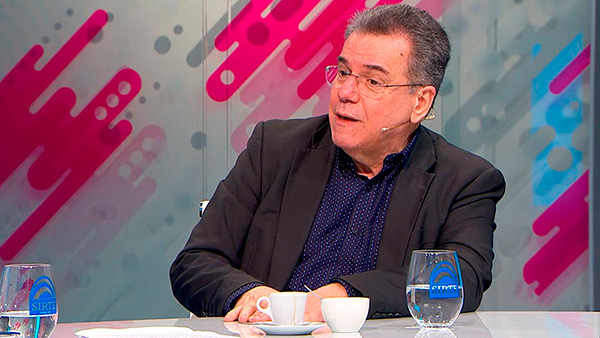

Gerardo CaetanoProfessor , Full Professor of the Department of Political Science (DCP) of the Faculty of Social Sciences (FCS), was appointed president of the National Academy of Letters of Uruguay.
Historian and political scientist Caetano teaches at the undergraduate level and in the Master's programs in Political Science and Political History. He was director of the Institute of Political Science from 2000 to 2005. He is a member of the Uruguayan Academies of Letters and Sciences, and a corresponding member of the Academy of History in Argentina and the Royal Spanish Academy.
In addition, he was a member of the Steering Committee of the Latin American Council of Social Sciences (CLACSO) for the subregion made up of Argentina and Uruguay and is co-coordinator of the CLACSO Working Group “Decentering International Relations”.
Former president of the Higher Council of the Latin American Faculty of Social Sciences (FLACSO), he was also the first president of the Uruguayan Association of Historians and of the Uruguayan Association of International Studies.
Caetano has published numerous books and articles in his areas of expertise, for which he has received several national and international academic awards. The most recent is the 2022 Latin American and Caribbean Social Sciences Prize, CLACSO's highest distinction. He currently leads three lines of research within the Department of Political Science (DCP): Left and Right in Uruguay; Liberalism, Republicanism, and Citizenship: Uruguay (1890-1934); and Regionalism and Integration in Latin America.
His book was presented on October 4, 2023, as part of the 45th Montevideo International Fair. "The novelty of history. An essential anthology. Politics, rights, integration, and democracy", a joint edition of the Latin American Council of Social Sciences and Editorial Planeta.
Created in 1943, the National Academy of Letters has the following objectives: to ensure and promote the proper use of the language; to contribute to the definition of national language policies; to carry out and promote linguistic research, in particular, lexical and grammatical studies relating to both general Spanish and Uruguayan Spanish; to stimulate and disseminate literary creation and research in all its manifestations; to advise public or private bodies and individuals who request its opinion on matters within its competence; to collaborate with the national education system; to maintain close ties with the Royal Spanish Academy, with the other Corporations that make up the Association of Spanish Language Academies and with its Permanent Commission.
If you would like to receive more information about CLACSO's training programs:
[widget id=”custom_html-57″]
to our email lists.

