
“Gender, time and care”
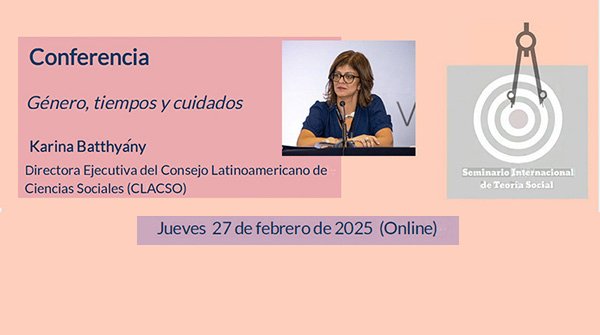

On Thursday, February 27, the Executive Director of CLACSO, Karina Batthyány, will deliver the Conference “Gender, time, and care” within the framework of the “International Seminar on Social Theory – Latin American capitalism in the 21st century"with a focus on Latin America and the global south."
It was organized by the Department of Sociology of the University of Barcelona (Spain), the University of Flensburg (Germany) and the University of La Frontera (Chile).

Gender, times, care
Karina Batthyány
The purpose of this conference is to provide some reflections on the emergence of care as an object of study and as a public problem in Latin America and the Caribbean, in the context of the so-called care crisis and under the prism of gender inequalities.
From its emergence as an academic concern to the present day, care in general has become one of the most dynamic and controversial fields of study in contemporary social sciences.
The emergence of care as a social problem
In recent years, the term "care" has begun to appear prominently in health, education, social services, and pension policies. Care has become a key dimension of analysis and research on social protection policies, and regulatory advances—albeit more slowly than desired—are beginning to emerge that point to its recognition as a public, rather than a private, matter.
The pandemic highlighted the importance of care for the sustainability of life, its unfair social organization in Latin America and the Caribbean, where it continues to be considered an externality and not a fundamental component for development.
Gender studies have shown how domestic work is crucial and essential for the functioning of the economic system and for social well-being. The concept of care work emerges to represent reproductive labor, also encompassing the more affective and relational aspects of these activities.
We can say, without attempting an exhaustive definition, that care refers to the act of helping a child or dependent person in their daily life and well-being. It involves taking charge of their material needs. It is work. But it also represents economic care, which, in turn, has a cost. Furthermore, it encompasses psychological care, which entails an "affective, emotional, and sentimental bond." The specific nature of care work is based on its relational aspect. The definition proposed by the Spanish sociologist María Ángeles Durán (2000) establishes that care provides both subsistence and well-being, as well as development. It encompasses the indispensable daily provision of physical, affective, and emotional well-being throughout a person's entire life cycle.
Care can be provided on a voluntary or charitable basis by relatives within the family setting, or it can be provided for remuneration, either within the family or not. The nature of the activity will vary depending on whether it is carried out within or outside the family and also on whether it is a paid or unpaid task (Batthyány, 2005).
The emergence of care as an object of study
Care is a concept in continuous theoretical development, which was incorporated into academia from common sense without initial theoretical conceptualization (Carrasco et al., 2011; Thomas, 2011). Due to its richness and theoretical depth, care has become a powerful and strategic concept in both academia and politics, successfully articulating disparate debates and agendas.
Academic debates on care work date back to the 70s in Anglo-Saxon countries, driven by feminist movements within the social sciences to represent reproductive labor while also encompassing the more affective and relational aspects of these activities. In Latin America and the Caribbean, care work has become a subject of specific study in the last twenty years.
The approach to care work began by understanding it as one of the various types of unpaid labor. During the 1970s and 80s, care work was integrated into what was known as “domestic work.” In these early studies, care work was not the central focus: the emphasis in the study of domestic work was on making visible the tasks that women performed in homes without pay, but which contributed to social well-being.
As studies proliferated, the analysis of these tasks became more complex. New problems were incorporated, such as the link between these tasks and the sexual division of labor and the productive and reproductive spheres; and progress was made in describing and understanding the activities carried out within households, and their distribution between men and women.
In the process of visualizing and understanding unpaid work, care work began to be distinguished from domestic work. Care work has its similarities with domestic work because it shares its invisibility and its association with feminine skills. but it is distinguished by its relational component. This key shift allowed for the diversification of treatments towards care, eventually establishing it as a field of knowledge (Batthyány, 2020).
Care as a critical issue of inequality in Latin America and the Caribbean
Latin America exhibits significant heterogeneity in the social organization of care, stemming from highly differentiated family dynamics, labor markets, and economic structures, as well as states with dissimilar strengths and traditions. Despite these differences, the data available to date reveal some common features that characterize the social organization of care in the region. Among these, the fact that care remains a private function, primarily undertaken by families and, as is well known, by women within those families, stands out.
The view of care as a component of well-being, focused on understanding the place of care in welfare regimes, has its roots in the criticisms and problematization applied from feminist literature to the typologies introduced by the Danish sociologist Gøsta Esping-Andersen (1990) on welfare regimes, according to the distribution of social responsibilities between the State, the market, the family and the voluntary sector or non-profit institutions.
The main criticisms were that the Danish sociologist's analysis did not give families and women the importance they deserve as providers of well-being. In response, feminists developed an extensive body of theoretical work that does characterize the contribution of families to well-being and gender inequalities within households (Shahra Razavi, 2008).
As in much of the world, welfare systems in Latin America presupposed men being employed outside the home and women remaining at home, caring for children and the elderly. This model is deeply challenged from both empirical and normative perspectives.
The available data show that, over the last thirty years, this version of the family and labor markets has become blurred. In short, this is reflected in an increase in female-headed households, a sustained rise in divorces, greater unemployment and informality among the male population, and a marked increase in the female participation and employment rate in labor markets, which are also more informal and precarious (ECLAC, 2018).
In Latin America and the Caribbean, the productive structure, gender roles, and family configurations have solidified profound inequalities in the distribution of time between men and women. The current social organization of care presents a significant imbalance among the four spheres of access to well-being: families, the state, the market, and the community. This results in inequalities in terms of opportunities for the personal and professional development of men and women. Indeed, in the region, before the pandemic, women dedicated between 22 and 44 hours per week to domestic and caregiving tasks. Time-use surveys conducted in the region have shown that women spend two-thirds of their time on unpaid work and one-third on paid work, while men spend their time in the opposite ratio (ECLAC, 2020).
In Latin America and the Caribbean, social inequalities are closely linked to the unequal provision of family and social care, forming a true vicious circle: those with more resources have greater access to quality care, in circumstances where they have fewer household members to care for.
Empirical research shows that the social organization of care in the region is a dynamic result of the changing way in which families, the State, the market and community organizations interact to produce care, and that it still falls predominantly on women (Faur, 2009; Esquivel, 2011; Rodríguez Enríquez, 2015; Salvador, 2011).
The pandemic made evident the importance of care for the sustainability of life, as well as the low visibility of this sector in the societies and economies of Latin America and the Caribbean, where it continues to be considered an externality and not a fundamental component for development.
An agenda with life-saving care at its center
This crisis has highlighted the need to begin considering new forms of social organization in general, where the social organization of care plays a central role. We are in a transition toward societies that will undergo reconfiguration in the short and medium term. It is essential that we establish the need to place care at the center, moving beyond the market as the organizing principle of communal life. A significant advance in the region to date is the placement of care issues on the public agenda, resulting from the shift in the focus of analysis from the private sphere of families to the public sphere of policy.
Putting care at the center means starting to think in relational terms, recognizing and respecting the other, shifting the focus away from liberal individualism and autonomy, which currently dominates human relationships, and placing interdependence, reciprocity, and complementarity at the center. People need goods, services, and care to survive. Care is relational and interdependent: we have all needed or will need care at some point in our lives, and we have all cared for or will care for someone at different stages of our life cycle (Batthyány, 2021).
Care work is essential for social reproduction and the well-being of individuals and society. The so-called productive economy relies on unrecognized and unpaid care work, subsidizing both public services and private profits. Care policies have significant potential to impact income equity; gender equality; the promotion of population change; the gendered division of labor and the care deficit at the family level; and the labor market.
Measures are needed that break with traditional norms so that women are not always the ones who sustain the functioning of our societies in critical moments. The intensification of the care crisis as a result of the pandemic will not be resolved with minor adjustments to social policies, nor by distributing care more equitably between men and women at an individual level. Rather, its importance and value must be recognized, and it must be provided in part by society, with the State assuming its responsibility.
The care crisis in Latin America: causes, challenges and possible solutions
La care crisis In Latin America, the care crisis refers to the growing difficulty in providing necessary care to a population requiring attention, such as older adults, children, the chronically ill, and people with disabilities, within a context of profound gender inequalities and social transformations. This crisis, which manifests itself in both the public and private spheres, is driven by demographic, social, and economic factors that put pressure on family structures and welfare systems, and has disproportionate consequences for women. This analysis addresses the causes, manifestations, and challenges of the care crisis in Latin America, as well as possible solutions to confront it.
Factors driving the care crisis in Latin America
The care crisis in the region stems from a combination of structural and demographic factors that have generated a growing demand for care and, at the same time, an insufficient supply of services. Some of these factors are:
- Population agingIn many Latin American countries, the population is aging rapidly due to increased life expectancy and declining fertility rates. This demographic shift has increased the demand for care for the elderly, many of whom require constant attention due to chronic illnesses or physical limitations. In countries like Uruguay, Argentina, and Chile, the proportion of people over 60 is rising significantly, placing increasing pressure on families to provide this care.
- Transformations in the family structureLatin American families have undergone profound changes in recent decades. The average household size has decreased, and the number of single-parent households, mostly headed by women, has increased. Furthermore, the rise in women's labor force participation has reduced the amount of time available for care work within the home, without this entry into the labor market being accompanied by an equitable redistribution of caregiving responsibilities between men and women.
- Feminization of careIn Latin America, the vast majority of care work—both paid and unpaid—is performed by women. According to ECLAC studies, women dedicate between 22% and 42% more time that men are relegated to caregiving and unpaid domestic work. This unequal distribution creates a double workload for women, who, in addition to their paid jobs, assume most of the caregiving responsibilities, which affects their opportunities for professional and economic development.
- Deficiencies in social protection systemsIn much of Latin America, social protection systems are fragmented and insufficient to meet care needs. Although some countries, such as Uruguay with its National Integrated Care System (SNIC)While progress has been made in creating public policies to address this problem, in most cases, available care services are limited, of low quality, or inaccessible to low-income families. The lack of adequate public infrastructure and care policies reinforces social and gender inequality.
3. Impact of the care crisis on women
- Limitations in access to employment and the wage gapThe burden of caregiving limits women's opportunities to access formal, quality, and well-paid jobs. Many women, especially those with lower levels of education or income, must resort to informal or part-time work to balance their caregiving responsibilities with employment. This not only perpetuates the gender pay gapbut it also creates inequalities in access to social benefits such as retirement and social security.
- Poverty and economic vulnerabilityWomen's unpaid work contributes to the perpetuation of intergenerational poverty. Unable to access well-paying jobs or have the time to invest in their education or personal development, many women become trapped in cycles of economic insecurity, affecting both their well-being and that of their families.
- Health & WellnessThe excessive workload resulting from combining paid employment with caregiving responsibilities has negative effects on women's physical and mental health. Caregiving tasks, especially those related to dependent or ill individuals, are often emotionally and physically exhausting, and performing them without adequate support can lead to chronic stress and long-term health problems.
The care crisis in Latin America is a complex and multidimensional phenomenon, reflecting the tensions between demographic changes, women's participation in the labor market, and the deep-seated gender inequalities that persist in the region. Addressing this crisis requires comprehensive policies that recognize the centrality of care in social and economic life and promote a more equitable distribution of these responsibilities among the state, families, and the market. Only through such measures will it be possible to move toward a more just and egalitarian society, where women and men can fully develop their potential, free from the unequal burdens of care.
Right to Care
However, faced with the challenges arising from social, economic, and demographic changes, exacerbated during the pandemic crisis, the challenge of advancing the recognition of the right to care and its positive inclusion in public policies emerges. This implies actions in at least three areas: redistributing, revaluing, and reformulating care (Pérez Orosco, 2011). Redistributing means building collective responsibility for care, moving from its exclusively private consideration to considering it a matter of collective responsibility, and thus achieving universal access to dignified care. Revaluing means dignifying care as work and recognizing it as an essential dimension of well-being. Reformulating means detaching care from its association exclusively with femininity and family. These three elements are not independent: redistributing without revaluing will be impossible, and vice versa. As long as care is not valued, only those with the least capacity to choose will provide it; at the same time, those who do not provide care cannot value care work because they will continue to naturalize it. Recognizing that care is an essential activity and that it should not fall solely on women signifies a revolution that implies changes in all social structures.
Care systems aim not only to generate public policy regarding dependency but also to bring about a cultural transformation: the transformation of the sexual division of labor within the framework of current family-oriented models, towards solidarity-based and co-responsible models. This implies rethinking sectoral public policies with their own institutional framework, funding, governance and regulation, service delivery, and redefining services and responsibilities that in some cases were conceived exclusively as belonging to certain sectors, such as education and health.
Care policies should not be considered solely as targeted or social inclusion policies. The only comprehensive and effective response to crises in the reproduction of life lies in universal, public, and free institutions, in spaces of the commons, where the state, the market, the community, and the family actively contribute to their development and management, under a logic of shared responsibility.
Lessons learned
Care policies are still under development, and like all public policies, they must consider the multiple interests that emerge at different stages of the development process, depending on the national context and circumstances. The pandemic seems to have made it clear that states are not dead and have a key role to play in implementing policies capable of effectively transforming reality. These are public policies that address the long-postponed challenge of building universal protection systems, shifting the focus from the market to people, and placing life and care at the center. For this, the state, particularly the welfare state, acquires a central role, as does the need for greater regional and international collaboration and cooperation.
In a scenario characterized by the multiplicity of interests, actors, resources, objectives and rights, we can already extract some lessons learned and main challenges from the processes that our countries have gone through.
Among the lessons learned, we can highlight the potential of care policies to positively impact income equality between men and women, promote population change, address the gendered division of labor, reduce care deficits at the family level, and influence the labor market. It has also become clear that, in our countries, social inequalities are closely linked to the unequal provision of family and social care, creating a vicious cycle: those with more resources have greater access to quality care and, in turn, have fewer household members to care for; conversely, those with fewer resources face a series of disadvantages because they cannot afford care, accumulate a heavier burden of domestic work, have difficulty accessing public services, and end up hiring caregivers under informal conditions.
Among the lessons learned, we can include the identification of the care system as a regional challenge that involves rethinking sectoral public policies with their own institutional framework, financing, governance and regulation, service provision and redefinition of services and responsibilities that, in some cases, were thought of exclusively as part of certain sectors such as education or health.
Care systems thus aim not only at generating public policy regarding dependency, but also at a cultural transformation of the sexual division of labor within the framework of current, family-oriented models, towards solidarity-based and co-responsible ones. However, comprehensive care systems or policies in Latin America face some critical obstacles to their implementation. The first concerns universality, since care policies should not be considered exclusively targeted or social inclusion policies. The only comprehensive and effective response to crises in the reproduction of life lies in universal, public, and free institutions, in spaces of the commons, where the State, the market, the community, and the family actively contribute to their development and management, under a logic of co-responsibility.
Then there is the tension between developing gender-just policies that promote a better balance in care work and encourage women's participation in the labor market, and an approach that prioritizes social investment in children's health, targeting the most disadvantaged sectors. At its most extreme, this debate is even framed as a struggle between children's rights and women's rights. Added to this is the necessary consideration of the normative, economic, institutional, cultural, and social issues linked to care work, so that the risks associated with providing and requiring care do not fall solely on the family, and within it, primarily on women. On the contrary, these policies aim to ensure that caregiving actions take place in a context where the state, the market, the community, and the family actively contribute to their development and management, based on a logic of shared responsibility.
The biggest challenge is how to move toward a world where individuals, and society as a whole, recognize and value the importance of different forms of care, but without reinforcing the idea that only women and girls can and should do this. It seems very simple, but it's a transformation that faces multiple forms of cultural resistance.
Ultimately, it is about building new social pacts in our Latin American and Caribbean societies: agreements between classes, genders and generations, founded on the inalienable real equality – and not just formal – and on the recognition of solidarity and interdependence as key values for building a fairer and more sustainable social system in our region.
Towards a social justice agenda: Proposals and public policies
Given the diagnosis outlined above, it is crucial to move towards a social justice agenda that places care at the heart of public policy. Recognizing, redistributing, and reducing care work are the fundamental pillars of this agenda, which seeks not only to correct historical inequalities but also to transform how we understand and structure society.
First, recognizing the value of care work implies its formal inclusion in economic analysis and public policy. Unpaid work, performed primarily by women, must be made visible as an essential contribution to the functioning of the economy. To this end, official statistics must include measurements of the time dedicated to care work, and national accounting systems must develop indicators that reflect this activity, such as the household satellite accounts already implemented in some countries. This recognition is not merely symbolic; it must be accompanied by a redesign of social policies that consider care as a collective right and need, not just an individual or family one.
Secondly, the redistribution of care work is a key component for advancing gender equality and social justice. To achieve this, it is essential to adopt policies that promote shared responsibility between men and women in the domestic and family sphere, as well as between the state, the market, and communities. Among the most important strategies are more equitable and transferable parental leave policies that incentivize men's active participation in the care of children and family members. Strengthening public care services, such as daycare centers, adult day care centers, and home care services for the elderly or dependent individuals, is also crucial. These services must be accessible, high-quality, and adequately funded so that the burden of care does not fall disproportionately on women or low-income households.
Furthermore, it is necessary to address the redistribution of time. Long working hours and a lack of flexibility in formal employment prevent both women and men from balancing their caregiving responsibilities with work. To this end, labor policies must integrate a gender perspective and promote shorter working hours, the creation of flexible work arrangements, and the implementation of work-life balance measures that do not penalize caregivers in terms of income or job security.
The third pillar, reducing unpaid care work, is related to alleviating the excessive burden placed on women, especially those with lower incomes. Investment in infrastructure and technology that supports caregiving can be of great help in this regard. It is also necessary to review fiscal policies to ensure that low-income families receive direct support to compensate for the time spent on caregiving. An effective reduction can also be achieved by creating formal and decent employment for paid care workers, ensuring that their labor rights are guaranteed and that they receive fair wages for their contributions.
Implementing a public policy agenda focused on care also requires a cross-cutting approach that integrates various sectors. For example, health policies must include care programs for older adults and dependent individuals, and education policies must ensure the training of care professionals with the skills necessary to meet the challenges of an increasingly aging and diverse society. Similarly, social security policies must be reformulated to include unpaid caregivers, granting them access to pensions, insurance, and other labor rights.
Finally, this care-based social justice agenda cannot be effective without the active participation of civil society and care workers. Feminist movements and women's organizations have played a central role in placing care on the political agenda, and it is essential that their voices continue to be heard in policy design and implementation. Furthermore, caregivers, both formal and informal, must be recognized as key actors in co-creating solutions.
In short, moving towards social justice requires reconfiguring the economy and public policies so that care is a priority. Only in this way can we guarantee a more equitable society, in which the well-being of all people, and not just economic growth, is the central objective of public policies.
References
Aguirre, R., K. Batthyány, N. Genta and V. Perrotta (2014), “Care in the research agenda and in public policies in Uruguay”, Íconos. Journal of Social Sciences, 50, 43-60. Anderson, J. (2006), “Gender systems and processes of change”, in K. Batthyány (coord.), Gender and development: a training proposal, Uruguay, fcs-udelar Doble clic Ed., Montevideo.
Batthyány, K. (2005). Childcare and work: An exclusively female challenge?: A look from gender and social citizenship. Montevideo: International Labour Office.
Batthyány, K., 2020. Latin American perspectives on care, in Latin American perspectives on care. Buenos Aires: CLACSO.
Batthyány, K., 2021. Policies of care, Autonomous City of Buenos Aires- Mexico City, CLACSO – Casa Abierta al Tiempo.
Carrasco, C., Borderías C. and Torns, T. (2011). Introduction. Care work: historical background and current debates. In Carrasco, C. Borderías C. and Torns T., ed. Care work: history, theories and policy. Madrid, Los Libros de la Catarata.
ECLAC (2018). Care in Latin America and the Caribbean. Selected Texts 2007-2018. Compiler(s): Bidegain Ponte, Nicole and Calderón. Santiago: Coral. Selected Pages of ECLAC. No. 218.
ECLAC (2020). Latin America and the Caribbean facing the COVID-19 pandemic: economic and social effects. Santiago, Chile: Economic Commission for Latin America and the Caribbean. Retrieved from https://www.cepal.org/es/publicaciones/45337-america-latina-caribe-la-pandemia-covid-19-efectos-economicos-sociales
ECLAC (2022). “Social Panorama of Latin America, 2021”. Economic Commission for Latin America and the Caribbean. Available online: https://www.cepal.org/es/publicaciones/47718-panorama-social-america-latina-2021
Durán, M. (2000). Time use and unpaid work. Journal of Social Sciences. Monographic issue: Social gender inequalities. Montevideo: FCU.
Faur, E. (2014). Childcare in the 21st century. Women jugglers in an unequal society. Buenos Aires: Siglo XXI.
Faur, E. (2014). Childcare in the 21st century. Women jugglers in an unequal society. Buenos Aires: Siglo XXI
Esping Andersen, G. (1990). The Three Worlds of Welfare Capitalism. Cambridge: Polity Press.
Esquivel, V. (2011). The care economy in Latin America. Putting care at the center of the agenda. Panama: UNDP.
ILO (2022). Latin America and the Caribbean: Gender equality policies and the labor market during the pandemic. International Labour Organization. Available online at: https://www.ilo.org/americas/publicaciones/WCMS_838520/lang–es/index.htm
UN Women (2021). “Gender-Differentiated Effects of COVID-19 on Sustainable Development”: United Nations. Available online at: https://lac.unwomen.org/es/digiteca/publicaciones/2021/05/efectos-diferenciados-por-genero-de-covid-19
Rodríguez-Enríquez, C. (2015), “Feminist economics and the economics of care. Conceptual contributions for the study of inequality”, Nueva Sociedad, 256.
Salvador, S. (2011). Towards a national care system in Uruguay. In Nieves Rico N. ed. The challenge of a National Care System for Uruguay. Santiago de Chile: ECLAC Social Development Division.
UNICEF (20229. Let's Avoid a Lost Decade. United Nations. Available online at: https://www.unicef.org/es/informes/unicef-75-evitemos-una-decada-perdida
Razavi, S. (2007), The Political and Social Economy of Care in a Development Context. Conceptual Issues Research Questions and Policy Options Gender and Development Program Paper n° 1, Genoa.
Thomas, C. (2011). Deconstructing the concepts of care. In Care work: history, theory and policies, ed. C. Carrasco, C. Borderías, and T. Torns. Madrid: Catarata.
Pérez Orozco, A. (2011). Inequalities on the surface: Global care chains. Concrete examples in domestic work and public policies. Madrid: UN Women.
If you would like to receive more information about CLACSO's training programs:
[widget id=”custom_html-57″]
to our email lists.

