
Disputed borders
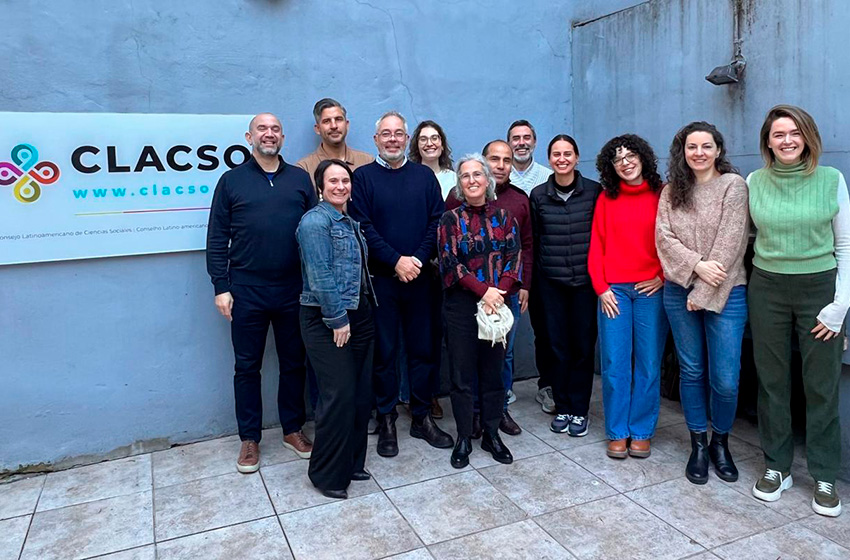
From August 5 to 7, the writing workshop “Borders in Dispute” was held at the CLACSO executive headquarters in Buenos Aires, “an opportunity to share a space for discussion, reflection and collective construction,” said Pablo Vommaro , Executive Director of the Latin American Council of Social Sciences, at its opening.
Participants:
Sikandar Ali Choudary, University of Sydney, Australia (Virtual)
Javiera BarandiaránUniversity of California, Santa Barbara – UCSB, United States
Araceli ClavijoCONICET (Virtual)
Melisa EscosteguyCONICET
Nushy GolrizUniversity of California, Los Angeles – UCLA, United States
Craig Johnson, University of Guelph, Canada
Don Kingsbury, University of Toronto, Canada
Teresa Kramarz, University of Toronto, Canada (Virtual)
Manuel Olivera Andrade, Universidad Mayor de San Andrés, La Paz, Bolivia
Susan Park, University of Sydney, Australia
Ignacio SabbatellaCONICET, FLACSO, Argentina
Martín ObayaCONICET/University of San Martín, Argentina
This was a writing workshop on the politics of lithium extraction and the global energy transition, a topic addressed by the CLACSO Working Group on “Energy and Sustainable Development,” which brings together specialists from different countries to analyze the political, social, and environmental dimensions of energy systems in Latin America. The Working Group addresses issues such as energy transitions, extractivism, climate justice, and the role of public policies in building sustainable and equitable energy futures.
The shared long-term goal is to lay the groundwork for a public policy dialogue on the regional and global dimensions of the green energy transition, to be carried out in 2027, in a long-term collaboration with the Lithium Frontiers team and the University of Guelph in Canada.
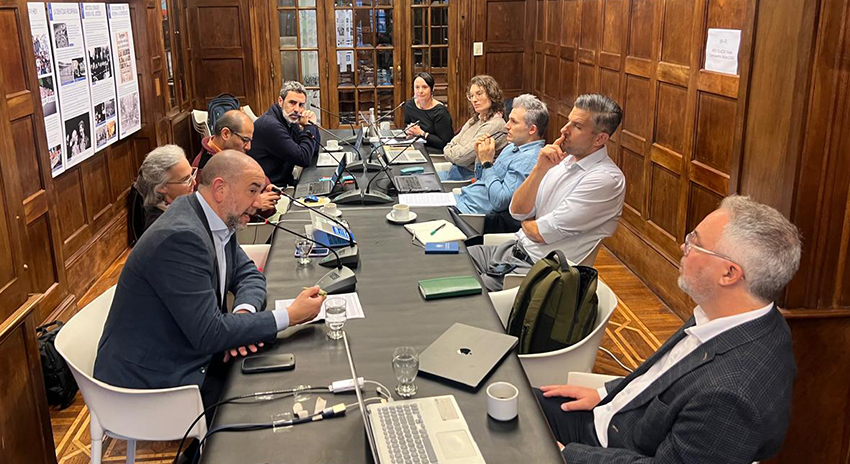
Pablo Vommaro pointed out that “these meetings are increasingly necessary. We live in a time when the great questions facing humanity necessarily require dialogue based on problems that cross different disciplines, countries, and regions, and above all, diverse experiences and perspectives. A pluralistic perspective is needed to address complex problems in a rapidly changing world.”
CLACSO is delighted to welcome you and support this initiative through research (for example, through the Working Groups), training, and advocacy. At CLACSO, we believe that the social sciences, humanities, and arts cannot simply describe reality. They also have the responsibility to understand its contradictions, engage with the needs and aspirations of our societies, and contribute to envisioning more democratic, just, and sustainable futures. That is why we promote research, international cooperation, capacity building, open access to knowledge, open science, and collaborative and networked work. We understand that complex problems require collectively constructed solutions and that no institution or country can address them in isolation. This spirit of cooperation runs through CLACSO's history and is also what inspires this meeting.
We are at a particularly challenging historical juncture. The climate crisis has become one of the world's major concerns, and there is broad consensus on the need to move towards sustainable decarbonization and energy transition processes. However, we know that no transition is neutral. Every transition involves disputes, political decisions, distributive conflicts, and new ways of reorganizing territories, communities, and economies. That is why we speak of just transitions.
In this context, lithium has acquired extraordinary centrality. The growing demand for batteries for electric vehicles and energy storage technologies has transformed this mineral into a strategic resource for the global economy in the digital age. But it would be a mistake to think of lithium solely as an input for the energy transition.
Lithium also represents territories, communities, ways of life, water resources, ecosystems, state capacities, international relations, and development projects. Ultimately, it raises a series of profoundly political questions about how the energy transition is being built, its purpose, and who is involved. And that is precisely why this project is relevant to CLACSO.
The Lithium Frontiers team proposes a comparative look at different lithium-producing regions – Argentina, Bolivia, Chile, Canada and Australia – to understand how these new extractive frontiers are configured, how states, companies, communities and social organizations interact, and what tensions emerge around the governance of a resource considered strategic for the global energy future.
We are particularly interested in this approach because it avoids oversimplification. It doesn't start from a celebratory view of the energy transition, but neither does it automatically condemn the mineral extraction processes necessary for development. Instead, it proposes a critical analysis of the multiple dimensions of these processes: the economic opportunities they can open up for our countries, but also the environmental, social, cultural, and political challenges they generate.
These types of questions resonate deeply with the agenda that CLACSO has been promoting for years and which we have been developing further since our last Conference in June 2025.
Our network includes Working Groups that investigate issues related to ecological transitions, extractivism, climate justice, energy, common goods, indigenous peoples' rights, agrarian organizations, socio-environmental conflict, natural resource governance, the political economy of development, and alternatives for building fairer and more sustainable societies.
Therefore, this workshop is not an isolated activity for us. It is part of a much broader conversation that cuts across Latin American and Caribbean social sciences and seeks to understand how our countries can face the challenges of the 21st century from a democratic perspective, with multiple forms of justice such as social, environmental, gender, and racial justice, and sovereignty over our resources and knowledge.
I would also like to highlight another aspect that I consider especially valuable. This meeting is not just for presenting the results of a completed research project.
Over these three days, they will work collectively on shared ideas, chapters, conceptual frameworks, and questions. They will debate, review, question, and enrich their research with the goal of building a collective work. Common ground within a framework of plurality.
This way of producing knowledge perfectly expresses how we at CLACSO understand academic work: knowledge built through dialogue, cooperation, diverse perspectives, and exchange among different intellectual traditions. It also includes the recognition of multiple epistemic systems, including those of Indigenous peoples, among others.
For this reason, we decided to support this meeting initiative from its inception. We did so by supporting the proposal submitted by the University of Guelph, offering our venue for the workshop, making institutional resources available, and suggesting researchers from our network's Working Groups to participate in this collective process.
We believe that creating spaces like this is part of CLACSO's mission, and we are convinced that international cooperation strengthens both knowledge production and its capacity to influence public debates. And today, international cooperation is more necessary than ever. Therefore, given its decline, projects that aim to revitalize it are essential.
I would like to acknowledge the work done by the Lithium Frontiers team , as well as the commitment of the institutions that each of you represents and that of each of the people who participate in this workshop.
Bringing together researchers from different countries, with diverse backgrounds and disciplines, is an intellectual endeavor that is especially necessary at a time when the problems we face are increasingly global, while their impacts are experienced in a profoundly unequal way across territories.
Latin America and the Caribbean occupy a central place in these discussions. This is not only because they hold a significant portion of the world's reserves of lithium and other rare earth metals, but also because for decades they have been producing critical reflections on development, extractivism, inequalities, collective rights, environmental justice, and the relationship between nature and society.
I believe that Latin American and Caribbean social sciences have much to contribute to a debate that is now global. And I also believe that this contribution will be stronger if we manage to build increasingly broad networks of academic cooperation, interdisciplinary dialogue, and collective knowledge production. The result of this work will be a collaborative publication that will express the richness of the discussions taking place here and that will hopefully become a valuable resource for those who research these issues, for those who design public policies, and for the communities that inhabit the territories with which we work.
And I also hope that this workshop is just the beginning for future collaborations.
“I am confident that this meeting will allow us to consolidate a shared work agenda between CLACSO, the Lithium Frontiers team , the participating universities, and CONICET. This will involve joint research, new spaces for exchange, and collaborative projects that will deepen our understanding of these issues,” Vommaro concluded.

