
“In the face of migration, specific forms of discrimination related to gender emerge.”
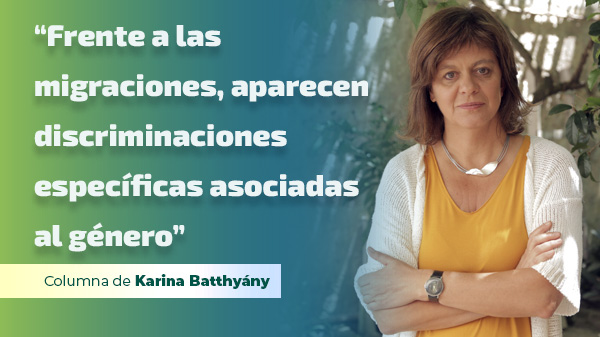
Transcript of Karina Batthyány's column
in InfoCLACSO – August 16, 2023
The theme of Being a Woman and a Migrant is linked to two Platforms for Social Dialogue (PDS): the Platform for Migration and Human Mobility and the Platform for Rights, Violence, and Gender Equality. Indeed, one of the issues that currently concerns all governments in Latin America is international migration and human mobility.
While Latin America could be defined until the 20th century primarily as a source of migrants, it is now a region characterized by both emigration and immigration, transit, and return migration. All countries in the region, to varying degrees, are involved in migration dynamics and human mobility. Some migrants head to the United States or Europe, while others seek destinations within the region (what we call intraregional migration).
In recent years, we have seen the emergence of some new migration flows in Latin America. For example, Venezuelans have migrated to various countries in the region, especially those in the South Pacific such as Colombia, Ecuador, Peru, and Chile, but also more generally to the rest of Latin America. We have also seen relatively new migration flows, such as that of Haitians, primarily to Brazil and Chile.
In addition, we must consider the long-standing and traditional migration flows in our region, such as the transit of people from Mexico and Central America to the United States. This phenomenon became visible relatively recently due to the well-known caravans, those collective movements of migrants heading to that country. There are also traditional flows of people from the Andean region, primarily from Bolivia, Peru, Argentina, and Chile, as well as internal and international migration of Colombians to the rest of the region and the world.
Globally, if we were to place this phenomenon in context, according to 2021 data from the International Organization for Migration (IOM), there were 281 million migrants worldwide, representing 3.6% of the global population. Of this group, 48% are women and 52% are men.
Given the migratory reality of our region, it is in South America, in particular, where significant intraregional movements are observed. According to IOM data, it is estimated that of the nearly 12 million migrants from Latin America and the Caribbean, 70% are located in South America. The economic situation is one of the factors driving immigration within the subregion, but there are also political and social factors that contribute to accelerating these phenomena.
We need to consider the moment of transition from one place to another, but also focus on the processes of settling in a new place, country, or state. There, certain barriers emerge that are closely linked to the daily lives of migrants, such as finding housing, employment, access to healthcare and education, and other issues related to migration.
When we talk about the phenomenon of migration, the discourses that have become widespread globally, particularly in our region, add stigmas to migrants, who are often seen as invaders, criminals, drug traffickers, or terrorists. A multitude of stigmas are attached to these people, who in many cases migrate in search of opportunities to improve their daily lives and those of their families.
There, a set of ideas, discourses, and practices emerge that view migration as a problem—that is, as an "other" that creates problems for us. Migrants are seen as a threat to the countries that receive them. A threat to internal security, to the national economy, and they are also considered the cause of many social problems.
Migration is a phenomenon we must address thoroughly in all our countries, because it generates ideologies, practices, and regimes that directly exclude, despise, and belittle the other, normalizing exclusion and openly practicing xenophobia. In many cases, migration and the movement of people are seen by our governments as a problem and not as an opportunity or a factor in social and cultural integration.
At CLACSO, we aim to critically examine the phenomenon of migration and human mobility as a right. This problem has been exacerbated by the pandemic and the securitization of borders. Furthermore, we must focus on the diverse experiences and struggles of these migrant communities, as well as on transforming the aforementioned perceptions, stereotypes, and stigmas.
The issue of migration and human mobility is also linked to the platform of Rights, Violence, and Gender Equality, because the migration of women in Latin America encompasses other dimensions associated with poverty and violence, with some particular characteristics related to the sexual division of labor and the tasks that women are expected to perform, such as caregiving. In addition to all the problems faced by the migrant community, there are specific gender-based discriminations and violence, which is a general phenomenon in migration, but there is a gender-based violence that specifically affects migrant women.
The number of female migrants in Latin America has increased in recent years: the latest available data indicates more than 10 million female migrants in our region, representing almost half of all migrants in the region. Most of these women migrants come from Central American and Caribbean countries and generally head north to the United States, Spain, and Canada.
Migration brings with it specific forms of discrimination related to gender, race, sexual violence, and human trafficking. Furthermore, upon settling in the destination country, the issue of childcare arises, both for children in that new country and for children who did not accompany the migrant woman but whose care must also be provided in the women's countries of origin or departure.
At the XV Regional Conference on Women in Latin America and the Caribbean, held at the end of 2022 in Buenos Aires, Argentina, it was recognized that the social organization of care, the unfair distribution of its use over time, disproportionately affects migrant women living in poverty, such as girls, adolescents, young and older women, indigenous or Afro-descendant women, refugee women, among others.
We must promote a systemic shift in how we approach migration from a gender perspective, with an intersectional and intercultural approach, placing human rights at the center to make visible the contributions of these migrant women to both their countries of origin and destination, particularly regarding care work and global care chains. Some women leave their families to care for their children in their countries of origin and migrate to care for them and other dependents in other households, generally in countries of the Global North.
The Buenos Aires commitment, resulting from the XV Regional Conference on Women, highlights the importance of care work in considering the option of agreements, cooperation and alliances with organizations among countries of origin, transit, destination and return, paying particular attention to guaranteeing the rights of women who are part of these migration chains and global and regional care chains.
– In the context of a certain exacerbation of right-wing discourse, what is your interpretation regarding migration processes?
– In the face of all the stigma associated with migrants, which positions them as the "other," they are often blamed for the problems in our societies. According to right-wing discourse, migrants are the ones who prevent native-born citizens from finding work, or they are the reason why healthcare systems become overwhelmed and certain social problems arise.
Migrants are often portrayed as the problem. In reality, we must understand that human mobility is a right for everyone. And that migrants who exercise this right to human mobility in the territories to which they choose to migrate must have their rights recognized. Furthermore, migration frequently occurs as a result of the development of right-wing and far-right policies in these territories, the expulsion of people, or the reduction of services and support programs for the most vulnerable.
At CLACSO, we defend human mobility as a right and we will continue working on research, training and dissemination to dismantle these stigmas associated with migrants.
If you would like to receive more information about CLACSO's training programs:
[widget id=”custom_html-57″]
to our email lists.

