
“In the face of the pandemic, build universal social protection systems”
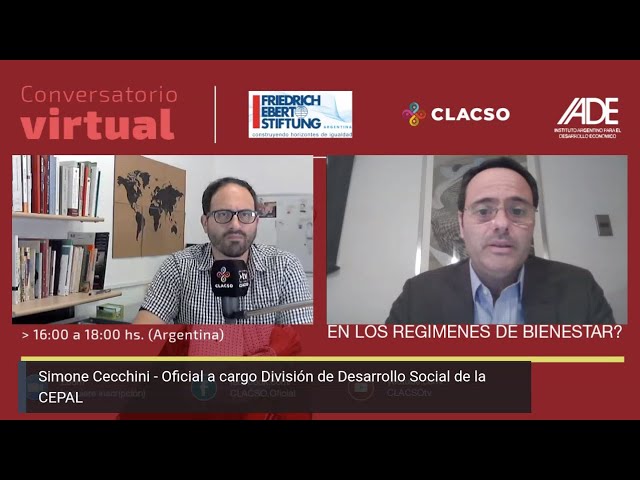
Simone Cecchini, Officer in Charge of the Social Development Division of ECLAC, participated on August 4 in the Third Meeting: “The social challenge in times of pandemic. Structural changes in welfare regimes?”, organized by the Latin American Council of Social Sciences, the Friedrich Ebert Foundation, IADE and the CLACSO Working Group on Social Security and Pension Systems.
The other speakers were: Fernanda Raverta, Executive Director of ANSES; Karina Batthyány, Executive Secretary of CLACSO; and Svenja Blanke, FES Representative for Argentina and Director of the journal "Nueva Sociedad." The moderator was Nicolás Dvoskin of the Argentine Institute for Economic Development.
Simone Cecchini spoke to CLACSOtv.
Interviewed by Gustavo Lema
Simone Cecchini explained that “we are facing a crisis of historic proportions; we all know it, we are all experiencing it, no one expected it. From an economic standpoint, a 9,1% drop in Gross Domestic Product is estimated for 2020, representing the largest decline in recorded economic history, even worse than the 29 crisis. So we are facing something of global proportions because what is happening is a synchronous crisis. At the same time, all countries in the world are experiencing this crisis, with lockdowns, trade falling, commodity prices plummeting, domestic consumption declining, and hence this massive drop in GDP. Of course, this has a very concrete impact on people's lives, beyond the need to take care of themselves and their health, which is paramount. There are also impacts on the ability to generate income. And in terms of employment, ECLAC estimates that the unemployment rate will rise to 13,5% this year. And of course, there is the social drama of a substantial increase in poverty, which could reach…” 37,3% of the population lives in poverty, and 15,5% in extreme poverty. It's important to clarify that extreme poverty means not having enough money to afford a basic food basket. This means that this year, 15 out of every 100 Latin Americans will lack even those resources. This goes hand in hand with basic problems like food insecurity and the fight against hunger. As we've been discussing in the seminar on welfare systems, the need to create or strengthen a social state, a welfare state, it's important to emphasize that beyond widespread poverty, there are also large sectors of society that are highly vulnerable to falling into it and who barely have enough to get by. For example, we measure social stratification based on family income, how many times the poverty line their income is, and in 2020, 8 out of 10 Latin Americans had incomes only up to 3 times the poverty line. This tells us that there is widespread vulnerability because these resources are insufficient if there is unemployment, if When someone gets sick, they need protection for quite some time. Hence the need to call for strengthening the social state, the welfare state, to build universal social protection systems that, of course, include care, health, and the importance of having a universal health system and also primary care that is accessible to all. These are the great challenges we face.”
If you would like to receive more information about CLACSO's training programs:
[widget id=”custom_html-57″]
to our email lists.

