
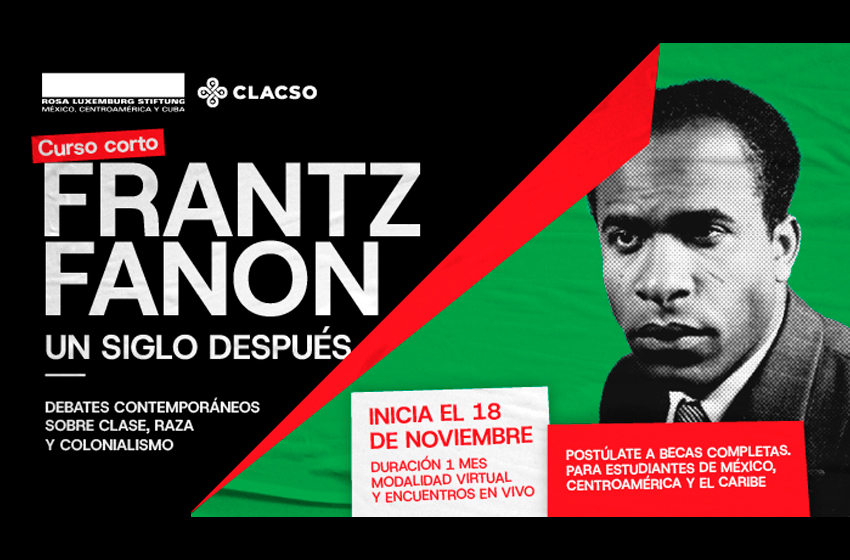
Online course: Frantz Fanon, a century later. Contemporary debates on class, race, and colonialism
TEACHING TEAM: Karina A. Bidaseca (CLACSO / CONICET, Argentina) | Rosa Campoalegre Septien (GT Afro-descendants and counter-hegemonic proposals) | Camille Chalmers (State University of Haiti / Executive Director of the Platform for Alternative Development, Haiti) | Alejandro De Oto (CONICET, Argentina) | José Luis Gásquez (Faculty of Political and Social Sciences and PUEAAO, National Autonomous University of Mexico) | Félix Valdés García (Institute of Philosophy, Cuba)
Home: 18 / 11 / 2025 | Registration: 16/09/2025 al 17/11/2025
Modality: Virtual with live classes and exclusive materials
Workload: 50 hours long.
Duration: 1 month
Organized by Latin American Council of Social Sciences (CLACSO) with the support of the Rosa-Luxemburg-Stiftung Regional Office for Mexico, Central America and Cuba.
RESULTS
We appreciate the overwhelming response to this call for participation. We have received over 100 applicationsThese applications were carefully evaluated. Following this process, the following individuals were selected to participate in the course:
| Name | Last Name | Country |
| Ana Laura | Fernández de Lara López | Cuba |
| Andrea Montserrat | Urbina | Honduras |
| Coral | Lamb | Dominican Republic |
| Isis | Neri Santos | Mexico |
| Keli Patricia | Durán Lobos | El Salvador |
| Laura | Rodríguez de la Cruz | Cuba |
| Mariana | Morales Hernández | Mexico |
| Mariana | Pérez Galaz | Mexico |
| Rodrigo | Nava | Mexico |
| Rosaura Ermelinda | Raguex Morales | Guatemala |
Frantz Fanon (1925-1961), revolutionary, psychiatrist, philosopher, and writer born in Martinique under French colonial rule, is one of the most influential figures in 20th-century critical thought. One hundred years after his birth, his work remains an essential reference point for postcolonial studies, critical theory, and Marxism.
His reflections on colonialism, racism, and decolonization shaped liberation movements in Latin America and the Caribbean during the 1960s and 1970s, as well as struggles in Algeria, Palestine, South Africa, and other anticolonial processes. The anti-imperialist Pan-Africanism he championed resonated with the spirit of the Third World and the Bandung Conference, constituting a horizon of emancipation that continues to engage with our present.
Fanon lucidly analyzed the social divisions of the colonial world, where racism was not an incidental or merely ideological phenomenon, but the very foundation of domination. The position of individuals was racially structured, and the imposition of white culture became a central mechanism of alienation. From his work "Black Skin, White Masks" to "The Wretched of the Earth," Fanon offers us keys to understanding how these matrices of oppression are reproduced and how they can be transformed.
This course proposes a discussion of his major writings based on what they evoke and produce in situated contexts in Latin America, the Caribbean, and Africa. Where his work becomes a field of dispute and critical reading, an agonistic space of tensions, contradictions, and debates opens up, allowing us to map contemporary forms of class, race, and colonialism.
- Class 1 | Fanon in Haiti. Legacies of the first Black Republic
Camille Chalmers (Haiti) - Class 2 | Fanon, an Antillean thinker
- Felix Valdés García (Cuba)
- Class 3 | Fanon and the racial question in the Cuban revolution
Rosa Campoalegre Septien (Cuba) - Class 4 | Fanon and the postcolonial subject
Alejandro De Oto (Argentina) - Class 5 | Fanon in Algeria, Africa – Live
José Luis Gásquez (Mexico) - Class 6 | Fanon. Contemporary debates on race, gender, and colonialism
Karina A. Bidaseca (Argentina)
- Karina A. Bidaseca (CLACSO / CONICET, Argentina)
- Rosa Campoalegre Septien (GT Afro-descendants and counter-hegemonic proposals / University Program of Studies of Cultural Diversity and Interculturality (PUIC-UNAM), Mexico / Nelson Mandela Chair of Studies on Afro-descendants (CENMA), Cuba)
- Camille Chalmers (State University of Haiti / Executive Director of the Platform for Alternative Development, Haiti)
- Alejandro De Oto (CONICET, Argentina)
- José Luis Gásquez (Faculty of Political and Social Sciences and PUEAAO, National Autonomous University of Mexico)
- Félix Valdés García (Institute of Philosophy, Cuba)
The course will be delivered online, combining synchronous and asynchronous components. Over the course of one month, a total of six classes will be offered: four live sessions with the instructor (synchronous) and two recorded sessions available for asynchronous viewing.
Live classes will be held on the following days Tuesday 10am (MEX/Central America) / 11am (COL/ECU/PERU) / 13pm (ARG/URU/BRA/CHI) / 17pm (ESP) through the Zoom platform, which will allow direct interaction between participants. In addition, students will have access to exclusive materials, available in the virtual classroom, that will complement the content covered in each session.
The final assessment will consist of an individual online questionnaire, which will be a necessary condition for passing the course.
Will be awarded 10 full scholarships for people from Mexico, Central America and the Caribbean aimed at activists in social movements, members of community organizations, students, researchers, public officials and the general public who carry out activities related to the subject matter of this course
Requirements for the application:
- Applications will be submitted through the CLACSO website.
- The candidates must:
1. Complete your details
2. Briefly describe your interest in participating (and the relevance of the issue to your organization, territories, and areas of operation)
- The available scholarships will be allocated respecting regional diversity and gender equity.
- This call for applications will remain open. until 29/10/2025.
Queries: [email protected]

