
Photography: Image and Power in the Insular Caribbean
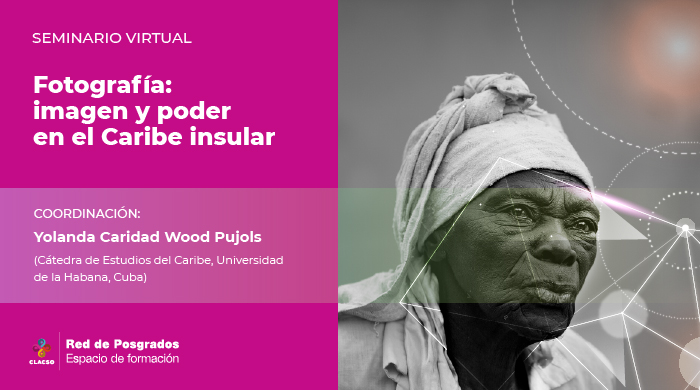
Seminar 2131
ChairCLACSO
Coordination: Yolanda Caridad Wood Pujols (University of Havana, Cuba)
Teaching team: Kirenia Rodríguez Puerto (University of Havana, Cuba)
Home: 30/06/2021 | Registration: 22/03/2021 to 29/06/2021
Workload: 12 weeks – 90 hours.
Photography emerged in the Americas in accordance with the patterns of coloniality; intrinsically, it became the foundation for a dual consciousness manifested as subjectivities formed within the colonial difference, containing the seeds of emancipatory stances and cultural legitimation. This essentially contradictory critical philosophical basis has been permeated by uneven historical and social developments in our island contexts.
While the image of the Antilles began to take shape in travel journals as early as the 16th century, it was with the advent of photography in the 19th century that we witness a process of simultaneous representation from the perspective of the other and self-representation. Documentary photography became an essential means of producing symbolic values about the reality and political instability of the islands, remaining highly relevant throughout the 20th century. Through the press and its mass reach, a universe of modernity was shaped. Strong connections and creative exchanges were established within the arts and among intellectuals, whose visual codes persist to this day through multiple forms of image circulation.
Therefore, this course is organized with an interdisciplinary profile, taking into consideration the role of the image in contemporary culture and as an analytical tool to access other fields of knowledge such as history, sociology or anthropology.
• To highlight the role of photography in the cultural framework of Caribbean thought within the coloniality/decoloniality axis of reflection.
• Analyze the connection between photographic images and transcendental moments in the history of the islands, emphasizing the critical capacity of the image to narrate, document and observe with critical acuity its historical time.
• To highlight the contribution of photography to the construction of cultural paradigms in the islands, by helping to shape an iconography of the island's heroes, as well as documenting political interference and popular reactions throughout the 20th century.
• Systematize the contributions of photography in the context of contemporary artistic practices and in dialogue with the main cultural problems of the Caribbean subject.
• To value the multiplicity of perspectives on the photographic image from different fields of knowledge.
- Image and photography in the Caribbean. The contradictory coordinates of Modernity/Coloniality
- Times of visual foundation: insular trajectories of photography
- Ethnology and photography: race, maroonage, and slavery
- Press and photography. Island independence movements in the 19th century and the founding heroes. 1898, a colonial turning point in the Caribbean
- History as a photographic document. Investments, interventions and occupations in the 20th century: Panama Canal, Haiti and the Dominican Republic
- History as a photographic document: Intellectuals, peace, decolonial and anti-racist thought in the Caribbean
- History as a photographic document: The Cuban Revolution, popular resistance in the Dominican Republic, and the image of the Heroic Guerrilla.
- Photography and decolonization in the contemporary Caribbean: marginality and cultural resistance
- BORDIEU, PIERRE (2003): “First part,” Photography, a medium art, Editorial Gustavo Gili. SA, Barcelona, 2003 p. 51-162
- BRISSET MARTÍN, DEMETRIO (1999): “About ethnographic photography” Gazeta de Antropología, University of Málaga, p. 15
- BURKE, PETER (2005): “The Testimony of Images” “Photographs and Portraits”, Seen and Unseen. The Use of the Image as a Historical Document, Barcelona, pp. 8-31.
- FRENKEL, STEPHEN (2004): “Jungle Stories. North American Representations of Tropical Panama”. Tareas Magazine, No. 117, May-August. CELA, Center for Latin American Studies, Panama. pp. 97-118.
- GUILLÉN, NICOLÁS (2011): “Elegy to Jacques Roumain” AND CAMEJO, ARIEL “Nicolás Guillén Invitation to eternity: the «Elegy to Jacques Roumain»” Nicolás Guillén: the chosen elegies, coordinator Yanelis Velazco. Havana: Editorial UH, pp. 127-133
- HAYA, MARÍA EUGENIA (1980): “On Cuban photography,” Revolution and Culture, No. 35, Havana, Pp. 41-58
- MARI MUT, JOSÉ A (2013): The photos of Puerto Rico in Our islands and their people. DIGITAL EDITIONS.
- MARTÍ, JOSÉ (2016): “Iconography” Complete Works-Critical Edition. Vol. 1 Center for Martí Studies/CLACSO pp. 227-242
- MILLER, JEANNETTE (2010): History of Dominican Photography. Santo Domingo: Ed. Grupo León Jiménes.
- MILLER, JEANNETTE (2010): History of Dominican Photography. Santo Domingo: Ed. Grupo León Jiménes.
- MILLER, JEANNETTE (2010): History of Dominican Photography. Santo Domingo: Ed. Grupo León Jiménes.
- Photography in Latin America and the Caribbean in the nineteenth and early twentieth centuries (1998) (English/Spanish/French - CD-ROM) IFLA/UNESCO.
- QUIJANO, ANÍBAL (2014): “Marginal Pole and Marginal Labor”. Issues and Horizons: From Historical-Structural Dependency to the Coloniality/Decoloniality of Power. Buenos Aires: Lugar CLACSO Editorial/Editor, pp. 125-169
- QUIJANO, ANÍBAL: “Coloniality of Power, Eurocentrism and Latin America” in Lander, Edgardo (2008): The Coloniality of Knowledge: Eurocentrism and Social Sciences, CLACSO, Argentina. UNESCO-Ediciones FACES/UCV
- RODRÍGUEZ PUERTO, KIRENIA (2015): “The visual universe of the Caribbean in times of foundation. Photography as a temporal and cultural marker in the image of the Caribbean.” (Digital text will be attached)
- RODRÍGUEZ PUERTO, KIRENIA (2015): “Photography in the Caribbean, recent images for historical exclusions.” Paper presented at LASA, Puerto Rico.
- RODRÍGUEZ PUERTO, KIRENIA (2015): “Puerto Rican Lens: Art and Photography of the 20th Century”
- RODRÍGUEZ PUERTO, KIRENIA (2017): “Photography in the Caribbean: Art and decolonization.
- SONTAG, SUSAN (2006): “In Plato’s Cave,” On Photography, Santillana Ediciones Generales, SA Mexico, pp. 15-44
- TROUILLOT, MICHEL ROLPH (2011): “Modern in another way. Caribbean lessons from the place of the savage” Tabula Rasa. Bogotá - Colombia, No.14: January-June, 79-97
- VÁZQUES, CARMEN: “Alejo Carpentier in Paris (1928-1939)” Virtual Cervantes Center. pp. 101-115
- VILAS, CARLOS. “International Population Movements and Capital Valorization in the Caribbean.” Anales del Caribe. Havana. No. 3. 1983. Pp. 19-50
- WOOD PUJOLS, YOLANDA (1997): Artists of the Hispanic Caribbean in New York, Havana: Editorial Letras Cubanas
- WOOD PUJOLS, YOLANDA (2012): “Art in environmental dialogue” Caribbean Islands. Art, nature and society, Havana: Editorial UH and CLACSO p. 153-24
- WOOD PUJOLS, YOLANDA (2018): “Hispanic Caribbean in the sixties: commitments and projections of the plastic arts” Caribbean: visual universe, Havana, Editorial Félix Varela, pp. 135-147
- WOOD PUJOLS, YOLANDA (2018): “Photography, society and culture in the contemporary Caribbean” Caribbean: visual universe, Havana, Editorial Félix Varela, pp. 148-155
- WOOD PUJOLS, YOLANDA (2018): “The Caribbean Image” Caribbean: Visual Universe, Havana, Félix Varela Publishing House, pp. 113-123
- WOOD PUJOLS, YOLANDA AND KIRENIA RODRÍGUEZ (2011): Pierre Verger and the Caribbean, Havana: Casa de las Américas, Office of the Historian and Pierre Verger Foundation
|
|
In one payment by 29/06 |
In one payment without discount |
|
CM Plenos |
$75 |
$150 |
|
CM Associates |
$95 |
$190 |
|
No link |
$95 |
$190 |
FAQ
The basic requirements for taking a seminar are:
- Availability of at least 4 hours per week to dedicate to the seminar course.
- Internet access.
- Reasonable handling of communication and computer tools.
- Language proficiency in the language in which the course will be taught. The official languages are Spanish and Portuguese.
If you have a link with a CLACSO Associated Center:
Paying in one payment: USD 150 (includes issuance and shipping costs of the digital certificate).
Paying BEFORE 29/06/2021: USD 75 (includes issuance and shipping costs of the digital certificate).
If you have a link with a Network or Institution Associated with CLACSO:
Paying in one payment: USD 190 (includes issuance and shipping costs of the digital certificate).
Paying BEFORE 29/06/2021: USD 95 (includes issuance and shipping costs of the digital certificate).
If you do NOT have a link with a CLACSO Associated Center:
Paying in one payment: USD 190 (includes issuance and shipping costs of the digital certificate).
Paying BEFORE 29/06/2021: USD 95 (includes issuance and shipping costs of the digital certificate).

