
Strengthening protection mechanisms for human rights defenders and refugees or exiles for political reasons
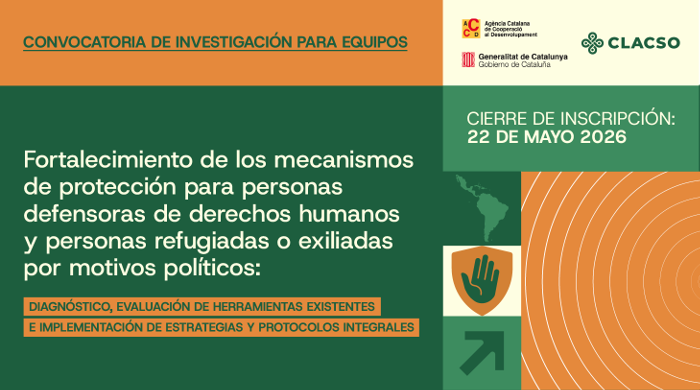
Diagnosis, evaluation of existing tools and implementation of comprehensive strategies and protocols
Call for research teams
Background
The Latin American Council of Social Sciences (CLACSO) and the Catalan Agency for Development Cooperation (ACCD), in ongoing collaboration and dialogue with the Open University of Catalonia (UOC) and the Autonomous University of Barcelona (UAB), have been promoting various joint initiatives aimed at strengthening knowledge production. It is within this framework that this research call is presented, based on the recognition that in the current regional context, marked by persistent structural violence, migration crises, sociopolitical conflicts, and setbacks in fundamental rights, human rights defenders and those who have been forced to flee their countries for political reasons face multiple forms of vulnerability, precariousness, and security risks. These individuals not only carry out practices essential to the upholding of rights, justice, and democracy, but are also frequently targets of threats, persecution, and exclusion—situations that are exacerbated in contexts of state violence, criminalization of social protest, and a lack of effective public protection policies.
Despite the existence of international legal instruments, national regulatory frameworks, and sectoral protocols aimed at protecting human rights defenders and providing assistance to refugees or exiles for political reasons, significant limitations persist in their effective implementation, inter-institutional coordination, and territorial application. Many of these tools suffer from operational gaps, poor coordination between state and non-state organizations, an insufficient intersectional approach (including gender, race, ethnicity, sexual diversity, and disability), and a lack of systematized information that would allow for the identification of gaps, best practices, and persistent obstacles.
International organizations, governments, and civil society networks have repeatedly pointed out that current responses are fragmented and do not always address the real needs of people at risk. These limitations also hinder the ability to design evidence-based public policies that guarantee comprehensive protection, harm prevention, and effective access to legal, psychosocial, and security support. In many cases, the lack of standardized and evaluated protocols amplifies the vulnerability of these groups, preventing not only timely responses but also the accumulation of lessons learned about what works and what doesn't.
This call for proposals responds to the urgent need to promote research that rigorously diagnoses current limitations and needs, evaluates existing tools, and proposes additional strategies and protocols to strengthen the protection of human rights defenders and refugees or exiles for political reasons. The approach presented here recognizes that scientific and applied knowledge is fundamental to informing public action, strengthening inter-institutional coordination, and fostering substantive interactions among academic communities, social movements, and humanitarian protection organizations. This approach is also grounded in a critical and decolonizing perspective, seeking to challenge hegemonic logics of knowledge production and standardized responses that, in many cases, fail to engage with local realities, situated experiences, and the knowledge constructed by the defenders themselves and the affected communities. In this sense, the call promotes the generation of useful and contextualized knowledge, oriented towards state actors, social organizations, regional networks and academic spaces committed to the validity of human rights and political justice, incorporating situated, intersectional and territorially rooted approaches that contribute to the structural transformation of protection practices.
This initiative seeks to generate robust input that will not only allow for a deeper understanding of existing gaps and challenges, but also contribute to the formulation, adjustment, and strengthening of protection instruments with a rights-based, intersectional approach, focused on the real reduction of risks and vulnerabilities. It also aims to foster a pluralistic dialogue among academia, civil society, and policymakers so that, together, they can bring about substantial improvements in protection conditions for these groups.
RULES OF THE CALL FOR APPLICATIONS
- The information provided in the registration form is considered a sworn statement.
- Collective applications are expected (teams of between 3 and 5 members).
- At least one of the members of the applicant team must maintain accredited links with a CLACSO Network Member Center.
- If the project is selected, the team must submit a letter of support signed by the highest authority of the Member Center with which the proposal is linked.
- If applicants are affiliated with a CLACSO member center, the center must not have any outstanding membership fees for the year 2025.
- Team composition must respect gender parity. Teams are expected to be intergenerational, integrating researchers from diverse backgrounds and experiences.
- The teams must be made up of trained researchers, that is, those who hold a master's degree, doctorate or equivalent, and proven academic track record; and researchers in training, that is, those who are pursuing master's/doctoral studies or have a degree.
- Proposals from researchers who are currently recipients of fellowships or grants under other research calls, scholarships, or essays organized by CLACSO will not be accepted. Applications from researchers who have been selected in a CLACSO research call will be accepted, provided that the recipient has fulfilled all obligations in a timely manner.
- Members of the Steering Committee or officials of the Executive Secretariat of CLACSO, or officials of the Catalan Agency for Development Cooperation (ACCD), may not apply.
- Each researcher may only participate with one proposal in this Call.
- To register the research proposal, the team must select one of its members as responsible for registering the project; that person must open the form and include the other team members.
- Should the project be awarded and any travel be necessary, the winners will be responsible for covering the costs of medical insurance or similar expenses.
The amount of support will consist of 5.000 Euros (its equivalent in dollars or in national currency) for each selected proposal.
The proposed research will be carried out within a maximum period of 5 (five) months. The support will be paid in installments through bank transfers made to the name of the representative designated at the time of registration.
The selected teams will work with the support of tutors assigned by CLACSO who will monitor their research process and results. These tutors will have ties to the Open University of Catalonia (UOC) and the Autonomous University of Barcelona (UAB).
CLACSO and the Catalan Agency for Development Cooperation (ACCD) will publish the final products in print and/or digital media, giving them wide publicity and dissemination through the means they deem appropriate. If necessary, researchers will be asked to make the adaptations and adjustments required so that the resulting research can be published in various formats.
The authors will transfer the original publication rights of their works, given that CLACSO adheres to and defends the principles of open science and open access to knowledge, so that the resulting work is easy to find, accessible, interoperable, and reusable. Subsequently, these works may be published in any other medium, always citing this Call for Papers. Researchers must inform CLACSO of the subsequent publication of the works resulting from their research.
- Completed research projects will not be accepted. Proposals may be linked to ongoing research processes, but the final works must be original and unpublished products and developed within the period established by the call for proposals.
- Texts written in the four languages commonly used in Latin America and the Caribbean (Spanish, Portuguese, English and French) will be accepted, depending on the country of origin of the proposal.
- Proposals must be uploaded to the registration system, completing the form that appears once the personal and academic data of those who make up the research team have been completed.
- In the first stage, the submitted proposals will be reviewed for their formal and administrative aspects to ensure their compliance with the competition rules. Proposals that do not meet the established requirements will be rejected.
- Applications that pass to the next stage will be evaluated by an International Committee composed of experts who will assess the quality and relevance of the proposals, which will be submitted under a pseudonym.
- The Call may be declared void or a smaller number of projects may be selected, if the proposals submitted do not meet the required quality and consistency.
- Situations not covered in this document will be resolved by the convening institution.
- The ruling will be irrevocable and unappealable.
- The research projects will develop their work plan between July 2026 and November 2026. This plan will be implemented under the facilitation of tutors assigned by CLACSO.
- Three reports will be submitted throughout the research process: i) revised proposal, ii) progress report, and iii) final report. Each of these submissions will be presented in virtual meetings focused on exchange, collective learning, feedback, and sharing of experiences. All reports will be evaluated by the assigned tutors.
- The final products to be delivered will be at least two:
- Chapter for a collaborative book. The chapter should be between 12.000 and 15.000 words (excluding appendices and bibliography) in Times New Roman 12-point font, single-spaced. This is an approximate length guideline, and CLACSO and the Catalan Agency for Development Cooperation (ACCD) reserve the right to make revisions or exceptions if deemed necessary. Furthermore, once submitted, CLACSO and the Catalan Agency for Development Cooperation (ACCD) may request adjustments and changes from the researchers to ensure the final research chapters meet institutional criteria for publication. The text structure is flexible, adhering to academic writing conventions and CLACSO's editorial guidelines, as well as APA style and gender considerations.
- Action Guidelines (ALGs) document, containing inputs, proposals, and recommendations for public policies and social intervention on the topics investigated, based on the research results. The format of these AGs will be communicated in due course.
- Texts written in Spanish and Portuguese will be accepted, depending on the country of origin of the proposal.
- Enter the website of CLACSOThe online registration system will be available starting on April 22nd 2026.
- Register in the CLACSO Single Registration System (SUIC). The generated username and password will be required each time you wish to access the system to consult, modify, add, or submit information for this or any other CLACSO activity. Applicants who are part of collective proposals must open a single form This will include all researchers on the team. One of the authors must also be designated as responsible for the application. This same person will receive the corresponding monetary award if the proposal is selected.
- Identify the proposal by indicating its title and the pseudonym of the applicant(s). Applications with pseudonyms that correspond to the applicant's first and/or last name will not be accepted. Once the corresponding fields are completed, the system will enable the uploading of the following data.
- Applicants must indicate their institutional affiliation with a CLACSO Network Member Center on the application form. The updated list of member centers can be found at: https://www.clacso.org.ar/clacso/centros_miembros_clacso/inicio.php.
- Complete the personal and academic data form and attach the curriculum vitae in free format; the digital copy of the identity document, passport or ID card; the digital copy of the highest academic degree obtained (or proof of degree in process) and the photograph.
- The proposal must be filled out on the form that appears once the personal and academic data has been completed.
- Once registration is closed, the system will produce an electronic certificate of receipt that will serve as proof of application.
Registration closes: May 22, 2026
Winners will be announced in June 2026.
Project implementation: July 2026 to November 2026
Start of the research period: June 2026
The results will be published on the CLACSO website. The winners will be contacted by email.
Inquiries: [mail protected]

