
Care society and life policies
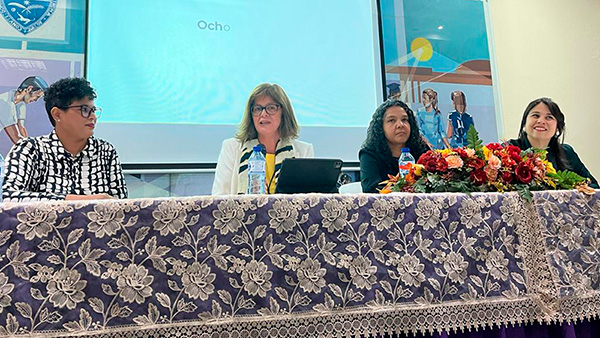

The morning of Friday April 21At the Autonomous University of Santo Domingo, in the Dominican Republic, the Forum “Society of Care and Policies of Life” was inaugurated, organized by the university, the CLACSO Member Centers of the Dominican Republic, UN Women, OXFAM and the Friedrich Erbert Foundation.
Opening words: Nisaly BritoMinistry of Women, Dominican Republic. Pamela Suero, Sectoral Coordinator of the Directorate of Analysis of Poverty, Inequality and Democratic Culture. Ministry of Economy, Planning and Development (MEPYD). Karina Batthyány, Executive Director of CLACSO. Gloria AmézquitaRepresentative of the CLACSO member centers of the Dominican Republic.
In that context, Karina Batthyány maintained that "what we want is to promote dialogue between those who are reflecting, researching, and studying these issues, those who are taking action at different levels of public policy regarding the issue of care, and social organizations and movements," emphasizing that "if we really want to put care at the center, that implies a profound cultural transformation; it implies reshuffling and starting over in terms of the gender contracts we have in most of our countries."
On Friday the 21st, the following activities continued:

Inaugural Dialogue | Let's Talk About Care: Policies, Challenges and Perspectives from LAC
Karina Batthyány, Executive Director of CLACSO, Uruguay
Nisaly BritoMinistry of Women, Dominican Republic
Moderated: Tania Pierre-CharlesCRESFED, Haiti

Dialogue 1 | Public policies for care: Breaking with inequalities and poverty?

Presentation of the audiovisual: “Caring for the Caregivers“—Care Block, Ciudad Bolívar, Bogotá, Colombia. A production of CLACSO.tv.

Verónica SerafiniMember of the Steering Committee of CLACSO, Paraguay
Valentina PerrottaWorking Group on Care and Gender and Master's Program in Care of CLACSO, Uruguay
María Isabel DomínguezMember of the Steering Committee of CLACSO, Cuba
Pamela Suero, Sectoral Coordinator of the Directorate of Analysis of Poverty, Inequality and Democratic Culture. Ministry of Economy, Planning and Development (MEPYD).
Tania HernandezFeminist activist, Dominican Republic
Moderated: Cheila ValeraFLACSO, Dominican Republic

Dialogue 2 | Paid care: labor dynamics and union perspectives
Eulogia FamiliaNational Council of Trade Union Unity (CNUS), Dominican Republic
Miguel UrrutiaMember of the Steering Committee of CLACSO, Chile
Paola MascheroniCLACSO Working Group on Agricultural Work, Inequalities and Ruralities, Uruguay
Melina Zaiz, In charge of the legislative agenda, Dominican Republic
Moderated: Carolina Jimenez, Colombia

Dialogue 3 | Challenges in the implementation of care policies in the Dominican Republic

Gloria Reyes, Director of the Supérate Program
Addys ThenMinistry of Women of the Dominican Republic
Angel Serafín CuelloSectoral Analyst at the Ministry of Economy, Planning and Development of the Dominican Republic
Virtues of the RosePaula Rodríguez, FES Caribe, Autonomous University of Santo Domingo, Dominican Republic
Moderated: Lia Pinheiro Barbosa. Humanities Center, State University of Ceará, Brazil


Previously, the Thursday April 20The International School of Postgraduate Studies in Care with a Gender Perspective was inaugurated. The opening remarks were delivered by the Executive Director of CLACSO, Karina Batthyány, and members of the Steering Committee María Isabel Domínguez, Gloria Amézquita, and Tania Pierre-Charles.

The first activity was the Workshop “Conceptual debates on care” coordinated by Valentina Perrotta (University of the Republic, Uruguay), Analís Santos (Supérate, Dominican Republic) and Pamela Suero (Sectoral Coordinator of the Directorate of Poverty, Inequality and Democratic Culture of the Ministry of Economy, Planning and Development of the Dominican Republic).


-Workshop 2 – Care systems and policies in Latin America Coordination: Valentina Perrotta (University of the Republic, Uruguay) and Paula Rodríguez (FES).

-Workshop 3 – Migration and Care (elective) Coordination: Bridget Wooding and OBMICA team (OBMICA, Dominican Republic).


-Workshop 4 – Rethinking care from the perspective of young people (elective) Coordination: Franklyn Gómez (Flacso Dominican Republic / Supérate) and Débora Soto (Profamilia, Dominican Republic).

-Workshop 5 – Care from rural and community contexts. Coordination: Paola Mascheroni (University of the Republic, Uruguay) and Tania Hernández (Ministry of Women, Dominican Republic).

-Workshop 6 – Youth, generational approach and inequalities. Coordination: María Isabel Domínguez (Center for Psychological and Sociological Research, Cuba) and Estefanía de la Cruz (Institute of Gender and Family of the UASD, Dominican Republic).

-Workshop 7 – Critical debates between Refounding Health Systems and Care Systems in the 21st Century. Coordination: Gonzalo Basile (CLACSO International Health Working Group) and Tania Pierre-Charles (CRESFED, Haiti).

-Workshop 8 – Revolutions and memories. Coordination: Matías Bosch (Juan Bosch Foundation/ APEC) and Amaury Pérez (UASD).

-Workshop 9 – Care and mental health. Coordination: Sirelbys Frías, Mery Santana and Ilenia Encarnación (Human Development, Inequality and Poverty Program, FLACSO Dominican Republic).
The International Postgraduate School in Care with a Gender Perspective is an intensive, in-person, postgraduate-level training program with a comparative and regional perspective. It aims to provide theoretical and practical tools for understanding the relationship between gender and care, as well as the main debates and conceptual tensions surrounding it. This training is expected to contribute to the design and analysis of public policies, enabling students to make contributions that integrate a gender perspective into the field of care.


On Thursday the 20th, the meeting of the CLACSO Member Centers in the Dominican Republic with the members of the Executive Secretariat also took place.

The Forum is conceived as a multi-stakeholder space for the open and dynamic exchange of ideas and experiences related to care, approached from diverse perspectives. Multiple activities will take place: roundtables, an International Postgraduate School on Care with a Gender Perspective, in-person workshops, and the presentation of audiovisual materials. The roundtables are designed as spaces for exchange and conversation, where key themes will be presented to stimulate debate on the Forum's central topic among a diverse group of participants, including researchers, policymakers, and members of social organizations.
The Society of Care and Life Policies Forum is part of the Platform for Social Dialogue "Rights, violence and gender equality," which CLACSO is promoting for the coming years.
If you would like to receive more information about CLACSO's training programs:
[widget id=”custom_html-57″]
to our email lists.

