
Forum on Economic Proposals for the Future of Argentina
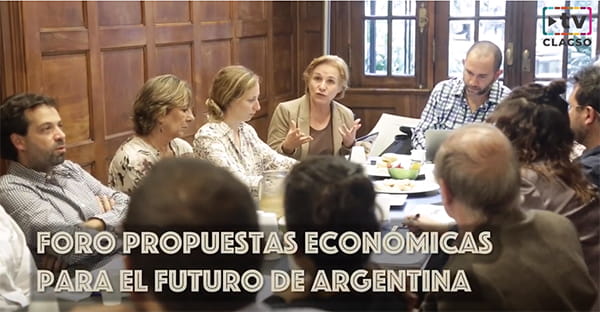
On May 3, the “Economic Proposals for the Future of Argentina Forum” brought together economists from different backgrounds convened by the Latin American Council of Social Sciences, the Friedrich Ebert Foundation and the Floreal Gorini Cultural Center of Cooperation.
This was the first of three meetings scheduled to coordinate actions in the search for solutions to the deep economic and social crisis into which the current government has plunged the country.
Several of those present spoke to CLACSOTV.
Federico PastranaThe economist from “Center-Periphery” referred to “the conditions imposed by the International Monetary Fund, Argentina’s high level of debt, what to do or how that level of debt can be managed in the coming months and especially in the coming years, and how the government can deal with that situation.”
At the same time, Felisa Miceli, director of the “Center for Research and Management of the Solidarity Economy” (CIGES), and former Minister of Economy of Argentina during the presidency of Néstor Kirchner (2005-2007), contrasted the current adjustment policies with “growth with social inclusion, which allows for an improvement in the quality of life of the population”.
To Guillermo Gigliani, from the “Society of Critical Economics”, which brings together economists from several national universities, agreed on the fundamental importance of confronting the crisis in order to “reverse the conditions of poverty, misery and backwardness that the country is going through today”.
Ana AcostaThe "Observatory of Economic Trends and Public Policies" (OEPP) highlighted the importance of these meetings "to discuss this complex situation, conduct an analysis and seek solutions" for the future.
At the same time, Pablo Wahren, also from OEPP, referred to the problem of dollarization in the Argentine economy and concluded: “it is urgent to activate the economy, it is urgent to restore employment, to restore income, in a context where we have very important financial limitations that we have to overcome.”
CClaudio KatzSpeaking on behalf of the “Network of Leftist Economists,” he diagnosed that “growth is impossible under the suffocating debt conditions facing Argentina.” He warned that “the IMF will likely accept a debt restructuring, extending deadlines and modifying payments, but in exchange for labor reform, pension reform, and greater hardship for our children who already have nothing to eat.”
“Open Letter” participated Guillermo Wierzbawho pointed out that, for political reasons, “the United States administration gave Argentina the opportunity to enjoy a level of loan from the International Monetary Fund, with the objective of establishing a hegemonic policy on the continent without allowing for independent policies.” Faced with this reality, a need arises “not only to negotiate with the Fund in a tough manner, but also to confront a Fund that will try to force Argentina to adapt to the conditions that imply a lack of autonomy with respect to the general policies they want to implement on the continent.”
Finally, Lavih AbrahamThe economist from “El Mirador de actualidad de trabajo y la economía” emphasized the importance that, within the framework of this crisis, it was possible for “dissident voices that oppose the logic of this government to agree on certain basic principles that allow us to think about the future of a government that can change the current economic situation, which is very detrimental to all workers, and in particular to women and young people.”

