
Platform for the Promotion of Postgraduate Programs
Master's Degree in Anthropology
Postgraduate Unit - Faculty of Social Sciences - National University of San Marcos - UPG/UNMSM - Peru
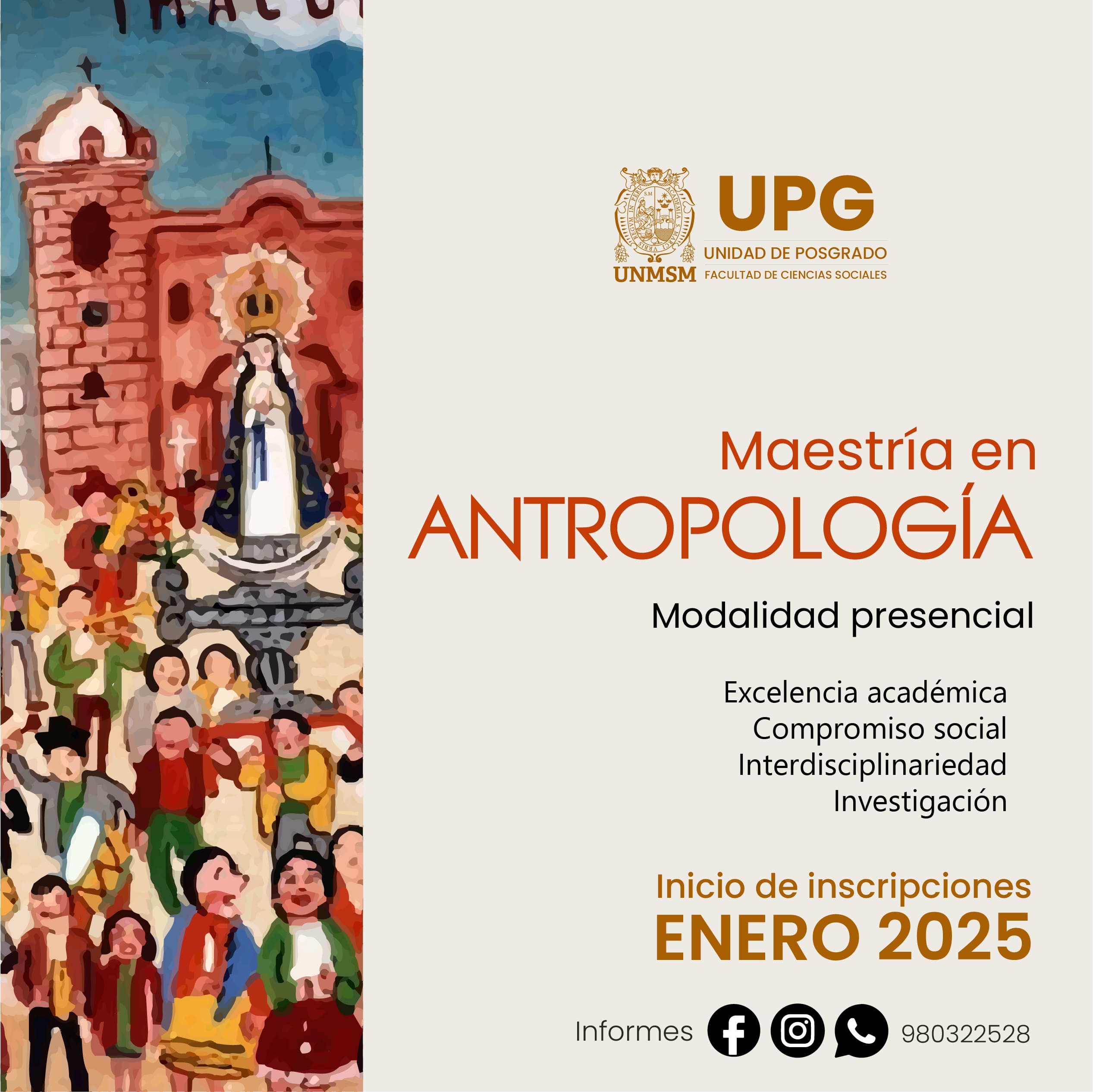
General Information
Director: Dr. Mercedes Giesecke Sara LaffoseTitle: Master's degree in Anthropology
Modality: In‑person
Duration: 2 years in the Making
Registration opens: 3/01/2025
Registration deadline: 20/03/2025
Email: [email protected]
Website: https://csociales.unmsm.edu.pe/maestria-en-antropologia/
Phone: (511) 6197000 extension: 4003
Academic program
To train in the disciplinary knowledge for the development of ethnographic anthropological studies, interdisciplinary research, proposal of public policies and social management, development projects and social promotion.
Develop skills and abilities: in dialogue, in performance in the ethnographic field for the generation and processing of field data, in the handling of qualitative research methodology, in carrying out pedagogy and social geography, in administrative managerial coordination and management.
To foster values and coexistence: to instill an ethical sense of equity and a commitment to achieving improvements within the vulnerable communities where they practice their profession. To implement conditions of full respect for legitimate demands for intercultural dialogue, and to promote a coherent and coordinated approach to gender equality.
Specialize students by selecting elective courses that delve deeper into aspects of professionalization.
Develop skills and abilities: in dialogue, in performance in the ethnographic field for the generation and processing of field data, in the handling of qualitative research methodology, in carrying out pedagogy and social geography, in administrative managerial coordination and management.
To foster values and coexistence: to instill an ethical sense of equity and a commitment to achieving improvements within the vulnerable communities where they practice their profession. To implement conditions of full respect for legitimate demands for intercultural dialogue, and to promote a coherent and coordinated approach to gender equality.
Specialize students by selecting elective courses that delve deeper into aspects of professionalization.
Develop historical and theoretical knowledge of classical and contemporary anthropology: Understand the main historical transformations that occurred during the colonial and post-colonial process of the Andes and Latin America.
The ethnographic treatment is addressed: It has an ethical performance as a specialist in the qualitative study of culture and society, with the ability to produce critical knowledge, with deep social sensitivity.
Develops skills and abilities to lead disciplinary and interdisciplinary academic research: applied to development projects and programs, as well as to public and social policies, according to their specialization, in health, education, territorial planning, cultural heritage, environment, among others.
The ethnographic treatment is addressed: It has an ethical performance as a specialist in the qualitative study of culture and society, with the ability to produce critical knowledge, with deep social sensitivity.
Develops skills and abilities to lead disciplinary and interdisciplinary academic research: applied to development projects and programs, as well as to public and social policies, according to their specialization, in health, education, territorial planning, cultural heritage, environment, among others.
• Bachelor's degree in the specialties of Social Sciences, Humanities or related Academic fields.
• Academic Certificates
• Knowledge of a foreign language that allows the reading of texts.
• Documented Curriculum Vitae
• Research Project (maximum 02 pages).
• Interview
* File evaluation
• Academic Certificates
• Knowledge of a foreign language that allows the reading of texts.
• Documented Curriculum Vitae
• Research Project (maximum 02 pages).
• Interview
* File evaluation

