
Political education and militant subjectivity
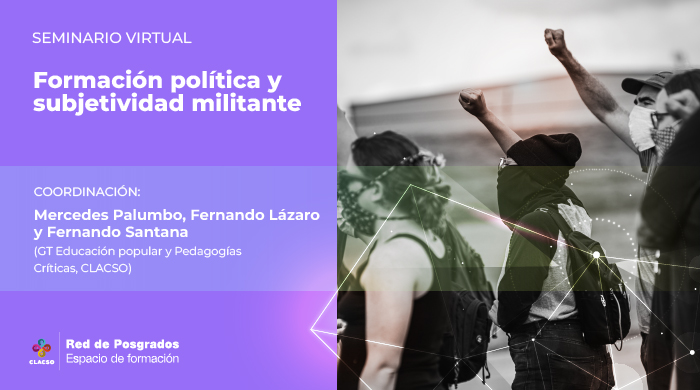
Seminar 2253
ChairCLACSO
Coordination: María Mercedes Palumbo, Fernando Darío Lázaro and Gerónimo Fernando Santana (GT Popular Education and Critical Pedagogies, CLACSO)
Teaching team: María Mercedes Palumbo, Estela Beatriz Quintar, Fernando Darío Lázaro, Gerónimo Fernando Santana, Oscar Jara, Alfonso Torres Carrillo (GT Popular Education and Critical Pedagogies, CLACSO)
Home: 07/09/2022 | Registration: 02/05/2022 to 06/09/2022
Workload: 12 weeks – 90 hours.
The seminar seeks to review, historicize and analyze different proposals for Political Education in Latin America and the Caribbean, in order to build theoretical, methodological, pedagogical and alternative lines that allow addressing the topic of training and the processes of shaping a militant subjectivity.
The collective political and social experiences unfolding across our continent have opened up fields for thought and action that require reflection, revisiting, and narration using categories that need reinventing. Understanding the processes taking place in the region allows us not only to open up a field of increasingly consolidated, multifaceted discourse, but also to delve into the specific meaning of political education in our current times: its objectives, its purpose, and especially, its real potential for shaping alternatives in the present and post-pandemic landscape. It is about fostering hope in resistance movements while simultaneously developing educational proposals with a real-world impact, allowing us to explore the challenges and potential of forming activist individuals.
This seminar aims to recognize and strengthen the diverse political education strategies being developed in Latin America and the Caribbean, and their impact on the processes of constructing subjectivities and militant subjectivities. Among these, Popular Education and Critical Pedagogies stand out as particularly relevant philosophical, political, ethical, and pedagogical perspectives. To this end, we propose some guiding questions: What do we mean when we talk about political education? How can political education processes impact the formation of militant subjectivities? Faced with the rise of the new right and the discourses of religious fundamentalism, what possibilities exist within popular movements, organizations, and social movements to generate critical thinking that can permeate the hegemonic common sense of the majority of the population? On the other hand, how is it possible to recover the militant experience of organizations and their histories of struggle in order to generate militant capital that enables the construction of counter-hegemonic processes and the prefiguration of other social relations? How does each of them generate and produce knowledge?
The notion of praxis is fundamental to understanding political and educational practices. Politics is a transformative praxis of reality. Thus, thinking about political education implies a deliberate action to shape activist subjects who can carry out transformative experiences, with the capacity to influence and modify the existing order.
But, although it is a practice inherent to our being human, with Freire we believe that politics also has an educability and for that very reason, it is central to deploy strategies that allow us to pedagogize and problematize it.
Throughout this seminar, different conceptual issues will be presented that will allow us to delve into the specificity of political formation, as well as the strengths and vicissitudes that the processes taking place within the processes that are already developing in this direction go through.
Recovering those stories, those networks of struggle, is also a commitment to reconstructing historically undervalued knowledge, and understanding that our own experiences contain knowledge that deserves to be systematized, recovered, and put into dialogue.
Popular Education, for its part, is understood in its polysemous nature, as it is not possible to attribute a single definition to it, since the diverse political, educational, and theoretical approaches that constitute it have resulted in different perspectives that depend on the social, cultural, and population contexts in which it is applied. Therefore, the concepts that define it require a certain malleability and capacity for contextualization, as they are intertwined with the mutations and transformations of the historical moment and the social and political movements that lead, accompany, and shape them in each social context. It is also undeniable that the starting point of any practice framed within it is the interpretation of the world in which that practice is situated; for this very reason, the interpretation of the context and the historical conditions in which these actions acquire meaning will be something to be considered throughout this Seminar.
Objective
- To enable reflection on the processes of political formation and their impact on the formation of political and militant subjectivities, with a view to understanding their conceptual, methodological and epistemic specificities, as well as their historical anchors and their contributions to the disputes over the public sphere in Latin America and the Caribbean.
Specific objectives
- Understanding the processes of Political Formation, in their specificity, that take place in Latin American and Caribbean territories.
- To recognize and complicate the view on the disputes over the public sphere, the construction of collective subjects and processes of political subjectivation that are currently developing in Latin America and the Caribbean.
- To generate tools for the critical and creative analysis of the problems of Latin America and the Caribbean, for the analysis of the local and the creation of training proposals for those territories where they have some point of anchorage.
- To strengthen the training of researchers, students, and civil society leaders with critical thinking skills who understand reality with others, through the development of exchange processes and academic debate, for the purpose of influencing social transformation.
- Political education in Latin America today: A critical reading of educational experiences.
- Political training from a popular education approach.
- Political education and theatre of the oppressed.
- Places and strategies of political training: practices, reflections and problems from Brazil.
- Social movements and political formation in Argentina.
- Political education from the perspective of Critical Pedagogy.
- Political training and popular education in Bolivia.
- Experiences of political self-education in Chile.
- The experience of political training at IPECAL (Mexico).
- Popular education and the formation of subjectivities.
- Alfieri, Ezequiel; Lázaro Fernando; Santana, Fernando; Zilbersztain, Andrea: Dora Barrancos School of Trainers. Working document prepared for the CLACSO Working Group on Popular Education and Critical Pedagogies.
- Arendt, Hannah (1966). Between Past and Future: Eight Exercises in Political Thought. Mexico: Peninsula.
- Boal, Julián (2014). Towards a political history of the theatre of the oppressed. Literature: theory, history, criticism. Volume 16, number 1, pp.41-79.
- Cabaluz, Fabián (2021). Crisis, popular revolt and pandemic: Contributions of Chilean teachers' organizations to constitute an emancipatory educational project (2019-2021). Momento Diálogos Em Educação, 30(01).
- Working document prepared for the CLACSO Working Group on Popular Education and Critical Pedagogies. Rebellato, José Luis (2010): Ethics, politics and liberating Popular Education (selection of texts) in: "José Luis Rebellato, radical intellectual", Eppal-Nordan-Extensión Udelar, Montevideo.
- Freire, Paulo (2001). “To change the face of school.” In: A education in the city. São Paulo: Cortez, p. 27-40.
- Freire, Paulo (2017). Teaching in a human specificity. In: Pedagogy of autonomy. Necessary knowledge for educational practice. Mexico: Siglo XXI, pp. 88-139.
- Gadotti, Moacir e Torres, Carlos Alberto (2001): “Paulo Freire, public administrator.” In: Freire, Paulo: A education in the city. São Paulo: Cortez, p. 11-20.
- García Linera, Álvaro (2016). "Indigenous Autonomies and the Multinational State." In: La Migraña Magazine, No. 20, La Paz, pp. 10-17. García Linera, Álvaro (2019). Hatred of the Indian. Caracas: MINCI Editions.
- Goldar, Maria Rosa (2008): Popular Education and Social Movements in the current context of Latin America and the Caribbean, in: “La Piragua”, CEAAL, n. 27, 2008.
- Federal Government (2014). “Apresentação”, “Chapter 3: Objectives of the Framework of Reference” and “Chapter 6: Principles and guidelines for the actions of popular education in public policies”. In: Popular Education Reference Framework for Public Policies. Brasília: SGPR, 2014, p. 5-6; 25; 49-53
- Guelman, Anahí and Palumbo, María Mercedes (2021). Notes on political formation in popular movements in Argentina. Working document prepared for the CLACSO Working Group on Popular Education and Critical Pedagogies.
- Huanca, Andrés (2021). "What fascism? Some preliminary notes: Cochabamba Youth Resistance and the takeover of the Departmental Legislative Assembly." In: Digital magazine ¡Bolivia de pié!, No. 3. Santa Cruz, pp. 45-61.
- IPECAL (2012). An experience of systematization. On political training in Latin America. Working document prepared for the CLACSO Working Group on Popular Education and Critical Pedagogies.
- Jara, Oscar (2018): Latin American Popular Education, history and ethical, political and pedagogical keys, CEP Alforja, CEAAL, Alboan, Intered. Jara, Oscar and Goldar, María Rosa (2021). Political formation from popular education: a strategic commitment of CEAAL in motion.
- Mayorga, Fernando (2020). "Political defeat of the MAS and oligarchic-seigneurial restoration." In: Mayorga, Fernando (coord.). Crisis and political change in Bolivia. October and November 2019: democracy at a crossroads. La Paz: CESU-UMSS/OXFAM in Bolivia, pp. 1-28.
- Naranjo, Carlos (1993). The Agony of Patriarchy. Barcelona: Editorial Káiros
- Ortega, Piedad and Villa, Jennifer. (2021). Critical pedagogy: insubordinate feelings from the feminist becoming. In: (thought), (word) and work, number 26.
- Palumbo, M. (2018). Knowing how to speak: building militant capital in popular movements in Argentina. ÍCONOS. Journal of Social Sciences (61), 179-202.
- Quintar, Estela (2005). In epistemic didactic dialogue. Voices and texts, Mexico.
- Reich, Wilheim (2008) The Biosocial Revolution. International Circle of Anti-Bolshevik Communists.
- Ricoeur, Paul (1993). Power, fragility and responsibility.
- Torres, Alfonso (2009). Collective action and subjectivity. A balance from social studies. In: Folios # 30, Colombia: pp.51-74.
- Torres, Alfonso (2015): Popular Education and Social Movements in Latin America, Biblos, Buenos Aires.
- Zemelman, Hugo (1992). Critical note. On historical blockage and utopia in Latin America. Sociological Studies, Volume X, number 30, pp. 809-817.
- Zemelman, Hugo (1994). Education in the constitution of subjects. In La Piragua, No. 5. Ceaal. Santiago de Chile.
- Zemelman, Hugo (2001). "History and rationality in social knowledge." In: From history to politics. The Latin American experience. Mexico: Editorial Siglo XXI/United Nations University, 2nd Edition, pp. 25-86.
- Zemelman, Hugo (2007). From History to Politics. The Experience of Latin America. Mexico: Siglo Veintiuno.
- Zemelman, Hugo (2007). From History to Politics: The Latin American Experience. Mexico: Siglo XXI-United Nations University.
- Zemelman, Hugo (2012). Video conference: history and autonomy in the subject.
|
|
Discount for one payment until 31/8 |
In one payment after 31/08 |
|
CM Plenos |
$75 |
$150 |
|
CM Associates |
$95 |
$190 |
|
No link |
$95 |
$190 |
FAQ
The basic requirements for taking a seminar are:
- Availability of at least 4 hours per week to dedicate to the seminar course.
- Internet access.
- Reasonable handling of communication and computer tools.
- Language proficiency in the language in which the course will be taught. The official languages are Spanish and Portuguese.
|
|
Discount for one payment until 31/8 |
In one payment after 31/08 |
|
CM Plenos |
$75 |
$150 |
|
CM Associates |
$95 |
$190 |
|
No link |
$95 |
$190 |
More information: [email protected]

