
FOLEC 2025 – Scientific evaluation: horizons, configurations and proposals
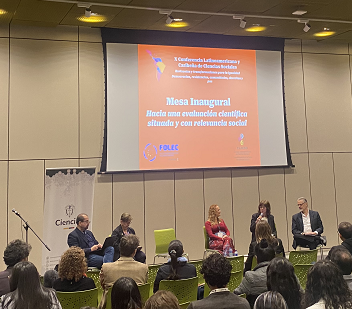
Within the framework of the X Latin American and Caribbean Conference on Social Sciences of CLACSO, the FOLEC Forum “Scientific Evaluation: Horizons, Configurations, and Proposals” was held on June 10 and 11, 2025. Organized by the Latin American Forum on Scientific Evaluation (FOLEC) together with the Working Groups “ Open Science as a Common Good ” and “ Mobile and Politicized Social Science ,” this forum brought together more than 60 panelists from Latin America, the Caribbean, and other regions of the world around a common objective: to collectively rethink academic and scientific evaluation systems from a situated, fair, and socially relevant perspective.
The Forum featured a diverse and robust agenda, including panels on institutional and national reforms in evaluation, experiences in engaging with non-academic stakeholders, methodological proposals for assessing the social impact of knowledge, and debates on regulatory frameworks for evaluation in the region. Experiences such as the AGORRA Observatory, the SILEU System , the FOLEC-CWTS-IDRC project on funding flows in the Global South ( Tracking Research Funding Flows in the Global South for More Transparent and Inclusive Science ), and the recently launched Postgraduate Diploma in Scientific and Academic Evaluation were presented, among others. The “Dominique Babini” Award , which recognizes innovative essays and experiences in open science, was also presented .
With the support of institutions such as Redalyc, DOAJ, CWTS (Leiden University), IDRC, SEGIB, and MINCIENCIAS Colombia, this event consolidated FOLEC as a key space for regional and international collaboration, promoting evaluative approaches that recognize epistemic diversity, open access, and the scientific sovereignty of our peoples. In this sense, the Forum not only highlighted concrete alternatives to the hegemonic evaluation paradigm but also opened a transformative horizon based on the creation of inclusive, contextualized public policies committed to the common good.
Scientific evaluation is neither neutral nor purely technical: it is a political tool that guides the production of scientific and technological knowledge. Therefore, at FOLEC-CLACSO, we reaffirm the importance of these forums for collectively designing new criteria, models, and meanings for academic evaluation in Latin America and the Caribbean. Because, as Mariátegui stated, it is not about imitating or copying, but about heroically creating from our own realities.

