
Financialization and development in the Global South
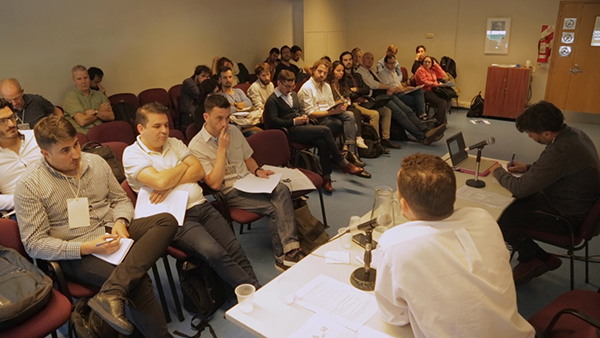
From November 26 to 28, 2019, the " Financialization and Development in the Global South " Congress was held at the Floreal Gorini Cultural Center in Buenos Aires. Among the participating academics who analyzed the situation for CLACSO TV were: Daniela Gabor from the University of the West of England (UWE-UK), Cédric Durand from the University of Paris 13/EHESS, France; Martín Burgos from the Floreal Gorini Cultural Center in Argentina; Raquel Rolnik from the University of São Paulo; and Rodrigo Fernández from the Centre for Research on Multinational Corporations (SOMO) in the Netherlands.
The congress proposed an interdisciplinary exchange between academics, politicians, and civil society organizations that study financialization in developing countries.
The study began by noting that, in recent years, research on the financialization process has proliferated across various disciplines, covering a growing range of topics. However, most research has focused on developed economies—initially in Anglo-Saxon countries, later expanding to Europe—where it has demonstrated how capitalism functions under the dominance of finance in countries with highly sophisticated financial and banking systems. The unequal nature of the finance-dominated regime, and in particular the subordinate integration of developing countries into global financial and monetary circuits, has received far less attention within financialization studies.
The growing power of global financial interests over developing economies manifests itself in many ways. For example, since the 2008 financial crisis, loose monetary policies in advanced economies have triggered a massive outflow of high-yield capital, resulting in unprecedented levels of public and private debt accumulation in developing economies. As the era of quantitative easing draws to a close, a shift in the direction of these flows from the periphery to the core threatens to recreate the dynamics that led to major debt crises in the past.
As the era of the Washington Consensus and its structural adjustment programs has ended, the World Bank has embarked on a major new project. Supported by the G20 and numerous other international organizations, this new project, called “Maximizing Finance for Development,” seeks to securitize infrastructure, health, and education projects to create new asset classes for institutional investors, enabling developing economies to access a share of global liquidity. This financialization mechanism, marketed with the slogan “from billions to trillions,” aims to facilitate the development, or at least the creation, of financial assets, opening up new opportunities for institutional investors.
If you would like to receive more information about CLACSO's training programs:
[widget id=”custom_html-57″]
to our email lists.

