
The end of the unipolar order: the case of Israel, Iran, and Palestine
By Martín Martinelli *
We foresee three axes of direct pressure and tension from the Empire: Israel, Ukraine, and Taiwan. All are zones of conflict against three Eurasian powers: Iran, Russia, and China. The first three are, in practice, US bases for provocation.
While for the major corporate media there is always a villain and a hero in the story – something to be nuanced – the truth is that many wonder where so much power in Israel comes from; the answer is the United States, its strategic partner.
Next year, 2023, marks the bicentenary of the Monroe Doctrine of 1823—America for the Americans—that is, for Our America. Meanwhile, the rest of the world, especially its people, has suffered under the oppressive military machine of that power since 1945. In the last thirty years, following the Soviet implosion, the United States has attempted to impose a unipolar world order through the Project for the New American Century (PNAC).
In 1999, NATO destroyed and dismembered Yugoslavia, right in Europe—a process of Balkanization, a classic case of "divide and conquer." However, in 2001, the Shanghai Cooperation Organisation (SCO), the China-Russia alliance so feared by the United States, emerged. Six months later, in an attempt to recolonize the region, they invaded Afghanistan (2001), Iraq (originally invaded in 1991 and now in 2003), and encircled Iran. The first two countries have suffered four decades—yes, four—of almost uninterrupted wars of various kinds in the heart of Eurasia (the Heartland).
Today we are witnessing a decline in US hegemony, which is not a short-term phenomenon but has been unfolding for several decades. This is evident in the percentage of global manufactured goods that has fallen from half to between 18 and 19% in seventy years. This decline is accompanied by the crisis in Europe, but above all by an Asianization of the economy, which has been shifting from the triad (the United States, Western Europe, and Japan) of collective imperialism to Southeast Asia, and exponentially to Eurasia.
The Shanghai Cooperation Organisation, the world's largest regional bloc, encompassing nearly half the global population and more than 30% of global GDP, recently convened. It comprises Russia, China, India, Pakistan, Kyrgyzstan, Uzbekistan, Tajikistan, and Kazakhstan, with Iran and Belarus soon to join. This group complements BRICS+ (Brazil, Russia, India, China, and South Africa), which is expected to be joined imminently by Argentina and Iran.
These organizations are integrated with other Eurasian entities such as the Regional Comprehensive Economic Partnership (RCEP, led by the Asian giant) and serve as a counterweight to the North Atlantic Treaty Organization (NATO, 1949-), which outlived its counterpart, the Warsaw Pact (1955-1991), as a military organization. NATO is currently expanding (30 countries) under the prerogatives of the Anglosphere, particularly the United States-United Kingdom-Israel axis. These are joined by close allies such as Japan, Canada, Australia, and South Korea, among others.
The small country within Israeli territory, in this geopolitical map, functions as an enclave—aside from colonizing and oppressing the Palestinians—of pressure on Iran. This is evident in the assassination of Qasem Soleimani and that of Mohsen Fakhrizadeh, one of the architects of Iran's nuclear program, who was killed by Israel's intelligence agency, Mossad. This was due to the mutual interference with the United States regarding the Iran nuclear deal, which is controlled by the five members of the UN Security Council: China, France, Russia, the US, and the UK, plus Germany. The US unilaterally withdrew from this agreement and is still negotiating with it.
We foresee three axes of direct pressure and tension—Israel, Ukraine, and Taiwan—on the three Eurasian powers: Iran, Russia, and China. The first three serve as US bases for provocation against the three Eurasian giants (India being the only one missing). Other axes are also being added, aligning with those established in the post-war period involving Japan, Germany, and Turkey. However, this is changing given Turkey's recent rapprochement with the SCO, as well as the meeting in Tehran, Iran, between Iranian President Raisi, Russian President Putin, and Turkish President Erdogan. Meanwhile, Ukraine has become a ticking time bomb for Europe itself, and particularly for Germany, whose industry is dependent on Russian gas.
Israel also possesses nuclear weapons and plays a co-imperial role with the United States, under the guise of German culpability for the Holocaust. This means that they, as a European population, suffered the criminality of the Nazi regime, in a lamentable context of between sixty and seventy million victims worldwide, with the greatest burden falling on the Soviets with more than 25 million souls lost.
Israel's growing influence and importance, despite its limited resources of gas, oil, population, and territory, both regionally and internationally, particularly in the Middle East and Africa, stems from its co-imperial role with the American superpower. This explains why its daily violence against Palestinians, Syrians, and Lebanese is concealed, despite these groups being the first to be colonized and the most affected by Israeli apartheid, a system denounced by global organizations such as B'Tselem, Human Rights Watch, United Nations agencies, and a large number of intellectuals who challenge the agenda of the mainstream media.
The Pentagon officially promises Israel a qualitative military advantage in the region. This is also evidenced by the number of military bases in the region, which have increased since 1991, as well as by the rise in US military interventions, which they themselves count at 250 worldwide, with a greater emphasis on the so-called "Greater Middle East." Israel functions as a strategic ally (similar to Saudi Arabia, but with shared cultural characteristics) of the United States due to the pro-Israel lobby and the nearly 7 million Israelis, who are comparable, on the one hand, to an equal number of Palestinians within the Israeli-Palestinian "borders" and, on the other hand, to an equal number of Jews in the United States. That decision-making power within the country with the highest military spending in the world, projected at more than 800 billion dollars (its counterpart is China lifting 800 million Chinese out of extreme poverty), is in an intertwined policy that marked the destruction of secular state powers such as Libya, Syria, Iraq, Afghanistan and Yemen, that oppresses Palestine, and that provokes Iran.
This latest instance of friction concerns us because it marks a turning point, given that these countries are allies of blocs that are now seen as antagonistic: one aligned with the United States, the other with Russia and China, the world's leading powers. But it brings us back to the issue of using countries as weapons of provocation. For an observer unfamiliar with the subject, the first thing that stands out is that a country of some 7 million people would attempt to challenge one with more than 80 million. This is striking, to say the least, and leads us once again to the question of which country is behind the geopolitical maneuvers of a nation that aspires to be European, even in sporting competitions, despite being located in a crucial area of the global system.
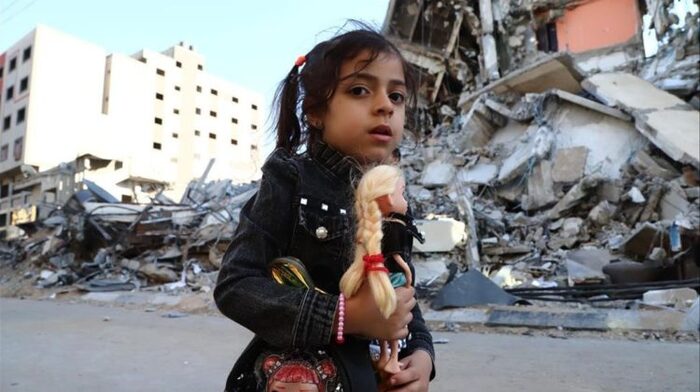
The army of that Mediterranean country is forging a strategy of domination and neo-imperialism in the region with the American giant, a crucial lever for exerting supremacy over the rest of the world and, even more so, over its hegemonic rivals. The victims are the millions of refugees, the dead, the devastating psychological consequences for families, and the destruction inflicted on every inhabitant of this region who resist but desperately need a reduction in the latent and constant violence that surrounds them.
* Martín Martinelli (Argentina). He holds a PhD in Social Sciences, is a Professor of History at the National University of Luján, and co-coordinator of the Al Zeytun Journal / CLACSO Special Group “Palestine and Latin America”.
Access the full article at: https://observatoriocrisis.com/2022/09/23/fin-del-orden-unipolar-el-caso-de-israel-iran-y-palestina/

