
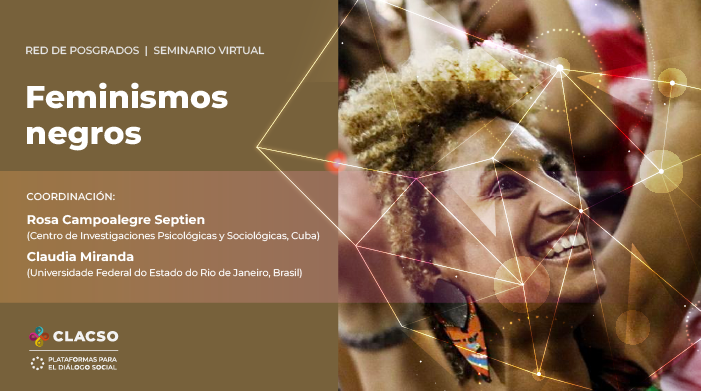
Black feminisms
Seminar 2337
Coordination: Rosa Campoalegre Septien (Center for Psychological and Sociological Research, Cuba) and Claudia Miranda (Federal University of the State of Rio de Janeiro, Brazil)
Home: 12 / 10 / 2023 | Registration: 19/07/2023 al 11/10/2023
Workload: 12 weeks – 90 hours.
This virtual seminar is being held within the context of the International Decade for People of African Descent, with the intention of going beyond it. Our seminar is part of a strategic project to develop a representative set of demands for academic and political training, which includes racialized women as interlocutors and direct agents of knowledge production.
Black feminisms constitute the foundation and raison d'être of the seminar. From this perspective, the teaching staff brings together Afro-feminist academic activists, members of the CLACSO Working Group “Afro-descendants and Counter-Hegemonic Proposals.” Rosa Campoalegre (Cuba) and Claudia Miranda (Brazil) will share this educational space. The seminar is distinguished by the voice of Black women, interpreting, narrating, and transforming their ancestral history and futures.
Among the main topics we will study are: an introduction to Black feminisms; the theoretical, methodological, and practical contributions of Black feminisms; the Black/Afro-descendant women's movement; the political platform of women leaders in the context of the Decade; the political, pedagogical, and spiritual dimensions of Afro-Brazilian women's activism; the "mothers of the saints" and the struggle for recognition in Brazil; the voices and silences of Afro-Cuban women; a comparative analysis of Brazil and Cuba; and concluding with an evaluation and closing remarks. We welcome you.
- Black feminisms as a process: the invisible emerges
- Theoretical and methodological contributions of Black feminisms
- The training and mobility perspective for Black women
- Black/Afro-descendant women's movement in Latin America and the Caribbean
- Political platform. Women leaders of Latin America and the Caribbean facing the International Decade for People of African Descent
- Political, pedagogical, and spiritual dimensions in Black feminisms
- The “mothers of the saint”: organizational dimensions and the struggle for recognition in Brazil
- Black/Afro-descendant women: voices and silences in resistance
- Epistemological disputes: research on networks of Black/Afro-descendant women
- Comparative analysis: Brazil, Colombia, Argentina and Cuba: looking from the perspective of Black feminisms
- Barriteau, VE (2011). “Contributions of black feminism to feminist thought: a Caribbean perspective in “ECOS Bulletin” (14) – March-May CIP- Ecosocial.
- Campoalegre, R. (2018). Black feminisms in a decolonial key: Approaches, tensions and futures from Cuba. Cubainforma: Bilbao.
- Campoalegre, R. Black women. Voices, silences and resistance: Once again about the Cuban experience. In A. Ocoró. and M. J, Alves Cordeiro. (Orgs.) Negritudes and Africanities in Latin America and the Caribbean. 2 (pp-72-88) Uberlandia, Brazil: Ribeirão Gráfica e Editora
- Campos, ZDP (2011). From Mãe de Santo to Mulher: Invenção e Reinvenção de Papéis. Mandragora, (17), pp. 17-37).
- Carneiro, Sueli. (2003). Blacken feminism.
- Castle, Lisa Earl. (2017). O Terreiro do Gantois: social networks and historical ethnography in the 19th century. rev. hist. (São Paulo), n.176, a05616, 2017
- Cavas, C. and Neto, MI (2017). A black diaspora: how women recreate through religion "imagined" Africa in the Brazil of all saints. Fazendo genre
- Collins, P.H. (2016). Learning with an outsider within: a sociological significance of black feminist thought. Society and State. 31 (1) January- April
- Collins, Patricia H. (2012). “Distinctive features of black feminist thought.” In Jabardo, M. (Ed.). Black feminisms. Anthology (pp. 209-243). Madrid, Spain: Traficante de sueños.
- Economic Commission for Latin America and the Caribbean. (2018). Afro-descendant women in Latin America and the Caribbean. Debts of equality. ECLAC: Santiago, Chile.
- Curiel, O. (n.d.). Decolonizing feminism: a perspective from Latin America and the Caribbean.
- Davis, A. (2016). Women, Race and Class (third ed.) Madrid: Akal Editions.
- García Savino, SB (2016). Organizations of Afro-descendant populations in Latin America. Santiago, Chile: ECLAC
- Lagardo, M. (ed). (2012). Introduction. Building bridges in dialogues with/from black feminism. In Jabardo, M. Black feminisms. Anthology. 27-57 Madrid, Spain: Traficante de sueños.
- Miranda, C. and Moreira NR (2019). Presentation. Thematic dossier: Teaching knowledge of black intellectuals: mediações extras versus the academic ethos. Práxis Educacional, 15, (32) p. 13-16, Apr./Jun. Bahia, Brazil: Vitória da Conquista.
- Miranda, C.. (2016) Afro-Brazilian intellectuals and their contributions for a feminist postcolonial critique.
- Neto, MID (2003). The door, the bridge and the network: reflections for thinking (the concept of network and the concept of community). In MID Neto and RM Pedro. Weaving development. Knowledge, gender, social ecology. Rio de Janeiro: Mauad Editora.
- Ocoró Loango, A. and Alves Cordeiro, M. (Orgs). (2018). Presentation. Black women, Blackness and Africanities in Latin America and the Caribbean. P 7-18 Uberlandia, Brazil.: Ribeirão Gráfica e Editora.
- Network of Afro-Latin American, Afro-Caribbean and Diaspora Women. (1995). Political platform of the leaders of Latin America and the Caribbean for the decade.
- SILVA, J. da. (2010). Black female teachers: what we call the official indicators. Perspective, 28, (1), pp
- Viveros, M. (2016). “Intersectionality: a situated approach to domination.” In Feminist Debate. Bogotá: National University of Colombia, pp. 1-17.
|
|
Discount for one payment until 05/10 |
In one payment after 05/10 |
|
CM Plenos |
$75 |
$150 |
|
CM Associates |
$95 |
$190 |
|
No link |
$95 |
$190 |
FAQ
The basic requirements for taking a seminar are:
- Availability of at least 4 hours per week to dedicate to the seminar course.
- Internet access.
- Reasonable handling of communication and computer tools.
- Language proficiency in the language in which the course will be taught. The official languages are Spanish and Portuguese.
A course consists of 10 classes, each accompanied by required reading bibliography, supplementary bibliography, discussion forums and training activities proposed by the teaching team, partial deliveries and a final project.
The course is online and asynchronous. Some instructors may propose synchronous activities. In those cases, the time and date will be agreed upon beforehand between the teaching team and the students to ensure everyone's participation.
To pass the seminar, you must participate in at least 80% of the discussion forums and activities proposed by the teachers, have completed the scheduled partial deliveries, and pass the final work.
|
|
Discount for one payment until 05/10 |
In one payment after 05/10 |
|
CM Plenos |
$75 |
$150 |
|
CM Associates |
$95 |
$190 |
|
No link |
$95 |
$190 |

