
Decolonial feminisms in Latin America and the Caribbean: critical theory, contemporary debates and situated readings
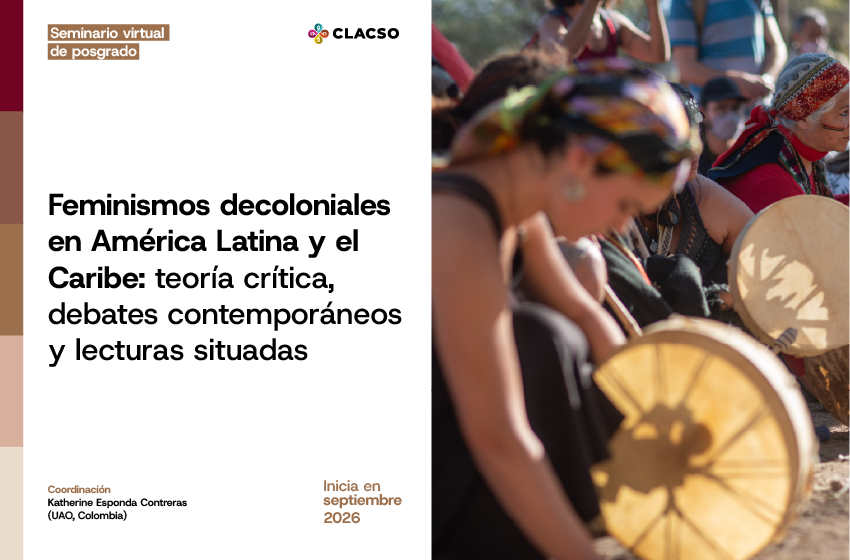
Seminar 2606
Coordination: Katherine Esponda Contreras (UAO, Colombia)
Teaching team: Elizabeth Gómez Etayo (UAO, Colombia) and Gleydis Martínez Alonso (UAO, Colombia)
Start date : 17/09/2026 | Registration : 5/06/2026 to 16/09/2026
Workload: 10 weeks – 90 hours.
This seminar proposes a critical and situated approach to decolonial and community feminisms in Latin America / Abya Yala, based on the analysis of the main theoretical contributions of the decolonial turn in gender studies and its articulation with contemporary problems of the Global South.
From a hermeneutic-philosophical perspective, the course examines central categories such as the coloniality of power, knowledge, and gender, modernity, race, body, community, and emancipation, engaging with key authors such as María Lugones, Silvia Rivera Cusicanqui, and Aníbal Quijano, among others. The seminar combines the rigorous study of theoretical texts with the analysis of thought-provoking case studies linked to current experiences, struggles, and debates within Latin American feminist movements, in order to understand how decolonial feminisms challenge hegemonic frameworks of knowledge, gender, and politics.
Aimed at a broad audience of students, researchers, teachers and activists, the course seeks to strengthen critical tools for the interpretation and production of situated knowledge, committed to social transformation in Latin America.
The development of decolonial and community feminisms in Latin America constitutes one of the most significant contributions of contemporary critical thought produced from the Global South. These approaches have radically challenged the universalist assumptions of hegemonic feminism, as well as the ways in which the coloniality of power, knowledge, and gender has historically structured social relations, epistemologies, and politics of emancipation in the region. In this sense, the decolonial turn in gender studies not only represents an expanding theoretical field, but also a political and epistemological intervention deeply linked to the struggles of feminist, community, and Indigenous movements in Abya Yala (the Americas).
There are several reasons that justify this proposal. First, there is a need to strengthen rigorous training programs that allow for a critical understanding of the theoretical foundations of decolonial feminisms, beyond their superficial or merely declarative use. Authors such as María Lugones, Silvia Rivera Cusicanqui, and Aníbal Quijano have developed key analytical categories for understanding the connections between colonialism, capitalism, racism, patriarchy, and modernity, which are essential for analyzing the structural inequalities that permeate contemporary Latin American societies. However, these contributions are often addressed in a fragmented or decontextualized manner in training programs, making a systematic and contextualized study of their arguments necessary.
Secondly, the seminar responds to the growing demand for interpretive frameworks that allow us to understand current problems in Latin America. Specifically, we could mention gender-based violence, territorial conflicts, disputes over the body and the reproduction of life, and tensions between the state, communities, and social movements; all from critical perspectives that recognize the centrality of colonial history and its enduring legacies. Decolonial feminisms offer conceptual and political tools to problematize these realities, articulating theory and practice based on situated experiences and knowledge.
Furthermore, this proposal combines a hermeneutic-philosophical approach with the analysis of contemporary, thought-provoking case studies, allowing participants not only to understand the concepts in their theoretical depth but also to engage them in dialogue with concrete contexts and experiences. This integration fosters critical, research-oriented training, capable of engaging graduate students, researchers, teachers, and activists interested in deepening their analytical tools.
The seminar is intended as a significant contribution to the contemporary debate on gender, coloniality and emancipation in Latin America, contributing to the production and circulation of knowledge committed to social transformation.
GENERAL PURPOSE:
To critically analyze the theoretical and epistemological contributions of decolonial and community feminisms in Latin America / Abya Yala, through a hermeneutic and situated approach, which allows understanding the relationships between coloniality, gender and power, as well as their relevance for the analysis of contemporary problems in the Global South.
SPECIFIC OBJECTIVES:
- To understand the conceptual foundations of the decolonial turn and its articulation with gender studies, based on the reading and discussion of key authors.
- To critically analyze central categories of decolonial feminisms (such as coloniality of gender, modernity/coloniality, body, community and emancipation) from a hermeneutic and contextualized perspective in Latin America.
- To problematize the tensions and debates between hegemonic feminisms and feminisms of the Global South, recognizing the political, epistemological and methodological implications of these disputes.
- Apply the theoretical frameworks worked on in the seminar to the analysis of contemporary cases linked to feminist struggles, practices and experiences in Latin America, integrating theory and context.
- Develop critical thinking and written argumentation skills that allow students to connect the seminar content with their own research interests, academic practice, or social activism.
- Coloniality, gender, and feminist critique of modern universalism
- The decolonial turn
- Decolonial feminist critiques of the Western concept of gender
- Intersectionality and coloniality of power
- Community and territorial feminisms in Abya Yala
- Community, reproduction of life and critique of colonial capitalism
- State, law and decolonial feminist critique
- Feminist and decolonial methodologies
- Lugones, M. (2008). Coloniality and gender. Tabula Rasa, (9), 73–101.
- Quijano, A. (2000). Coloniality of power, Eurocentrism and Latin America. In E. Lander (Ed.), The coloniality of knowledge: Eurocentrism and social sciences. Latin American perspectives (pp. 201–246). Buenos Aires: CLACSO.
- Mignolo, W. (2007). The idea of Latin America. The colonial wound and the decolonial option. Barcelona: Gedisa.
- Grosfoguel, R. (2013). Epistemic racism/sexism, westernized universities and the four genocides/epistemicides of the long 16th century. Tabula Rasa, (19), 31–58.
- Oyěwùmí, O. (2005). The invention of women. An African perspective on Western discourses of gender. Bogotá: Editorial En la Frontera.
- Lugones, M. (2011). Towards a decolonial feminism. La Manzana de la Discordia, 6(2), 105–119.
- Viveros Vigoya, M. (2016). Intersectionality: a situated approach to domination. Feminist Debate, 52, 1–17.
- Segato, RL (2018). Counter-pedagogies of cruelty. Buenos Aires: Prometeo Libros.
- Paredes, J. (2010). Weaving fine threads from community feminism. La Paz: Community Women Creating Community.
- Cabnal, L. (2015). Territorial community feminism from the body-land perspective. In Diverse Feminisms (pp. 123–136). Buenos Aires: CLACSO.
- Gutiérrez Aguilar, R. (2017). Community-popular horizons. Production of the common beyond state-centric policies. Madrid: Traficantes de Sueños.
- Federici, S. (2018). The Patriarchy of Wages: Feminist Critiques of Marxism. Madrid: Traficantes de Sueños.
- Curiel, O. (2014). Building feminist methodologies from decolonial feminism. Other Perspectives, 14(1), 45–59.
- Segato, RL (2014). The new forms of war and the women's body. Puebla: Tinta Limón.
- Smith, L. T. (2016). Decolonizing methodologies: Research and Indigenous peoples (2nd ed.). London: Zed Books.
- Harding, S. (1996). Science and feminism. Madrid: Morata Editions.
- Segato, RL (2013). Writing on the bodies of murdered women in Ciudad Juárez. Buenos Aires: Tinta Limón.
- Falquet, J. (2017). Pax neoliberalia. Feminist perspectives on (the reorganization of) violence. Buenos Aires: Madreselva.
- Walsh, C. (2018). Decolonial Pedagogies: Insurgent Practices of Resisting, (Re)existing and (Re)living. Quito: Abya-Yala Editions.
- Rivera Cusicanqui, S. (2010). Ch'ixinakax utxiwa: a reflection on decolonizing practices and discourses. Buenos Aires: Tinta Limón.
| Early registration (until 10/08) | General registration (11/08 to 10/09) | Registration without discount (11/09 to 16/09) | |
| Full or Associate Member Center | $100 | USD 150 | $200 |
| No link | $150 | USD 225 | $300 |
FAQ
The basic requirements for taking a seminar are:
- Availability of at least 4 hours per week to dedicate to the seminar course.
- Internet access.
- Reasonable handling of communication and computer tools.
- Language proficiency in the language in which the course will be taught. The official languages are Spanish and Portuguese.
The seminars last 10 weeks, plus the completion of a final project. A total of 90 hours of dedication will be credited.
A course consists of ten classes, each accompanied by required reading bibliography, supplementary bibliography, discussion forums and training activities proposed by the teaching team, partial deliveries and a final project.
The course is online and asynchronous. Some instructors may propose synchronous activities. In those cases, the time and date will be agreed upon beforehand between the instructors and the students to ensure everyone's participation. Attendance at synchronous sessions is not mandatory.
To pass the seminar, you must participate in at least 80% of the discussion forums and activities proposed by the teachers, have completed the scheduled partial deliveries, and pass the final work.
| Early registration (until 10/08) | General registration (11/08 to 10/09) | Registration without discount (11/09 to 16/09) | |
| Full or Associate Member Center | $100 | USD 150 | $200 |
| No link | $150 | USD 225 | $300 |
The possible payment methods are by credit card or bank transfer.
Inquiries: [email protected]

