
Feminism and the environment
At the InfoCLACSO on May 26, 2021, Cecilia Alemany, Deputy Regional Director at UN Women, participated from Montevideo, Uruguay, to announce the winning proposals of the call launched together with CLACSO on “Feminism and the environment”.
Interviewed by Gustavo Lema
The relationship between women's rights and the rights of nature has been analyzed for some years now, both in academia and among activists. Thus, violations of women's rights and the rights of nature have been linked as intertwined processes. More recently, analytical production focused on climate change and its impact on communities and the lives of women in particular has increased, although it does not always connect with the historical knowledge of the practices and philosophies of Indigenous women's groups in the region.
While progress in this field has yielded several milestones in publications and conferences worldwide, it remains an underdeveloped topic in Latin America and the Caribbean. One of its branches is the current known as ecofeminism, both a line of thought and a social movement, which proposes to articulate environmentalism and feminism.
Indeed, ecofeminism is a theory and a social movement that posits the existence of profound links between the subordination of women and the extractive and destructive exploitation of nature. Its objective is to defend and expand women's rights and transform the human relationship with other living beings and ecosystems.
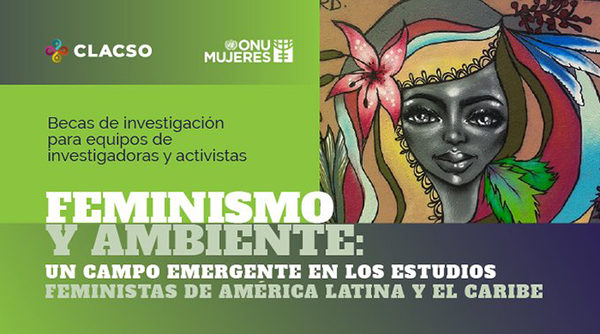
Assuming that ecofeminism is one of the possible currents in this field, that it does not exhaust it, and that these issues are still under-researched and underdeveloped in Latin America and the Caribbean, the Latin American Council of Social Sciences and UN Women launched a call for mixed teams, made up of researchers and social activists, to carry out one of the following lines of research and analysis:
• To develop a state of the art from a critical analytical perspective that highlights Latin American and Caribbean production in dialogue with the world.
• Develop a state of the art from a critical analytical perspective that highlights the practice of grassroots feminist organizations linked to the environment, use of resources, good living, sustainable development, climate change, etc.
• To develop a mapping of feminist organizations linked to the environment, resource use, good living, sustainable development and climate change in Latin America and the Caribbean.
View results of the call for applications
If you would like to receive more information about CLACSO's training programs:
[widget id=”custom_html-57″]
to our email lists.

