
Critical outreach in times of social emergency. Participatory and collaborative construction of viable new solutions.
CLACSO Working Group
Critical Extension: Theories and Practices in Latin America and the Caribbean
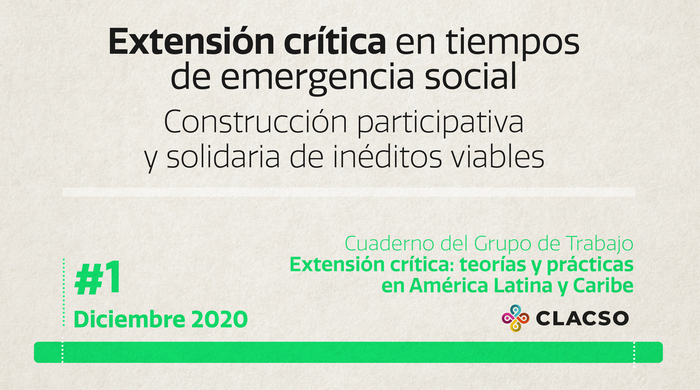
The CLACSO Working Group on Critical Extension: Theories and Practices in Latin America and the Caribbean presents the launch of Working Paper #1 “Critical Extension in Times of Social Emergency: Participatory and Solidarity-Based Construction of Viable New Projects”.
In the first quarter of 2020, all universities in the Latin American and Caribbean region experienced an unforeseen situation of suspension of face-to-face academic and administrative activities in view of the confinement, social distancing, social and preventive isolation measures, according to each country, due to the coronavirus.
In this context, there was a reorientation of the objectives of many of these activities, in response to the pandemic and its effects, which combined face-to-face modalities with virtual and remote work, as well as continuing education activities and scientific and cultural dissemination, which demonstrated the support provided by the universities.
In May 2020, the CLACSO Working Group on Critical Extension: Theories and Practices in Latin America and the Caribbean, through its coordinating team, undertook an exploration of extension, outreach, social action, and community engagement activities. This report represents the contribution of 36 active members of the CLACSO Working Group on Critical Extension and various collaborators who gathered data from different academic units, secretariats, and extension projects at 26 Latin American universities between May and July 2020.
The Working Group on Critical Extension: Theories and Practices in Latin America and the Caribbean highlighted these actions as they were the product of the effort, creativity, commitment, and collaboration of university teams in alliance with social actors, including municipal councils, grassroots social organizations, movements and collectives, volunteer groups, non-governmental organizations, cooperation agencies, and others who responded promptly with research, extension, and training activities, political advocacy, and direct support, as well as volunteering and humanitarian assistance in the face of the crisis, especially in the health system.
If you would like to receive more information about CLACSO's training programs:
[widget id=”custom_html-57″]
to our email lists.

