
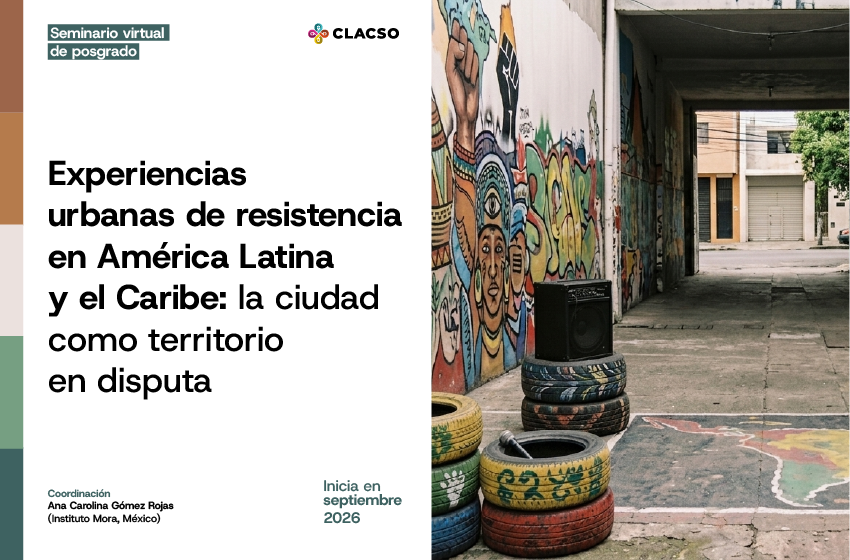
Urban experiences of resistance in Latin America and the Caribbean: the city as a disputed territory
Seminar 2609
Coordination: Ana Carolina Gómez Rojas (Mora Institute, Mexico)
Teaching team: Ana Carolina Gómez Rojas (Instituto Mora, Mexico) and Juan Sebastián Granada-Cardona (UNAM, Mexico)
Start date : 17/09/2026 | Registration : 5/06/2026 to 16/09/2026
Workload: 10 weeks – 90 hours.
The contemporary Latin American city is a contested space between transnational capital and communities that resist through self-management and collective action (Zibechi, 2015), within the context of neoliberal urbanism that deepens dispossession. In response to these logics of dispossession, urban micro-resistances emerge, understood as counter-hegemonic everyday practices that produce alternative geographies of citizenship (Sequera & Mateos, 2014). This seminar proposes a critical theoretical and methodological approach to urban territoriality, articulating the contributions of social anarchism and urban ecofeminisms to analyze resistance at different scales. Through case studies situated in Mexico, Argentina, and Colombia, concrete experiences of community self-management and the defense of urban territory will be examined in order to reflect on alternatives to neoliberal urbanism.
Latin America faces a profound urban crisis, marked by land dispossession, real estate speculation, and social exclusion. In the region's metropolises, neoliberal urban planning policies prioritize capital accumulation over the common good, reducing the city to a commodity. This translates into phenomena such as gentrification, the displacement of vulnerable populations, and the commodification of public space. In this context, the city becomes a field of constant struggle between commodification projects and popular aspirations for spatial justice.
Faced with these processes of urban dispossession, multiple forms of community resistance are emerging, defending the right to the city and a dignified habitat. Across the continent, neighborhoods and collectives are articulating collective responses that challenge the hegemony of neoliberal urbanism. These struggles redefine the principle of the right to the city as formulated by Lefebvre (1968) and Harvey (2012), understanding it as the collective right of the majority to transform urban life for the common good, not for profit. Analyzing urban resistance is relevant because it makes these struggles visible and provides insights for imagining alternatives to the growing inequality in cities.
The anarchist perspective offers a radical critique of power and a proposal for horizontal organization. Concepts such as self-management, mutual aid, and direct action provide a lens through which to understand autonomous urban experiences, such as neighborhood assemblies or occupations of vacant land, which build alternatives from below to the market logic of urban development.
Urban ecofeminisms, for their part, offer an integrative framework that links social and environmental justice. Women have assumed a leading role in the defense of urban territories and common goods, articulating struggles against patriarchal violence and ecological devastation (Svampa, 2021). This perspective demonstrates that the dynamics of urban dispossession affect women and vulnerable groups differently, while also highlighting the centrality of care, the reproduction of life, and respect for the environment in city planning. The ecofeminist perspective allows us to understand cities not only as economic spaces, but also as social ecosystems in which the sustenance of life is paramount.
Finally, multi-scalar methodologies are needed to address the complexity of the Latin American urban phenomenon. Analyzing cases such as those in Mexico, Argentina, and Colombia allows us to identify regional patterns of neoliberalization of the city, as well as the specific characteristics of local resistance. Likewise, a multi-scalar perspective helps us understand how global forces influence local urban dynamics, and how grassroots resistance movements are articulated in broader networks, scaling from the neighborhood to the national and even transnational levels.
GENERAL PURPOSE:
To critically analyze the Latin American city as a contested space in the context of neoliberal urbanism, articulating the theoretical and methodological perspectives of urban ecofeminism and anarchism through the comparative study of cases (Mexico, Argentina and Colombia), in order to contribute to the development of new interpretive frameworks and intervention tools oriented towards urban justice.
SPECIFIC OBJECTIVES:
- Examining the processes of neoliberalization in Latin American cities and their effects (dispossession, segregation, socio-environmental degradation), identifying the dynamics of conflict and exclusion in specific urban contexts.
- Analyze urban micro-resistance experiences inspired by anarchism and ecofeminism in Mexico, Argentina, and Colombia, highlighting their strategies of self-management, community care, and defense of the territory.
- To provide conceptual tools to understand urban territoriality and the different scales of resistance (from the neighborhood to the global), integrating notions such as the right to the city, common goods, autonomy and sustainability.
- To design a multi-scale and comparative research methodological proposal that links the analysis of everyday resistance practices with the understanding of structural processes, providing criteria for applied research and the formulation of alternative urban policies.
- The city as a territory of dispute
- Buenos Aires case: women from popular sectors
- Autonomy and anarchism
- Case study: Mexico City: La Pirámide Cultural Center
- Urban ecofeminisms, care and the city
- Bogotá case: La Totuma collective
- Resistance scales
- Bogotá case study: proposal for a self-managed museum
- Balance sheets, contemporary disputes, and future scenarios
- Harvey, David (2013) “Reclaiming the city for the anti-capitalist struggle” in Rebel Cities. From the right to the city to the urban revolution. Spain: Akal. Pages 171-223.
- Theodore, N., Peck, J., and Brenner, N. (2009). Neoliberal urbanism: the city and the empire of markets. Social Issues (66), 1-11.
- Pacífico, Florencia. (2026) Politicizing the home: women from popular sectors, collective organization processes and state programs in Greater Buenos Aires. Prometeo. Buenos Aires.
- Graeber, David (2011) Fragments of an Anarchist Anthropology. Ed. Virus. Barcelona.
- Méndez, N., & Vallota, A. (2001). Anarchism: A utopia that is reborn. Utopia and Praxis Latinoamericana, 6(15), 9–29.
- Montero, MC (2021). Culture, identity and resistance: Elements for a debate on the role of cultural management in the construction of community identity. Palimpsesto, 11(19), 203–212.
- Bayas, B. and Bregolati, J. (2021) Ecofeminist proposals to rethink cities. Paths towards the public and the community. Barcelona: Observatori del Deute en la Globalització.
- Valdivia, Blanca. "From androcentric urbanism to the caring city." Habitat and Society, no. 11, November 2018, pp. 65-84
- Pérez, P. & Gregorio, C. (2020). The right to the city from feminist ethnography: politicizing emotions and resistance in urban space. INVI Journal, 35(99), 1-33.
- Martí Comas, Julia (2025) "Combining temporal and spatial scales". Ecofeminist degrowth. Slowing down to recover life. ODG. Barcelona.
- González Ayala, Sofía, Wilson Duván Güiza, and Daniel Clavijo Tavera. "Tensions, Encounters and Desires". In Yes There Is a House for So Many People: Collective Reflections from and on the Museum of the Self-Built City, Ciudad Bolívar. District Institute of Cultural Heritage, 2023. pp, 122-140.
| Early registration (until 10/08) | General registration (11/08 to 10/09) | Registration without discount (11/09 to 16/09) | |
| Full or Associate Member Center | $100 | USD 150 | $200 |
| No link | $150 | USD 225 | $300 |
FAQ
The basic requirements for taking a seminar are:
- Availability of at least 4 hours per week to dedicate to the seminar course.
- Internet access.
- Reasonable handling of communication and computer tools.
- Language proficiency in the language in which the course will be taught. The official languages are Spanish and Portuguese.
The seminars last 10 weeks, plus the completion of a final project. A total of 90 hours of dedication will be credited.
A course consists of ten classes, each accompanied by required reading bibliography, supplementary bibliography, discussion forums and training activities proposed by the teaching team, partial deliveries and a final project.
The course is online and asynchronous. Some instructors may propose synchronous activities. In those cases, the time and date will be agreed upon beforehand between the instructors and the students to ensure everyone's participation. Attendance at synchronous sessions is not mandatory.
To pass the seminar, you must participate in at least 80% of the discussion forums and activities proposed by the teachers, have completed the scheduled partial deliveries, and pass the final work.
| Early registration (until 10/08) | General registration (11/08 to 10/09) | Registration without discount (11/09 to 16/09) | |
| Full or Associate Member Center | $100 | USD 150 | $200 |
| No link | $150 | USD 225 | $300 |
The possible payment methods are by credit card or bank transfer.
Inquiries: [email protected]

