
Decolonial aesthetics from the South. Art, memories and body
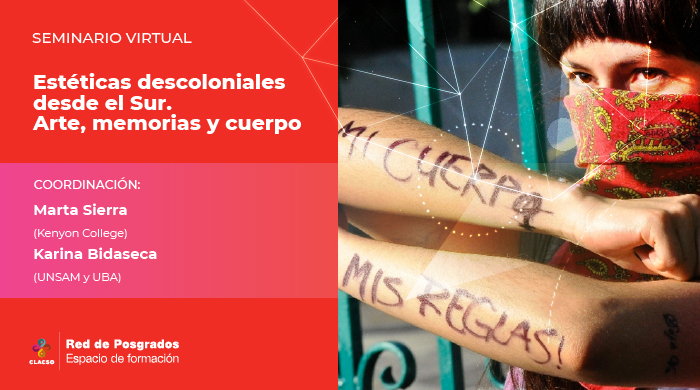
Seminar 2220
Chair : CLACSO
COORDINATION: Marta Sierra (Kenyon College) and Karina Bidaseca (UNSAM/UBA)
TEACHING TEAM: Karina Bidaseca (UNSAM/UBA) Marta Sierra (Kenyon College) Lucía Lodwick Nuñez (UNSAM)
HomeApril 22, 2022 | Registration: 21/12/2021 to 21/04/2022
Workload: 12 weeks – 90 hours.
Coloniality is an open wound etched on bodies as an indelible mark. Our proposal is that a situated and liberating aesthetic, such as that practiced by the artists considered here, allows us to break with the legacy of victimization and violence. The so-called “decolonial turn” stems from a Latin American genealogy that resonates not only in the classic studies of Aníbal Quijano and the coloniality-modernity group. In this course, we engage this paradigm in dialogue with other writings that also reflect on the importance of a situated and liberating aesthetic. From the Caribbean, we draw on the profound reflections on race and coloniality by Frantz Fanon, Aimé Césaire, and Édouard Glissant. From North American feminists of color, we examine the theories of Audré Lorde, Angela Davis, and Chicana feminists such as Gloria Anzaldúa and Cherríe Moraga. We also incorporate the important theoretical work of Islamic feminisms by Fatima Mernissi, Richa Nagar, Leila Ahmed, and Salma Mahmood. From Latin American feminist criticism, we draw on the theories developed by Rita Segato and María Lugones, as well as those of authors who have written about femicide, Indigenous Latin American feminisms, and urban feminist movements of the last ten years. The course's greatest contribution is exposing students to a broad network of theorists who construct diverse interpretations of situated thought on the coloniality of power. Based on this, students will examine critical theories of decolonial aesthetics and how they apply to the work of artists such as Ana Mendieta, Zanele Muholi, Regina José Galindo, Shirin Neshat, Fatima Mernissi, Teresa Margolles, Adriana Varejao, Joyce Kozlof, and Mona Hatoum, among others.
- Decolonial Feminist Aesthetics of Latin America and the Caribbean and the Middle East
- Skin and the Colonial Scar: The Tearing Apart (Singalit Landau and Emily Jacir)
- Poetics (erotics) of the Relationship. Tropic-Ana (Ana Mendieta)
- Queer art and aesthetics situated in South Africa (Zanele Muholi)
- Art and Performance: Regina José Galindo and Astrid Hadad Prof. Marta Sierra
- Necropolitics: The Subtle Art of Disappearance (Teresa Margolles and Graciela Sacco)
- Corpographies: Decolonizing the Map (Adriana Varejao and Lygia Clark)
- Orientalism and feminism in the visual aesthetics of the Iranian artist (Shirin Neshat)
- Mona Hatoum: Geographies in Fugue
- Geographies in flight. Other unappropriable ones (Trin T. Minha-ha)
- --- Bodies That Matter: On the Material and Discursive Limits of “Sex”. Translated by Alcira Bixio. Barcelona: Paidós, 2002. Chapter 4.
- Stand up, Gaston. A show Not Suitable for Mochos: Astrid Hadad and her Tarzans. Chasqui, 29.1 (2000): 3-18.
- Ana Gabriela Vilela Pereira de Macedo. “Mona Hatoum's narratives have the effect of 'contraponto': de-emoldurando odomestico as performativity and political gesture” Etudos Feministas. 2019 (27.1).
- Banwell, Julia. “Agency and Otherness in Teresa Margolles' Aesthetic of Death.” Other modernities, 4.10 (2010): 45-54.
- Bidaseca, Karina (2018) The Revolution Will Be Feminist or It Will Not Be. The Skin of Decolonial Feminist Art (Prometeo). Chapter 6. Women of Allah. Art in Exile. Shirin Neshat
- Bidaseca, Karina (2019) “The ‘Doors of No Return’ in Africa: Decolonial Performativity and Feminist Aesthetics in the Afro-Transatlantic Memories of Ana Mendieta and Édouard Glissant.” In Campoalegre Septien, Rosa and Anny Ocoró Loango (eds.) Afro-descendants and Counter-Hegemonies: Challenging the Decade. CLACSO/CIPS. http://biblioteca.clacso.edu.ar/clacso/posgrados/20191018124924/Afrodescendencias.pdf
- Bidaseca, Karina (2020) “Hail (Dark) Lioness”. In Bidaseca, Karina (2020) Towards an Erotic Poetics of Relationship. In press
- Campiglia, Maria. “Teresa Margolles. Reiterar la violencia.” Barcelona: Barcelona Research Art Creation, 2014. No page numbers.
- Cejudo-Escamilla, Sonia. The performative body of Regina José Galindo. Mexico: Revista Liminar 1 (2019): 158-167.
- Dieguez Caballero, Ileana. “Poetic incarnations. Body, art and necropolitics.” Athenea Digital, 18.1 (2018): 203-219.
- Estévez, Ariadna. Biopolitics and necropolitics, constitutive or opposite? Mexico: Espiral, XXV. 73 (2018). 9-43.
- Fanon, Frantz (1952) Black Skin, White Masks. Madrid: AKAL.
- Film. Reassemblage. 1983
- Giunta, Andrea. “Art, Memory and Human Rights in Argentina.” Artelogie, 6 (2014) no pages.
- Giunta, Andrea. Writing the Images. Essays on Argentine and Latin American Art. Buenos Aires: Siglo XXI, 2011.
- Griselda Pollock. Differentiating the Canon. Female Desire and Writing Art Stories. London and NYC: Verso, 1992.
- Jacques Ranciere. The Emancipated Spectator. Buenos Aires: Bordes Manantial, 2010.
- Judith Butler. Undoing Gender. Translated by Patricia Soley-Beltrán. Barcelona: Paidós, 2007. Chapters 1 and 2.
- Lina Meruane. Becoming Palestine. Michel Foucault. “The Eye of Power”. The Impossible Prison. A Foucault Reader. No publication information.
- Lorde, Audre. “Uses of the Erotic: The Erotic as Power.” In Sister Outsider: Essays and Speeches. Ten Speed Press, 1984.
- Mbembe, Achille. Necropolitics. Translation and editing by Elisabeth Falomir Archambault. Spain: Melusina, 2011.
- Saadi Ahmad and Lila Abu-Lughod Nakba, Palestine, 1948 and the Claims of Memory. CLACSO: 2018. Chapter: The Rape of Qula, a Destroyed Palestinian Village. Susan Slymovis.
- Sierra, Marta and Karina Bidaseca (2020) “Introduction”. In Bidaseca, K. and Sierra, M. Common Traces: Decolonial Feminist Aesthetics of Latin America and the Middle East. In press.
- Spivak, Gayatri. (1988) Can the subaltern speak? Orbis Tertius 6 (6).
- Sterling, Susan Fisher. “Virgin Territory.” Virgin Territory: Women, Gender and History in Contemporary Brazilian Art. 20-33
- Suely Rolnik. Sentimental Cartography. Sao Paulo: Estacao Libertades, 1989. (Chapters 7, 8 and 9).
- Suely Rolnik. The Knowing-Body Compass in Curatorial Practices. 2007 Theater (47.1): 116-136. 10
- Taylor, Diana. Performance. Buenos Aires, Argentina: Asunto Impreso Ediciones, 2012.
- Trinh Minha-ha (1986). She, The Inappropriate Other, Discourse 8.
- Varejão, Adriana. Adriana Varejão. Ed. Louise Neri. Sao Paulo: O Author, 2001.
- Yassine Chouati. “Leaving to tell: Mona Hatoum, Art and sociopolitical denunciation.” Estúdio (Universidade de Lisboa) 2017 (19): 88
|
|
Discount for one payment until 16/03 |
In one payment after 16/03 |
|
CM Plenos |
$75 |
$150 |
|
CM Associates |
$95 |
$190 |
|
No link |
$95 |
$190 |
FAQ
The basic requirements for taking a seminar are:
- Availability of at least 4 hours per week to dedicate to the seminar course.
- Internet access.
- Reasonable handling of communication and computer tools.
- Language proficiency in the language in which the course will be taught. The official languages are Spanish and Portuguese.
|
|
Discount for one payment until 16/03 |
In one payment after 16/03 |
|
CM Plenos |
$75 |
$150 |
|
CM Associates |
$95 |
$190 |
|
No link |
$95 |
$190 |
More information: [email protected]

