
Social unrest in Colombia: some clues from behind the scenes
Sandra Carolina Bautista[1]
On Wednesday, May 12, River Plate faced Atlético Junior in Barranquilla, Colombia, in the group stage of the Copa Libertadores. Before an empty stadium due to the third wave of the pandemic, but with a live broadcast across the continent, the match ended in a 1-1 draw amidst loud noises, shouts, and tear gas that drifted from the stadium's vicinity onto the pitch. Meanwhile, outside, 70 protesters were injured by the police—young people who refused to allow football to be used as a smokescreen, a showcase to conceal the repressive response of Iván Duque's government to the righteous anger sweeping Colombia. This anger has taken shape in the National Strike, initially motivated by a regressive tax reform. The scene of repression and football was repeated the following night in the América de Cali-Atlético Mineiro match, also held in Barranquilla, far from Cali and the Pascual Guerrero Stadium, América's traditional home ground, located in what is now the most militarized city in the country.
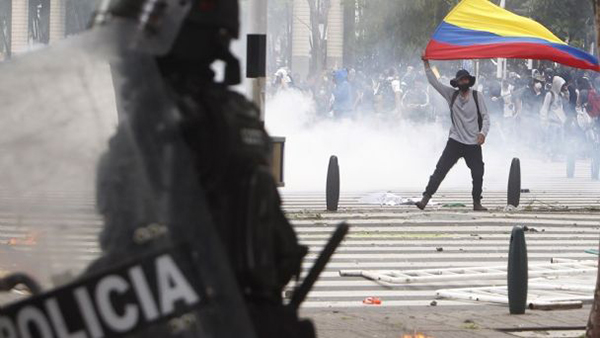
The residents of Cali's working-class neighborhoods, home to the most passionate football fan bases, have not only been deprived of enjoying the games of one of their beloved teams—which is certainly the least of their worries today. Over the past two weeks, state violence has literally robbed them of sleep, with constant helicopter overflights by the Army, the military and media siege they have been subjected to, and the excessive and brutal deployment of the Mobile Anti-Disturbance Squadron (ESMAD) of the National Police, which has violated all national and international protocols by indiscriminately attacking peaceful and festive gatherings of protesters.
This is a defined modus operandi that operates during the day and intensifies at night: cutting off streetlights, creating chaos by burning banks, hotels, and other public and private establishments, unleashing excessive violence, making people disappear, and sowing terror with the use of firearms, sexual assaults, and rapes of women. The ESMAD (Mobile Anti-Disturbance Squadron) has also turned its sophisticated arsenal of less-lethal weapons against homes, filling them with suffocating smoke that has already claimed the lives of several children. As if this were not enough, paramilitary hit squads have also appeared in high-end SUVs, firing on protesters, the Indigenous Guard, a human rights organization that came to Cali to protect the demonstrators, the medical mission, and human rights organizations, including one with UN delegates, even in the presence of police. As a result, the courageous Cali that has raised its voice against poverty, unemployment, the precariousness of social rights, racism and discrimination is searching for almost a hundred missing persons, and mourns more than 40 young people who have died under these forms of state violence.
It is surprising, both nationally and internationally, that Cali became the epicenter of the protests and the state's military deployment during the first few weeks of the National Strike. It is the country's third largest city, located in the southwest near the Pacific coast and Buenaventura, Colombia's main seaport. This has placed it at the heart of a region favored for the spread of armed conflict over the last fifteen years, fueled by national and international drug trafficking groups such as the Sinaloa Cartel, in association with various state-sponsored paramilitary organizations, especially since the FARC-EP guerrillas laid down their arms. Consequently, it is the main destination for displaced people from southwestern Colombia. It is a modern but drug-ridden city, where enormous flows of illicit money intertwine with the wealth generated by sugarcane plantations and the sugar and soft drink company, the largest of its kind in Latin America. Landowners, the agro-industrial bourgeoisie, and the drug trade have held the reins of Cali for the past few decades.
Conversely, this prosperity has become a privilege for the few, even more so in the context of the pandemic and lockdowns. According to the most recent official report, in the last year Cali has become the second city with the highest poverty rate (36.3%), while unemployment, at 19,3%, surpasses the national rate of 15,4% in April. For the population between 14 and 28 years old, the situation is worse, as local youth unemployment reaches 26% in a context of high school dropout rates and precarious access to the internet or laptops. Cali's youth face this stark impoverishment in a city with high levels of socioeconomic segregation, where luxurious condominiums and residential complexes coexist with neighborhoods lacking running water and where eating three meals a day is a luxury. In fact, during the current mobilization and amidst the community kitchens from which resistance is also being waged, it is common to hear young people...[2] to say: “I also come to the strike because I have eaten better here than at home.”
These events explain some of the demands outlined in the petitions drawn up by young people organized in various neighborhood collectives, as well as by the "First Line," a formation initially seen in the Chilean protests dedicated to defending popular mobilizations against police aggression with nothing but their spirit, their bodies, homemade shields, and stones. The demands of the group of protesters responsible for the most deaths in this confrontation are led by calls for employment, access to education, recreation, and reform of the health and pension systems, accompanied by guarantees against prosecution and spaces for remembering the victims of state violence.
But this isn't just a class or generational conflict. Gender discrimination is also intertwined, evident in the violence perpetuated against cisgender and transgender women, which made Cali the urban center with the highest number of femicides in 2020. Adding to this mix is racial discrimination in the first of the major cities with the largest Afro-descendant population, confined to the poorest neighborhoods and condemned to always be under suspicion because of their skin color and income level. Racism also flowed freely during the events of Sunday, May 9th, when residents of the most exclusive neighborhoods, who often refer to themselves as "upper-class people," marched against the Indigenous Guard, ambushed them, and shouted that "the Indians should return to their territories," while armed civilians attacked them with gunfire in broad daylight in the presence of the police, reviving the old paramilitary practices that have characterized right-wing politics.
The transformation of these multiple forms of exclusion and discrimination into 32 points of resistance and blockades, established throughout the city during the National Strike, has occurred within the crucible of a broad legacy of grassroots organizing and resistance, the seed of other forms of grouping and mobilization that have emerged in the last decade: artistic, sports, and alternative media collectives, urban agriculture and environmental groups; feminist and LGBTQ+ collectives, social fan groups, organizations of victims, displaced persons, Afro-descendants, and Indigenous people, among others. This diverse set of processes, while not single-handedly leading the current protest, has facilitated the self-organization and channeling of indignation, solidarity, and proposals, particularly among young people, the undisputed protagonists of this moment.
No more war!
The conflictive social situation in Cali is not unique, but it is particularly intense. Throughout the country, the sustained nature of the mobilizations has hardened the state's response, given Iván Duque's government's adherence to the doctrine of the internal enemy and the militarized treatment of social protest—traditional hallmarks of the exercise of power in Colombia. The international call to halt the violence in Cali has meant that, for the moment, the model of intervention, akin to warfare, is being transferred to other cities without being fully exhausted in the first. Thus, under the same climate of terror that is multiplying cases of police violence daily, in Bogotá a helicopter carrying supplies and weapons for the ESMAD (Mobile Anti-Disturbance Squadron) landed at a school, and the use of the mass transit system's facilities as detention and torture centers has been documented. In Pereira, located in the coffee-growing region, a student activist died after being shot eight times during a peaceful demonstration, while in Popayán a 17-year-old girl committed suicide after being sexually assaulted by the police.
Far from demobilizing the protesters, police, judicial, military, and paramilitary terror has strengthened their will to fight, albeit at an enormous cost in human lives and mental health—costs consistently disregarded by the Establishment, which is primarily concerned with walls, statues, and merchandise. This sustained protest, even with the potentially damaging consequences, speaks volumes about the historical opportunity this moment holds. It is no longer simply a matter of reaping victories to curb impoverishment and advance social rights, as has indeed occurred with the defeat of the tax reform and the resignation of the finance minister who designed it. At the same time, this, the most significant popular uprising in contemporary history, has made palpable a profound sense of rejection of both the ESMAD (Mobile Anti-Disturbance Squadron) and the figure of the former president, former congressman, and ex-convict.[3] Álvaro Uribe and the political movement that gathers around the governing party, the Democratic Center, which has neither one nor the other.
Uribe, a cattle rancher and landowner with ties to paramilitary groups and drug trafficking, has been the most influential figure of the far right and Colombian politics in the last two decades. This is not only because he was the first to govern for two consecutive terms after having twisted the constitutional rules on the matter, but also because, after losing the possibility of establishing a third term, he has designated and ensured the election of his chosen successors. He first rose to the presidency in 2002 after serving as governor of Antioquia, the department hardest hit by the war, and fostering the formation of paramilitary groups, responsible for 70% of the country's homicides between 1958 and 2021, according to figures from the National Center for Historical Memory. He did so after the breakdown of peace talks with the FARC-EP guerrillas, while the country was still feeling the effects of the most acute economic crisis of the 20th century, which occurred in 1999, and was struggling to recover from the worst moment of the armed conflict in history.
In this grim scenario, the far right, led by Uribe, managed to unify the entire elite and cultivate a social base among popular sectors to forge a consensus around war and the militarization of the country. This allowed them to legitimize 6.402 extrajudicial executions, mostly of young people who were not involved in the conflict, mass arrests, espionage against the opposition, and the 2007 bombing of Ecuadorian territory with guided missiles under the pretext of attacking a guerrilla camp. All of this was done with the financial and military support of the United States, while simultaneously deepening neoliberalism, dismantling social rights en masse, and exponentially strengthening the rights of capital.
After the Democratic Center and Uribe positioned themselves as the opposition to Juan Manuel Santos, whose government they had initially supported, and his policy of negotiation with the FARC-EP guerrillas, young people in Colombia began to distance themselves seriously from Uribismo, as it has sabotaged the implementation of the Peace Agreement and is determined to keep the country in a state of war, either with an internal enemy that has changed its name – first guerrillas, then terrorism, and now vandalism – or with an external enemy embodied in Venezuela and its president, Nicolás Maduro.
The current protests are also the culmination of this distancing, which has transformed into an outright break with both Uribismo and the Armed Forces, particularly the Police, which, stripped of its civilian character by the dynamics of the armed conflict, has become an agent of everyday violence thanks to its doctrine, given its military criminal jurisdiction. The historic outcry of victims and social movements to stop the war has now become a national rallying cry, and in the streets, young people are painting immense murals, fearlessly declaring themselves “anti-Uribista,” a declaration of their preferred political option: the rejection of repression, the ESMAD riot police, paramilitarism, authoritarianism, the criminalization of protest, and corruption. Uribismo goes beyond Uribe himself and has become, for many sectors, the symbol of everything that needs to be overcome for the exercise of power. His conviction can be interpreted as a sign that, at last, Colombia is approaching the breaking of the war consensus established at the dawn of the 21st century.
Everything is uncertain, and it's impossible to know how the National Strike will end, given the complexity of negotiations that should take place at the local level, where the heart of this massive protest lies, but which are neither centralized nor directed by a single figure. Nevertheless, there are reasons for hope in this school of street activism, struggle, and solidarity. Ultimately, this seismic time we are living through in Colombia shows us that young people, amidst complexities and contradictions, have the heart for a different kind of politics, a politics that prioritizes life over death.
[1] University lecturer. Member of the CLACSO Working Group “States in Dispute” and of the Me Muevo por Colombia collective in Mexico. Doctoral student in Latin American Studies at UNAM. Originally published in www.elpaisdigital.com.ar
[2] Appellation used to refer to young people in Colombia.
[3] Álvaro Uribe currently faces more than 70 legal proceedings, including 28 criminal cases. In August 2020, he was detained in connection with an investigation into witness tampering in another case investigating his ties to paramilitary groups, an unprecedented event in contemporary politics. After two months under house arrest, he was released.
If you would like to receive more information about CLACSO's training programs:
[widget id=”custom_html-57″]
to our email lists.

