
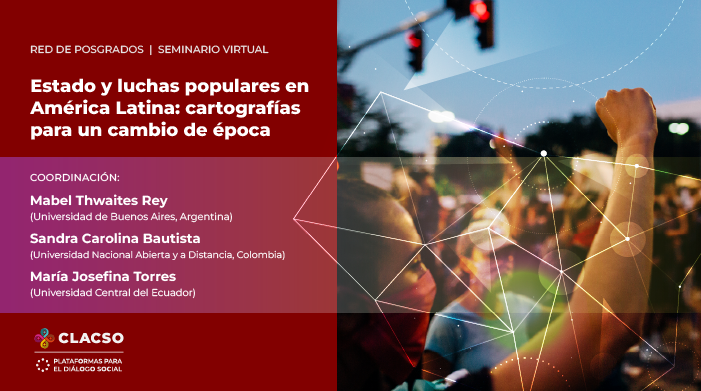
State and popular struggles in Latin America: cartographies for a change of era
Seminar 2343
Coordination: Mabel Thwaites Rey (University of Buenos Aires, Argentina), Sandra Carolina Bautista (National Open and Distance University, Colombia) and María Josefina Torres (Central University of Ecuador)
Teaching team: Julieta Paula Mellano (Postgraduate Program in Latin American Studies, Mexico), Hernán Darío Ouviña (University of Buenos Aires, Argentina), Javier Leonardo Moreira Slepoy (National University of Córdoba, Argentina), Danilo Enrico Martuscelli (Federal University of Uberlândia, Brazil), Anahí Durand Guevara (National University of San Marcos, Peru), Mariana Andrea Giaretto (National University of Comahue, Argentina), Victoria Darling (Federal University for Latin American Integration, Brazil), Jorge Viaña (Higher University of San Andrés, Bolivia), Rodolfo Gómez (University of Buenos Aires, Argentina), Juan José Martínez Volkmar (Colombian Peace Collective from Mexico), Adrián Piva (CONICET, Argentina), Santiago Eugenio Ortiz Crespo (FLACSO, Ecuador), Milton Piñeros Fuentes (National University of Colombia), Rafael Magdiel Sánchez Quiroz (Postgraduate Program in Latin American Studies, Mexico), Lucio Fernando Oliver Costilla (National Autonomous University of Mexico), Darío Clemente (FLACSO, Argentina) and Juan Carlos Monedero Fernández (Complutense University of Madrid, Spain)
Start date : 07/08/2023 | Registration : 08/05/2023 to 06/08/2023
Workload: 12 weeks – 90 hours.
The question of the State, as a locus of concentrated power, a privileged arena for disputes, and a territory for the struggles and construction of hegemony and counter-hegemony, has returned to the center of political debate in the last 20 years. This has meant reviving the fundamental discussion surrounding power, not only in its restricted dimension, but also with respect to the broad economic and socio-political significance it expresses as the core of the concentration of power relations. It is no coincidence that, in historical moments of rising popular struggles, but also in those marked by a destabilizing and/or restorationist tendency on the part of the economically dominant classes and elites, the “question of the State” reappears in the foreground with greater force, insofar as the substantive struggle for power is raised. Undoubtedly, this centrality has been evident in the processes that have attempted to advance more radical alternative proposals to the neoliberalism prevalent in the 90s, as well as in those that, in a more ambiguous way, sought to break with or distance themselves from some of its founding principles, but also in those countries where neoliberal hegemony still endures and seems to have no major cracks. The Seminar aims precisely to address this highly relevant dimension, without separating it from the popular struggles and power dynamics that shape and tear apart Latin American societies as a whole.
The Seminar proposal is based on the enriching analytical experience on Latin American and Caribbean states that, for more than ten years, has been developed by the CLACSO working groups that have had as their central focus the question of the State, and were made up of all those who make up the present teaching team.
This experience allowed us to delve into theoretical frameworks and, above all, the particularities, commonalities, and metamorphoses of statehood in Latin America and the Caribbean, both in terms of its configuration and historical development and in the unstable continental context of recent years. We assume that the state—as the material condensation of a correlation of forces, by definition asymmetrical and unstable—while not a neutral entity, cannot be considered a monolithic bloc at the service of the dominant classes, but rather must be viewed as a constitutively conflictive sphere. Between 2010 and 2022, we analyzed in detail the internal morphology of Latin American states, paying attention to their changes and continuities in relation to the evolving power dynamics, as well as to regional constraints and those imposed by the global capitalist system. From diverse perspectives and interpretations, we were able to account for the complex reality of these states, both in their most general aspects and in relation to specific national and/or plurinational issues. We characterize the period that began after the wave of structural adjustment and pro-market policies at the dawn of the new century in the region, where the state's role acquired renewed centrality, as the "Cycle of Challenge to Neoliberalism in Latin America," which began with the governments generically termed progressive. However, we consider that this cycle has its own stages and specificities, and that its continuity is contested both in terms of its durability and the questioning of the traditional neoliberal framework, which is currently experiencing its second wave in our region and appears to be facing societal limitations on its continuation. So far in the 21st century, our continent remains an emblematic territory of significant struggles and disputes surrounding the state as a site of concentrated power, a privileged arena for conflict, and a territory for the struggle and construction of hegemony. This scenario of political experimentation must also be understood in light of the effects of the deepening global crisis that began in 2008, followed by the Covid-19 pandemic, the Russia-Ukraine conflict, the unveiling of the struggle for US hegemony, and the imperial counteroffensive. On the one hand, it seems to have fueled the rise of right-wing political options of an authoritarian and conservative, even fascist, bent. On the other hand, anti-neoliberal struggles have been revived, with glimpses of anti-capitalist, anti-patriarchal, and anti-colonial resistance. Furthermore, analyzing experiences of other forms of popular power, such as those in Venezuela and Cuba, will help us to critically contrast the other Latin American cases.
In this sense, we will ask ourselves: To what extent has post-neoliberalism proven to be more of a rhetorical and discursive position than a concrete reality in terms of public policies and the configuration of a state entirely resistant to its logic? What do the Covid-19 pandemic and the presence of narco-capital reveal about the political direction of the state, the indispensable organizer of the infrastructure of the commons? Can we speak of processes related to what Antonio Gramsci called “passive revolution”? Or are we rather witnessing a relative and partial shift in the balance of power, without yet being able to announce the end of the cycle that began 20 years ago in the region? What democratizing prospects are emerging regarding the relationship between the state and popular struggles in Latin America and the Caribbean?
GENERAL OBJECTIVES
-Analyze and compare different views on the conceptualization and reality of Latin American and Caribbean states in the contemporary post-pandemic era, from an intersectional and critical perspective.
-To investigate the concrete transformations undergone by Latin American and Caribbean states in the current open regional and global situation with US and Chinese hegemony in conflict, as well as the particularities of each national and/or plurinational situation.
-To broaden perspectives on disputes over the public-state sphere, the development and implementation of public policies and their potential for democratization through the direct participation of social movements and political organizations in the region (popular movements and organizations, parties, unions, unitary platforms, etc.).
SPECIFIC OBJECTIVES
-Analyze the link that contemporary social movements and popular organizations establish with the State, in terms of confrontation, tension, negotiation, articulation and/or complementarity.
-To investigate the strategies deployed by these movements and organizations to defend and/or expand rights, obtain fiscal resources, and influence the institutional framework of the State, as well as the development and implementation of participatory public policies.
-To evaluate the modalities through which it is feasible (or not) for these organizations and movements to influence the legal-state order, and insert into it “elements” of the future society, even before the full conquest of power.
-Analyze the specific forms of constitution of political subjects and their relationship (of tension, opposition and/or complementarity) with the peripheral Latin American States in recent decades, and in particular in recent years.
- Critical theories of the State - Classical views and revisions from the State-gender dimension.
- Critical Theories of the State - Latin American Perspectives
- The State and the cycle of challenge to neoliberalism in Latin America: keys to understanding
- State and popular struggles in Mexico.
- State and popular struggles in Colombia.
- State and popular struggles in Peru
- State and popular struggles in the Andean region. The cases of Bolivia and Ecuador
- State and popular struggles in Brazil.
- State and popular struggles in Argentina
- State and popular struggles in Venezuela and Cuba
- Gramsci, Antonio (1999) Prison Notebooks (selection of notes), Editorial Era, Mexico.
- Horkheimer, Max (2006), The Authoritarian State, Mexico, Itaca.
- Jessop, Bob (1980) "Recent Theories on the Capitalist State", in Critical Review of Political Economy Number 16/17, Mexico.
- Federici, Silvia (2004), Caliban and the Witch, Buenos Aires, Traficantes de sueños.
- Zavaleta, René (1987) The State in Latin America, Editorial Los amigos del libro, La Paz.
- Aricó, José (1999) "Latin America as a problematic unit", in Justo's hypothesis, Editorial Sudamericana, Buenos Aires.
- Thwaites Rey, Mabel and Ouviña, Hernán (2012) “Latin American statehood revisited. Reflections and hypotheses around the problem of political power and transitions”, in
- Thwaites Rey, Mabel (ed.) The State in Latin America: continuities and ruptures, Editorial Arcis-CLACSO, Santiago de Chile.
- Thwaites Rey, Mabel and Ouviña, Hernán (2019) "The cycle of challenge to neoliberalism in Latin America: rise and fracture", in Ouviña, Hernán and Thwaites Rey, Mabel (comp.) States in dispute. Rise and fracture of the cycle of challenge to neoliberalism in Latin America, CLACSO and Editorial El Colectivo, Buenos Aires.
- Modonesi, Massimo (2017) "Passive Revolutions and Progressive Governments at the Beginning of the Century", in Passive Revolutions in Latin America, Editorial Itaka, Mexico.
- Monedero, Juan Carlos (2019) "Strategic Selectivity of the State and Change of Cycle in Latin America", in Ouviña, Hernán and Thwaites Rey, Mabel (comp.) States in Dispute. Rise and Fracture of the Cycle of Challenge to Neoliberalism in Latin America, CLACSO and Editorial El Colectivo, Buenos Aires.
- Oliver, Lucio (2016) "Mexico. The integral State in the 21st century: crisis of hegemony and changes in the State-society equation. A look with Gramsci", in Oliver, Lucio (coord.) Recent transformations of the integral State in Latin America, UNAM, Mexico.
- González Casanova, 50 years of the PRI. The Party of the State: https://nexos.com.mx/?p=3334
- Mellano, Julieta and Sánchez Quiroz, Magdiel (2019) "Mexico inside and outside CINAL: The exception or the mirror to the future?", in Ouviña, Hernán and Thwaites Rey, Mabel (comp.) States in dispute. Rise and fracture of the cycle of challenge to neoliberalism in Latin America, CLACSO and Editorial El Colectivo, Buenos Aires.
- Bautista, Sandra Carolina (2019). Peace, War, and the Paths of State Transformation in Colombia. In: States in Dispute: Rise and Fracture of the Cycle of Challenge to Neoliberalism in Latin America. Hernán Ouviña; Mabel Cristina Thwaites Rey (compilers). Editorial El colectivo, CLACSO. Buenos Aires.
- Cruz Rodríguez, Edwin (2016). The 2010-2016 protest cycle in Colombia. An explanation. Jurídicas CUC, Vol 12, No. 1, 31-62.
- Estrada Álvarez, Jairo (2021). Social rebellion as a production of power and the political perspective. Revista Izquierda, No. 97, 53-63.
- Quijano, Anibal (1978) Imperialism, social classes and the State in Peru, Center for Social Research, Mosca Azul Editores, Lima.
- Ugarteche, Oscar (2004) Goodbye State, welcome market, Ebert Foundation-National University of San Marcos, Lima.
- Crabtree, John and Durand, Francisco (2017) Peru: Power Elites and Political Capture of the State, Pontifical Catholic University, Lima.
|
|
Discount for one payment until 04/08 |
In one payment after 04/08 |
|
CM Plenos |
$75 |
$150 |
|
CM Associates |
$95 |
$190 |
|
No link |
$95 |
$190 |
FAQ
The basic requirements for taking a seminar are:
- Availability of at least 4 hours per week to dedicate to the seminar course.
- Internet access.
- Reasonable handling of communication and computer tools.
- Language proficiency in the language in which the course will be taught. The official languages are Spanish and Portuguese.
The seminars last 12 weeks, plus the completion of a final project. A total of 90 hours of dedication will be credited.
A course consists of twelve classes, each accompanied by required reading bibliography, supplementary bibliography, discussion forums and training activities proposed by the teaching team, partial deliveries and a final project.
The course is online and asynchronous. Some instructors may propose synchronous activities. In those cases, the time and date will be agreed upon beforehand between the teaching team and the students to ensure everyone's participation.
To pass the seminar, you must participate in at least 80% of the discussion forums and activities proposed by the teachers, have completed the scheduled partial deliveries, and pass the final work.
|
|
Discount for one payment until 04/08 |
In one payment after 04/08 |
|
CM Plenos |
$75 |
$150 |
|
CM Associates |
$95 |
$190 |
|
No link |
$95 |
$190 |
The possible payment methods are credit card, bank transfer and bank deposit.
Inquiries: [email protected]

