
State, democracy and social movements in Latin America and the Caribbean: continuities and emergencies in the 21st century
Registration deadline: September 14, 2020
RESEARCH GRANT FOR TEAMS
In recent decades, Latin America and the Caribbean have experienced periods of upheaval and political instability that have highlighted the limitations and structural problems of the state and the democratic system. Likewise, the region has witnessed the emergence and growing prominence of protest movements of various types and forms, reflecting both emerging issues and lingering problems from previous periods.
Currently, a wide variety of factors challenge democratic institutions in the region. The rise in discontent and social unrest is directly proportional to broken promises, unmet expectations, and growing frustrations in Latin American societies. In this sense, 2019 was a year marked by massive mobilizations and protests in various countries across the region.
In many countries, political parties have lost credibility as institutions capable of channeling societal demands and mediating between citizens and the state. This crisis of political representation has led to the emergence of authoritarian and regressive political trends, which in some countries have gained electoral support, as well as the rise of other actors such as the armed forces, which raise questions about the meaning of democracy.
Furthermore, particularly in recent years, there has been a notable increase in the influence of economic elites over state institutions, resulting in public policies that increasingly favor concentrated interests and run counter to the well-being of the majority. This process was interpreted as state capture in previous scholarship programs. For this reason, despite a context of relative improvement in social indicators, multidimensional social inequalities have grown in the region. Likewise, practices of discrimination, segregation, and stigmatization of various social groups have increased.
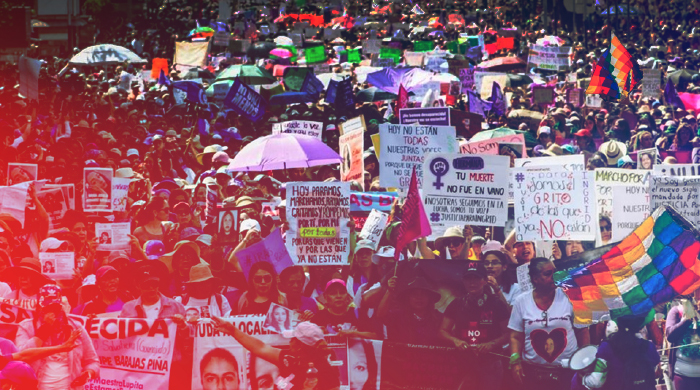
These changes have generated a regional landscape of surges in mobilizations, protests, and discontent in recent years, with a marked emphasis on feminist and gender movements, which have, in turn, provoked violent, rights-denying, conservative, and regressive reactions. This panorama invites us to investigate the characteristics of social protest movements and actions in their links to political changes, democracy, and the transformations in the configuration of state-society relations in the 21st century.
Based on these analyses, CLACSO is launching a research grant for teams entitled "State, Democracy, and Social Movements in Latin America and the Caribbean: Continuities and Emergences in the 21st Century." This call for proposals encourages applications from research teams comprised of researchers from diverse disciplines, backgrounds, and experiences who address the issues outlined here.
Applicant profile.
-
Applicants must be researchers with accredited ties to CLACSO Member Centers, which they will demonstrate with a sworn statement. If awarded the scholarship, they must submit a letter of support signed by the highest authority of the center.
-
Submissions by collective authors with no more than four members will be accepted.
-
The formation of the teams must respect gender parity (at least 50% women) and must select one of the members as responsible for the registration of the project.
-
Each team must be made up of trained researchers, that is, those who hold a master's degree, doctorate or equivalent and have a proven academic track record , and researchers in training, that is, those who are pursuing master's or doctoral studies or are up to 35 years of age, in this case with a degree.
-
Each researcher or research team may only participate with one proposal in this call.
-
If the scholarship is awarded and travel is necessary, the winners will be responsible for covering the costs of medical insurance or similar expenses.
Support to be granted
Four group scholarships will be awarded, of which at least two will go to teams from countries such as Bolivia, Brazil, Colombia, Ecuador, Haiti, Honduras, Guatemala and Paraguay or that work about them.
The amount of the scholarships awarded will consist of:
-
$24.000 for each research team.
The proposed research will be carried out over a maximum period of 10 (ten) months. The scholarships will be paid in installments via bank transfers made to the recipients. It is expected that at least 60% of the scholarship funds will be used for activities related to gathering and processing the information necessary for the research, which must be reported to CLACSO with supporting documentation.
The winners will work with the support of tutors assigned by CLACSO who will follow the process of their research and results.
CLACSO will publish the final products in print and/or digital media, giving them wide publicity and dissemination through the means it deems appropriate.
The authors will transfer the original publication rights of their works, given that CLACSO adheres to and defends the principles of open science and open access to knowledge, so that the resulting work is easy to find, accessible, interoperable, and reusable. Subsequently, these works may be published in any other medium, always citing the grant received. Grant recipients must inform CLACSO of the subsequent publication of works resulting from the grant work.
Characteristics of the proposals
-
The member centers to which the applicants are linked must not have any outstanding debts in the payment of membership fees corresponding to the year 2019, due on June 30 of the same year.
-
Completed research projects will not be accepted. Proposals may be linked to ongoing research processes, but the final works must be original and unpublished products and developed within the period established by the call for proposals.
-
Members of the Steering Committee or officials of the CLACSO Executive Secretariat may not participate.
-
Proposals from researchers who are currently recipients of research grants, fellowships, or research projects organized by CLACSO will not be accepted. Applications from researchers who have previously received a CLACSO research grant will be accepted, provided that the recipient has fulfilled all obligations in a timely manner.
-
Texts written in the four languages commonly used in Latin America and the Caribbean (Spanish, English, Portuguese and French) will be accepted, depending on the country of origin of the proposal.
Selection criteria for proposals
-
In the first stage, the submitted proposals will be reviewed for their formal and administrative aspects to ensure their compliance with the competition rules. Proposals that do not meet the established requirements will be rejected.
-
Applications that pass to the next stage will be evaluated by an International Committee composed of experts who will assess the quality and relevance of the proposals, which will be submitted under a pseudonym.
-
The Call may be declared void or a smaller number of scholarship recipients may be selected, if the proposals submitted do not meet the required quality and consistency.
-
Situations not covered in this document will be resolved by the convening institution.
-
The ruling will be final.
Characteristics of research papers
-
The research projects will develop their work plan between November 2020 and September 2021. This plan will be implemented under the facilitation of tutors assigned by CLACSO.
-
The progress and final reports submitted by the scholarship recipients will be reviewed by the tutors.
-
In their final version, the research papers submitted as a result should be between 12.000 and 15.000 words in length (excluding appendices and bibliography), written in Times New Roman 12-point font, single-spaced. This is an approximate guideline, and CLACSO reserves the right to make adjustments or exceptions if deemed necessary.
-
The structure of the text will be free, respecting the conventions of presentation of an academic text and the editorial standards of CLACSO, in addition to APA + GENRE.
-
In addition, each team must submit a Guidelines for Action Document, containing inputs and recommendations for public policies and social intervention on the topics investigated.
-
Texts written in the four languages commonly used in Latin America and the Caribbean (Spanish, English, Portuguese and French) will be accepted, depending on the country of origin of the proposal.
It is mandatory that the submission be made through the online registration system provided by CLACSO. Printed submissions and submissions sent by email will not be accepted. It is recommended to access the online system to review the registration form.
-
Visit the CLACSO website www.clacso.org . The online registration system will be available starting July 17th.
-
Register in the CLACSO Single Registration System (SUIC). The generated username and password will be required each time you wish to access the system to consult, modify, add, or submit information for this or any other CLACSO activity. Applicants submitting collective proposals must designate one of the authors as responsible for registration. This same person will receive the corresponding monetary award if the proposal is selected by the Jury.
-
Identify the proposal by indicating its title and the pseudonym of the applicant(s). Applications with pseudonyms that correspond to the applicant's first and/or last name will not be accepted. Once the corresponding fields are completed, the system will enable the uploading of the following data.
-
Applicants must complete the sworn statement on the registration form indicating their affiliation with a Member Center belonging to the CLACSO network. The database of member centers can be found at: www.clacso.org.ar/clacso/centros_miembros_clacso/inicio.php.
-
Complete the personal and academic data form and attach the curriculum vitae in free format; the digital copy of the identity document, passport or ID card; the digital copy of the highest academic degree obtained (or proof of degree in process) and the photograph.
-
Once registration is closed, the system will produce an electronic certificate of receipt that will serve as proof.
Registration closes: September 14, 2020, 24:00 PM (Argentina)
Winners will be announced on October 30, 2020.
Project completion: November 2020
Final report due: September 2021
Inquiries: [email protected]
If you would like to receive more information about CLACSO's training programs:
[widget id=”custom_html-57″]
to our email lists.
Results
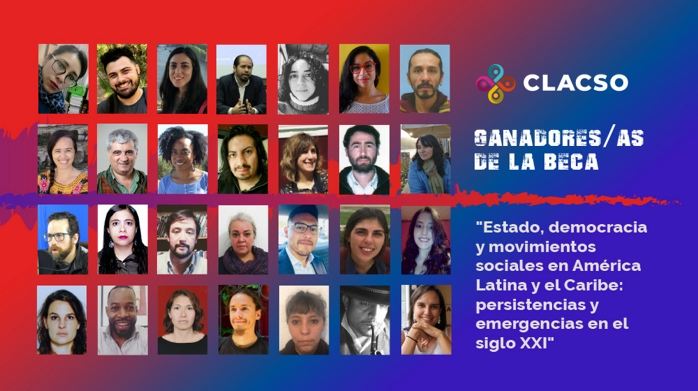
The Latin American Council of Social Sciences (CLACSO) announces the results of the Call for research grants for teams “State, democracy and social movements in Latin America and the Caribbean: continuities and emergencies in the 21st century” , which seeks to investigate the features that characterize social protest movements and actions in their links with political changes, with democracy and with the transformations in the configuration of relations between State and society in the 21st century.
142 applications were received , of which, after the technical and formal review, 137 were in a condition to be qualitatively evaluated by the International Committee to consider the quality, relevance and coherence of the proposals according to the Call.
The evaluation process was carried out by an International Committee composed of 27 experts from 12 countries: Julián Rebon (Argentina), Carolina Jiménez (Colombia), Pilar Lizárraga (Bolivia), Mónica Dias Martins (Brazil), Bernardo Mançano (Brazil), Stalin Herrera (Ecuador), Fernando Mayorga (Bolivia), Laura García Corredor (Argentina), Jorge Leal (Uruguay), María Fernanda Sañudo (Colombia), Ernesto Bohoslavsky (Argentina), Carlos Walter Porto Gonçalves (Brazil), Pablo Ariel Becher (Argentina), Felipe Milanez (Brazil), Mina Lorena Navarro Trujillo (Mexico), Lucio Oliver (Mexico), Blanca Fernández (Argentina), Mauricio Tubio (Uruguay), Graciela Castro (Argentina), Ana María Larrea (Ecuador) and Valeria Coronel (Ecuador).
As a result of the evaluation process and given the excellent quality and great relevance of most of the applications, CLACSO decided to recognize 4 winning teams with a monetary allocation of 20.000 dollars for each one and, in addition, add the recognition of 4 honorable mentions with an allocation of 8.000 dollars for each one.
In this way, the funds allocated to this call increased by almost 20%, which implies a great institutional effort with the aim of promoting research on the topics of the call, prioritizing the participation of more work teams and a greater diversity of researchers.
The list of winners and honorable mentions is as follows:
|
Winners |
|||
|
Researchers |
Member Center or Institution |
Country |
Title of the proposal |
|
Lourdes Guadalupe Delgadillo Díaz Leal, Verónica Renata López Nájera |
Postgraduate Program in Latin American Studies – PPEL/UNAM |
Mexico |
Indigenous Latin American feminisms and new social movements: The struggle of the Zapatista women in Mexico and the Bartolinas in Bolivia |
|
Pablo Mardones, Isabel Margarita Araya Morales, Ricardo Victor Amigo Durre, Lissien Camila Salazar Ordenes |
Institute of International Studies – INTE-UNAP |
Chile |
Between limited recognition, state racism and gender-racialized violence: Afro-descendant feminist networks and mobilizations in Arica and Santiago, Chile - Afro-descendant and migrant women |
|
Lia Pinheiro Barbosa, María Isabel González Terreros, Oscar Humberto Soto, Edgars Martínez Navarrete |
Post-Graduation Program in Sociology – PPGS – PPGS |
Brazil |
Territorial autonomies in Latin America: tensions, disputes and advances in the face of right-wing governments |
|
Randolfo Sandoval, Jessica Waleska Fernandez Norales |
Directorate of Scientific Research – DICU/UNAH |
Honduras |
Garifuna Indigenous Movements: A study of the processes of resistance and political organization of the peoples in the context of militarization in Honduras |
|
HONORABLE MENTIONS |
|||
|
Researchers |
Member Center or Institution |
Country |
Title of the proposal |
|
Lorena Soler, Mónica Susana Nikolajczuk, Ana Belén Mercado, Enzo Andrés Scargiali |
Institute of Latin American and Caribbean Studies – IEALC/UBA |
Argentina |
Social movements and the right wing in Paraguay (2015-2016), Colombia (2018-2020) and Brazil (2018-2020) |
|
Marco Giovanny Panchi Jima, Harry Soria Galvarro Sánchez de Lozada, Roxana María Viruez Valverde, Mónica Daniela Villacís Barahona |
Center for Higher University Studies – CESU-UMSS |
Bolivia |
Youth, democracy, and political persistence in the face of the Latin American progressive crisis (2019-2020): The cases of Ecuador and Bolivia |
|
Marielle Beatriz Pala Fernández, Abel Enrique Irala, Sarah Zevaco, Juan Carlos Yuste Alonso |
Base Social Research – BASE-IS |
Paraguay |
Where is democracy headed? Disputes, strategies, and tensions between social movements and elites surrounding democracy |
|
Paul Walter Cisneros, Yuri Fernando Torres Rubín de Celis, Elizabeth Lourdes Huanca Coila, Sofia Cordero Ponce |
Institute of Higher National Studies – IAEN |
Ecuador |
Two decades of internal tensions and political impact of the indigenous-peasant movements of Bolivia and Ecuador (2000-2020). |
This ruling is irrevocable and cannot be appealed.
Buenos Aires, November 10, 2020.

