
Specialization in Care Policies with a Gender Perspective

Online format | Starts in October 2026
Duration: 1 year
Cohort: 2026/2
Course start date: October 05, 2026
Total number of credits and hours: 22 credits – 1056 lecture hours
The Specialization is a joint academic proposal of the University of Manizales, the Latin American Council of Social Sciences (CLACSO) and CINDE , through its Center for Advanced Studies in Childhood and Youth (CEANJ).
It has an official title with qualified registration No. 021509 of November 10, 2025, issued by the Ministry of National Education of Colombia.
GENERAL COORDINATION
Karina Batthyány (University of the Republic, Uruguay)
ACADEMIC COORDINATION
Valentina Perrotta (University of the Republic, Uruguay)
The Specialization in Care Policies with a Gender Perspective arose in response to the profound changes taking place in Latin American societies today: the increasing participation of women in the labor market, the aging population, and transformations in family structures. These processes invite us to rethink how we organize care and what role it plays in building more just and equitable societies.
This program offers high-level training that provides theoretical and practical tools to analyze, design, manage, and evaluate public care policies from a perspective that seeks to reduce inequalities and promote gender equity.
In a context where care is recognized as a pillar of well-being and a central axis of social and gender inequalities, this specialization trains professionals with a critical, Latin American and transformative perspective, prepared to influence the design of policies and actions that promote a more equitable and supportive society.
The program aims to train specialists in the field of care policies with a gender perspective, based on knowledge and understanding of its conceptual and methodological debates, as well as the development of its policies and practices, primarily in Latin America. The specialization seeks to provide not only theoretical knowledge, but also analytical and reflective skills to comprehensively address the formulation, management, and evaluation of public care policies from a perspective oriented toward combating gender inequalities and inequities.
If you have any questions about this, you can write to the email address for the Specialization.
*Important (only for degrees obtained outside of Colombia): It is an essential requirement to present the apostilled undergraduate or graduate degree, either when registering or within a maximum and non-extendable period of 90 days.
- Karina Batthyány (University of the Republic, Uruguay)
- Valentina Perrotta (University of the Republic, Uruguay)
- Laura Pautassi (University of Buenos Aires, Argentina)
- Lucía Scuro (ECLAC)
- Eleonor Faur (National University of San Martín, Argentina)
- Magela Romero Almodóvar (University of Havana, Cuba)
- Paola Mascheroni (University of the Republic, Uruguay)
- Mariana Rulli (National University of Río Negro, Argentina)
- Castiblanco (La Salle University, Colombia)
- Lucía Martelotte (Latin American Team for Justice and Gender)
- Estefanía Aristizábal (CINDE, Colombia)
- Julian Loaiza (University of Manizales, Colombia)
- Gonzalo Tamayo (University of Manizales, Colombia)
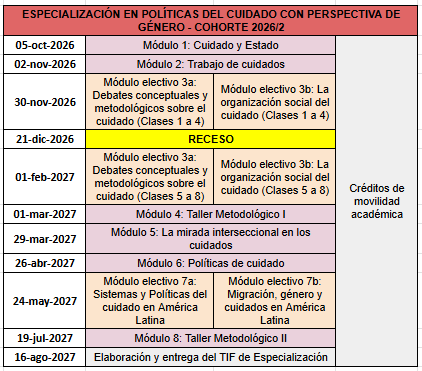
The Specialization in Care Policies with a Gender Perspective lasts 12 months and requires the approval of the following for accreditation:
- 8 mandatory modules
- 2 academic mobility credits
- Final Integrative Project (TIF)
The Specialization accredits 1056 hours/teacher of work and is certified by UManizales, CLACSO and CINDE-CEANJ, with the approval of the Ministry of National Education of Colombia.
Students will have the support of academic tutors who will accompany them through the different curricular areas and guide them in the completion of final projects.
In addition, prior to the start, a preparatory cycle will be carried out with a day dedicated to induction in the use of the CLACSO virtual platform and another dedicated to an inaugural class led by the program coordination.
This module presents key discussions and analyses on the topic of care from a gender perspective. It proposes to examine care as a central component of well-being and analyze how it is provided and distributed within different welfare systems. Furthermore, it will explore care as a universal right and the implications for public policy of guaranteeing this right. This will be achieved through the study of the concepts of the State, welfare systems, and care policies; care and the State; the right to care and caring cities. Students are also expected to reflect on and critically analyze the topics presented.
This module will explore the definitions and ambiguities of care work, focusing on the implications of considering care as work, both paid and unpaid, as well as the profound inequalities experienced by those (primarily women) who perform this work, its lack of recognition, its costs, and its specific characteristics in different contexts. In short, the main topics covered include reflections on care work and the invisible wealth of care; care workers; care and migration; and masculinities and care.
This module will introduce students to the various definitions of care and will explore reflections on the ethics of care; the links between gender theory and care; and different dimensions of care, among other topics. It will also address the complexities of measuring care in its various dimensions: material, emotional, and cultural. Advances in the region using different methodological strategies will be presented.
This module addresses care as a central component of social well-being. It connects this to the discussion of public policy and to care as a right. The module will explore in depth the notion of the social and political organization of care, allowing for an understanding of the strategies households employ to meet care needs using various resources, as well as the political decisions behind state-provided care and the costs to women's lives.
The Support Workshop aims to guide students in completing the Final Integrative Project (TIF) for their Specialization, which they must submit as a requirement for graduation. The goal is for them to complete the Workshop with a preliminary draft of their TIF.
In this first stage, the aim is for students to define their problem question and objectives for their final work, which will contribute a novel reflection to what has already been produced, the necessary evidence to answer the question, as well as the central notions and the relevant bibliography.
This module explores a dynamic and intersectional perspective on care, addressing various forms of discrimination that combine with gender to exacerbate inequalities in caregiving. Within this framework, it will examine how care policies can provide greater well-being and equality in later life, generational inequalities, the struggle to combat negative stereotypes associated with the hair of Black women—a key issue for women's groups from the African diaspora worldwide—and the main implications of caregiving in rural contexts in Latin America and the Caribbean.
This module will reflect on and critically examine care as an object of public policy, addressing the various regional commitments undertaken by states, the current state of the debate in the region and the progress in implementing care systems, as well as the role of civil society and the feminist movement in consolidating this demand. The main topics to be covered are: Comprehensive Care Systems: regional experiences; care communities: the Dominican Republic's experience; the care society; and the regional gender agenda; and Care Policies and Systems at the heart of feminist agendas.
This elective aims to focus on care policies developed by Latin American countries. To this end, it will critically discuss, from a gender and right-to-care perspective, the care policies and systems implemented by these countries. Experiences will be presented and analyzed, taking into account the main theoretical approaches covered in the specialization, to develop students' critical perspectives and enhance their ability to make recommendations within their diverse professional contexts.
This module will explore the phenomenon of migration in Latin America and its impacts on the social organization of care for dependent persons. It will address the public policy challenges posed by care migration corridors, the inequalities present in care work within the context of migration, and other relevant dimensions that allow for the inclusion of migration issues in ongoing care policies. This will be achieved through an analysis of migration dynamics in the region and its main dimensions; migration and gender studies; the importance of data for formulating equality policies; migration, work, and care; global care chains and migration governance; care migration corridors; an intersectional approach to migration analysis; and the racialization of migrant women.
In this phase, the work begun in Support Workshop I will continue. Its purpose is to guide students in completing the Final Integrative Project (TIF) for the Specialization, which they must submit as a requirement for graduation. The goal is for students to complete Workshop II with a draft of their TIF, developing the various sections and contributing to a deeper understanding of the presentation of results, analysis, and discussion, as well as the final reflections.
Mobility credits aim to enrich training through activities outside the specialization. Two credits must be earned in this modality.
They can be obtained by taking postgraduate seminars, completing MOOCs at the University of Manizales, presenting papers at academic events, or publishing articles or book chapters.
All activities must be carried out during the academic year and will be evaluated by the tutor and approved according to the criteria of the University of Manizales.
Important: Registration for these activities, as well as any associated costs (tuition, travel, materials, etc.), are the responsibility of each student.
1. Register for the specialization by accessing the online registration system. There you will need to complete your personal information and upload:
- National Identity Document (DNI) / Identity Card, both sides (not passport).
- University degree or undergraduate degree*.
If you have any questions, you can write to the Specialization's email address: [email protected]
*Important (only for degrees obtained outside of Colombia): It is an essential requirement to present the apostilled undergraduate or bachelor's degree, either when registering or within a maximum and non-extendable period of 90 days. - Health affiliation certificate (only for people residing in Colombia).
All documentation uploaded to the registration system will be evaluated and attached to each student's file.
2- Once the payment has been made and credited, in October you will receive the access credentials to the CLACSO Virtual platform where both the preparatory cycle and the course of the Specialization will take place.
| General registration (from 01/07/26 to 21/09/26) |
Registration without discount (from 22/09/26 to 30/09/26) |
3 installments | |
| General rate | $4.000 | $4.000 | - |
| Link with CLACSO Member Center, UManizales and CINDE/CEANJ | USD 460 (1) | $570 | USD 750 (3 x USD 250) |
| No link | USD 660 (2) | $960 | USD 1.290 (3 x USD 430) |
• General registration (from 01/07/26 to 10/08/26)
General rate: $4.000
Link with CLACSO Member Center, UManizales and CINDE/CEANJ: USD 460
No link: $660
• Registration without discount (from 11/08/26 to 30/09/26)
General rate: $4.000
Link with CLACSO Member Center, UManizales and CINDE/CEANJ: USD 570
No link: $960
• 3 installments
General rate: -
Link with CLACSO Member Center, UManizales and CINDE/CEANJ: USD 750 (3 x USD 250)
No link: USD 1.290 (3 x USD 430)
(2) Value with a 88,5% scholarship, granted as support for the academic training of people linked to CLACSO Member Centers, University of Manizales, CINDE/ CEANJ within the framework of this agreement.
(3) Value with 83,5% scholarship, granted as support for academic training for people who do not have a direct link with CLACSO Member centers, University of Manizales, CINDE/ CEANJ within the framework of this agreement.
If you have any questions about this, you can write to the email address for the Specialization.
*Important (only for degrees obtained outside of Colombia): It is an essential requirement to present the apostilled undergraduate or graduate degree, either when registering or within a maximum and non-extendable period of 90 days.
1. Register for the specialization by accessing the online registration system. There you will need to complete your personal information and upload:
- National Identity Document (both sides).
- Undergraduate degree certificate (for those who studied in Colombia) or apostilled degree certificate* (for those who studied in another country)
*If you are unable to complete the apostille process during the registration period, you can still upload your degree and must complete the process. during the following 90 days. Without exception. - Health affiliation certificate (only for people residing in Colombia).
All documentation uploaded to the registration system will be evaluated and attached to each student's file.
2- Finally, in September you will receive the access credentials to the CLACSO Virtual platform where the preparatory cycle and the course will be held starting in October 2026.
Classes will be held between October 2026 and September 2027.
All students will receive the necessary instructions to access classes, bibliography and discussion forums through the CLACSO Virtual platform.
Accessing and navigating the Virtual Learning Environment is very simple and user-friendly. In any case, a technical and academic support team will always be available to you.
The specialization combines asynchronous (pre-recorded) classes with synchronous sessions. The course is primarily delivered asynchronously, allowing each student to organize their study time according to their availability. At the beginning of each module, the coordinator will provide the schedule of synchronous sessions. Participation in these live sessions is highly recommended, although it is not a requirement for passing the course.
Mobility credits aim to enrich training through activities outside the specialization. Two credits must be earned in this modality.
They can be obtained by taking postgraduate seminars, completing MOOCs at the University of Manizales, presenting papers at academic events, or publishing articles or book chapters.
All activities must be carried out during the academic year and will be evaluated by the tutor and approved according to the criteria of the University of Manizales.
Important: Registration for these activities, as well as any associated costs (tuition, travel, materials, etc.), are the responsibility of each student.
You must pass 8 mandatory modules, 2 academic mobility credits and the Final Integrative Work (TIF).
All training courses must be completed and passed - without exception - in order to receive the specialist title.
Yes, the Specialist degree will be awarded by the University of Manizales in partnership with CLACSO and CEANJ. It is an official degree with accredited registration issued by the Colombian Ministry of National Education.
The graduation fee is approximately USD 20 (price to be reconfirmed upon completion of the process). Shipping the diploma in physical format (optional) will incur an additional fee, which will be communicated in due course.
Yes, it is possible to legalize or validate a specialization outside of Colombia (the country where the degree is registered). The legalization process is personal and must be carried out independently by each individual according to the requirements of their country of residence.
| General registration (from 01/07/26 to 21/09/26) |
Registration without discount (from 22/09/26 to 30/09/26) |
3 installments | |
| General rate | $4.000 | $4.000 | - |
| Link with CLACSO Member Center, UManizales and CINDE/CEANJ | USD 460 (1) | $570 | USD 750 (3 x USD 250) |
| No link | USD 660 (2) | $960 | USD 1.290 (3 x USD 430) |
• General registration (from 01/07/26 to 10/08/26)
General rate: $4.000
Link with CLACSO Member Center, UManizales and CINDE/CEANJ: USD 460
No link: $660
• Registration without discount (from 11/08/26 to 30/09/26)
General rate: $4.000
Link with CLACSO Member Center, UManizales and CINDE/CEANJ: USD 570
No link: $960
• 3 installments
General rate: -
Link with CLACSO Member Center, UManizales and CINDE/CEANJ: USD 750 (3 x USD 250)
No link: USD 1.290 (3 x USD 430)
(2) Value with a 88,5% scholarship, granted as support for the academic training of people linked to CLACSO Member Centers, University of Manizales, CINDE/ CEANJ within the framework of this agreement.
(3) Value with 83,5% scholarship, granted as support for academic training for people who do not have a direct link with CLACSO Member centers, University of Manizales, CINDE/ CEANJ within the framework of this agreement.
For any other questions, please contact [email protected]
Or send a WhatsApp message to +5491138801388
For group and institutional discounts, please contact [email protected]

