
Specialization in Social Research Methods and Techniques
Online format | Starts in March 2026
Duration: 1 year
Preparatory cycle: February 25, 2026
Course start date: March 2, 2026
Total number of credits and hours: 22 credits – 1056 lecture hours
The Specialization is a joint academic proposal of the University of Manizales, the Latin American Council of Social Sciences (CLACSO) and CINDE , through its Center for Advanced Studies in Childhood and Youth (CEANJ).
It has an official title with qualified registration No. 019264 of September 24, 2025, issued by the Ministry of National Education of Colombia.
GENERAL COORDINATION
Juan Ignacio Piovani (National University of La Plata / CONICET, Argentina) and Alberto Riella (University of the Republic, Uruguay)
The Specialization in Social Research Methods and Techniques , developed by the University of Manizales, CLACSO, and CINDE/CEANJ, aims to train professionals with advanced skills in the various approaches, methods, and techniques of social science research. Its central objective is to strengthen the ability to rigorously articulate the most relevant theoretical frameworks with updated and creative methodological strategies, promoting socially significant research at the local, regional, and international levels.
The program emphasizes the development of critical skills for the formulation, implementation, and evaluation of social research projects, as well as the production of sound and ethically committed knowledge for social change. It aims to train specialists capable of analyzing the epistemological and methodological foundations of the social sciences and of applying qualitative, quantitative, and mixed methods approaches effectively and appropriately.
The curriculum integrates epistemological, methodological, technical, critical, ethical, and pedagogical components. Through theoretical modules, design workshops, and applied spaces, it addresses contemporary debates surrounding epistemic shifts—hermeneutic, complexity, feminist, environmental, and decolonial—as well as the main methods and techniques for data production and analysis in social research.
This specialization falls under the detailed field 0314 – Sociology, Anthropology, and Cultural Studies , according to the International Standard Classification of Education (ISCED, 2013) of Colombia, reaffirming its focus on the critical understanding of social phenomena and the inequalities that permeate Latin American societies. Its graduates will be qualified to work in academic, institutional, and civil society settings, contributing to knowledge generation and the design of evidence-based policies and actions that strengthen equitable social development.
The program aims to train specialists in the field of social research methods and techniques, based on knowledge and understanding of its conceptual and methodological debates, as well as the development of its policies and practices, primarily in Latin America. The specialization seeks to provide not only theoretical knowledge, but also analytical and reflective skills to comprehensively address the concerns and methodological approaches related to understanding social nuances.
The specific purposes of the Specialization include:
- To promote among the students of the Specialization the disposition to discover and produce significant knowledge about the most relevant socio-historical phenomena of our contemporary societies.
- To specialize and update students in the main methodological strategies and technical repertoires for social science research, contributing to strengthening their critical capacities for the formulation and implementation of social research projects in the different disciplinary fields of performance.
- To present a renewed overview of current methodological debates in the social sciences and their bibliographical support for a critical approach to social research and the construction of knowledge in the social sciences.
- To provide conceptual and methodological tools that allow the production of solid knowledge for the design and evaluation of state public policies, government actions and civil society organizations.
The Specialization is aimed at university graduates; postgraduate students; teachers; activists and members of trade union organizations, social movements and political parties; public officials; press workers; members and managers of non-governmental organizations and professionals interested in deepening and updating their knowledge and methodological skills for social research.
A university degree/undergraduate degree or equivalent is required.
- Juan Ignacio Piovani
- Alberto Riella
- Gabriela Gómez Rojas
- Paola Mascheroni
- Jessica Pla
- Joan Miquel Verd
- Leticia Muñiz Terra
- Pablo Dalle
- German Quaranta
- María Eugenia Rausky
- María Gabriela Rubilar
- Fernando Tavares
- Juan Romero
- Mauricio Tubio
- Sara Victoria Alvarado Salgado
- Ginna Constanza Méndez Cucaita
- Germán Guarín
- Luis Miguel López
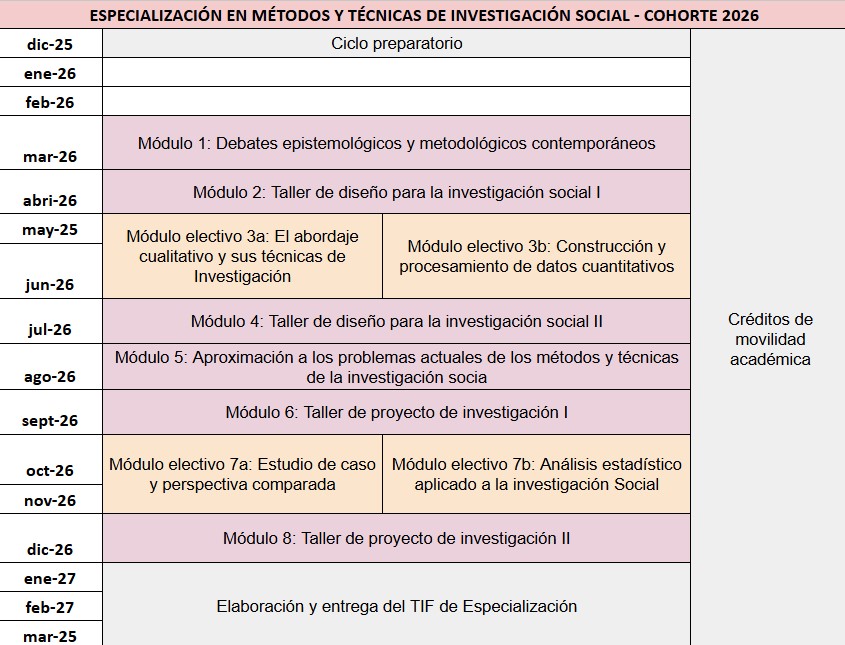
The Specialization in Social Research Methods and Techniques lasts 12 months and requires the approval of the following for accreditation:
- 8 mandatory modules
- 2 elective modules
- 2 academic mobility credits
- Final Integrative Project (TIF)
The Specialization accredits 1056 hours/teacher of work and is certified by UManizales, CLACSO and CINDE/CEANJ, with the approval of the Ministry of National Education of Colombia.
Students will have the support of academic tutors who will accompany them through the different curricular areas and guide them in the completion of final projects.
Also, in February 2026 a preparatory cycle will be carried out with a day dedicated to the induction in the use of the CLACSO virtual platform and another dedicated to an inaugural class led by the program coordination.
- Main current epistemological and methodological debates, with emphasis on those most relevant in relation to the socio-economic, socio-cultural and socio-environmental problems of Latin America.
- Epistemic shifts in situated research practices: the hermeneutic turn, the complexity turn, the feminist turn, the environmental turn, and the decolonial turn.
- Discussions and ethical criteria related to social research practices.
- The research design.
- Stages of the research process. Its variations according to the theoretical-methodological strategy implemented.
- Updated overview of research based on qualitative approaches, its characteristics and the theoretical-methodological debates that run through them.
- The origins of qualitative perspectives and their evolution, their epistemological foundations and their connection with different theoretical traditions in the social sciences.
- Design, sampling, data collection/production, and analysis strategies in qualitative research.
- Ethical aspects related to qualitative research.
- Mastery and development of quantitative measurement instruments applicable to different fields of academic and professional work in our continent.
- The survey research technique. Measurement, operationalization, and construction of indicators.
- Statistical sampling for survey research. Sample size and methods of extraction.
- Designs in qualitative and quantitative approaches.
- Methodological decisions, technical tools and pedagogical support for the preparation of the first draft of the Final Integrative Work
- Current theoretical and methodological debates, with emphasis on Latin American productions and discussions.
- Strategies, methods and quantitative and qualitative techniques for the production of social scientific knowledge, delving into the main conceptual and operational instruments of social research.
- Proposals for overcoming the quantitative/qualitative dyad: methodological triangulation and mixed methods; approaches based on big data.
- The internal logic and design of the research project in Social Sciences, with its different stages: the construction of a research object (the delimitation of a problem, the formulation of questions, hypotheses and objectives), definition of a methodological strategy, construction of a theoretical approach and a state of the question, definition of the analysis procedures and writing strategies.
- The centrality of the articulation between theoretical approach and empirical evidence for the evaluation of the relevance of different methodological approaches and technical solutions.
- Case studies as research strategies based on the in-depth study of a small number of instances (or even a single one) in which the phenomenon of interest is addressed in its natural context.
- The role of theory in case studies, deductive and abductive logics of knowledge production.
- Orthodox criticism of case studies and the responses and reformulations from sociological and ethnographic currents.
- The development and design of case studies and their methodological variations in relation to different research objects
- A reflective overview of the relationship between epistemological-methodological assumptions and the various technical alternatives from the analysis of quantitative data to address specific research problems.
- Knowledge of statistical analysis techniques and tools in the social research process.
- Practical experience in the use of statistical techniques for the study of the social structure of Latin American countries.
- The development of the individual research project, through the synthesis and appropriation of the knowledge and methodological tools acquired in the previous modules of the Specialization
- Preparation of the TIF based on the draft worked on in the first period, and writing of the final version of the same
Mobility credits aim to enrich training through activities outside the specialization. Two credits must be earned in this modality.
They can be obtained by taking postgraduate seminars, completing MOOCs at the University of Manizales, presenting papers at academic events, or publishing articles or book chapters.
All activities must be carried out during the academic year and will be evaluated by the tutor and approved according to the criteria of the University of Manizales.
Important: Registration for these activities, as well as any associated costs (tuition, travel, materials, etc.), are the responsibility of each student.
1. Apply for the specialization by accessing the online application system. There you will need to complete your personal information and upload:
- National Identity Document (both sides)
- Undergraduate degree certificate (for those who studied in Colombia) or apostilled degree certificate* (for those who studied in another country). *If you are unable to complete the apostille process during the registration period, you may still upload your degree certificate and complete the process during the course. However, please note that you will not be able to receive your specialist degree until you submit your duly apostilled undergraduate degree certificate.
- Health insurance affiliation certificate (only for residents of Colombia)
2- Once you complete your application form, you will need to wait for technical approval. This process usually takes 15 days.
3- If your application was accepted, you will receive an email with the steps to follow to pay your tuition and formally complete your registration.
4- Finally, in December you will receive the access credentials to the CLACSO Virtual platform where the preparatory cycle and the course will be held starting in March 2026.
| General registration (from 19/12/25 to 05/02/26) |
Registration without discount (from 06/02/26 to 01/03/26) |
3 installments | |
| General rate | $4.000 | $4.000 | - |
| Link with CLACSO Member Center, UManizales and CINDE/CEANJ | USD 460 (1) | $570 | USD 750 (3 x USD 250) |
| No link | USD 660 (2) | $960 | USD 1.290 (3 x USD 430) |
• General registration (from 19/12/25 to 05/02/26)
General rate: $4.000
Link with CLACSO Member Center, UManizales and CINDE/CEANJ: USD 460
No link: $660
• Registration without discount (from 06/02/26 to 01/03/26)
General rate: $4.000
Link with CLACSO Member Center, UManizales and CINDE/CEANJ: USD 570
No link: $960
• 3 installments
General rate: -
Link with CLACSO Member Center, UManizales and CINDE/CEANJ: USD 750 (3 x USD 250)
No link: USD 1.290 (3 x USD 430)
(2) Value with a 90% scholarship, granted as support for the academic training of people linked to CLACSO Member Centers, University of Manizales, CINDE/ CEANJ within the framework of this agreement.
(3) Value with 85% scholarship, granted as support for academic training for people who do not have a direct link with CLACSO Member centers, University of Manizales, CINDE/ CEANJ within the framework of this agreement.
The Specialization is aimed at university graduates; postgraduate students; teachers; activists and members of trade union organizations, social movements and political parties; public officials; press workers; members and managers of non-governmental organizations and professionals interested in deepening and updating their knowledge on the subject.
A university degree/undergraduate degree or equivalent is required.
1. Apply for the specialization by accessing the online application system. There you will need to complete your personal information and upload:
- National Identity Document (both sides)
- Undergraduate degree certificate (for those who studied in Colombia) or apostilled degree certificate* (for those who studied in another country)
*If you are unable to complete the apostille process during the registration period, you can still upload your degree and complete the process during the course. However, please note that you will not be able to receive your specialist degree until you submit your undergraduate degree with the apostille.
- Health insurance affiliation certificate (only for residents of Colombia)
2. Once you submit your application form, you will need to wait for technical approval. This process usually takes 15 days.
3. If your application was accepted, you will receive an email with the steps to follow to pay your tuition and formally complete your registration.
4. Finally, in December you will receive the access credentials to the CLACSO Virtual platform where the preparatory cycle and the course will be held starting in March 2026.
Classes will be held between March and December 2026.
All students will receive the necessary instructions to access classes, bibliography and discussion forums through the CLACSO Virtual platform.
Accessing and navigating the Virtual Learning Environment is very simple and user-friendly. In any case, a technical and academic support team will always be available to you.
The specialization combines asynchronous (pre-recorded) classes with synchronous sessions. The course is primarily delivered asynchronously, allowing each student to organize their study time according to their availability. At the beginning of each module, the coordinator will provide the schedule of synchronous sessions. Participation in these live sessions is highly recommended, although it is not a requirement for passing the course.
Mobility credits aim to enrich training through activities outside the specialization. Two credits must be earned in this modality.
They can be obtained by taking postgraduate seminars, completing MOOCs at the University of Manizales, presenting papers at academic events, or publishing articles or book chapters.
All activities must be carried out during the academic year and will be evaluated by the tutor and approved according to the criteria of the University of Manizales.
Important: Registration for these activities, as well as any associated costs (tuition, travel, materials, etc.), are the responsibility of each student.
You must pass 8 mandatory modules, two elective modules, 2 academic mobility credits and the Final Integrative Work (TIF).
All training courses must be completed and passed - without exception - in order to receive the specialist title.
Yes, the Specialist degree will be awarded by the University of Manizales in partnership with CLACSO and CEANJ. It is an official degree with accredited registration issued by the Colombian Ministry of National Education.
The graduation fee is approximately USD 20 (price to be reconfirmed upon completion of the process). Shipping the diploma in physical format (optional) will incur an additional fee, which will be communicated in due course.
Yes, it is possible to legalize or validate a specialization outside of Colombia (the country where the degree is registered). The legalization process is personal and must be carried out independently by each individual according to the requirements of their country of residence.
| General registration (from 19/12/25 to 05/02/26) |
Registration without discount (from 06/02/26 to 01/03/26) |
3 installments | |
| General rate | $4.000 | $4.000 | - |
| Link with CLACSO Member Center, UManizales and CINDE/CEANJ | USD 460 (1) | $570 | USD 750 (3 x USD 250) |
| No link | USD 660 (2) | $960 | USD 1.290 (3 x USD 430) |
• General registration (from 19/12/25 to 05/02/26)
General rate: $4.000
Link with CLACSO Member Center, UManizales and CINDE/CEANJ: USD 460
No link: $660
• Registration without discount (from 06/02/26 to 01/03/26)
General rate: $4.000
Link with CLACSO Member Center, UManizales and CINDE/CEANJ: USD 570
No link: $960
• 3 installments
General rate: -
Link with CLACSO Member Center, UManizales and CINDE/CEANJ: USD 750 (3 x USD 250)
No link: USD 1.290 (3 x USD 430)
(2) Value with a 90% scholarship, granted as support for the academic training of people linked to CLACSO Member Centers, University of Manizales, CINDE/ CEANJ within the framework of this agreement.
(3) Value with 85% scholarship, granted as support for academic training for people who do not have a direct link with CLACSO Member centers, University of Manizales, CINDE/ CEANJ within the framework of this agreement.
For any other questions, please contact [email protected]
Or send a WhatsApp message to +5491138801388
For group and institutional discounts, please contact [email protected]

