
Writing a Social Science thesis with AI assistance
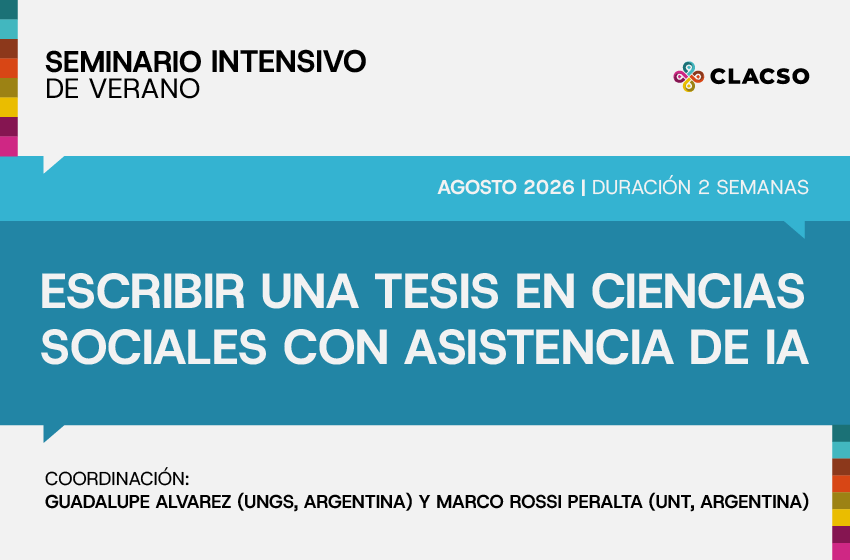
COORDINATION:
Guadalupe Alvarez (UNGS, Argentina) and Marco Rossi Peralta (UNT, Argentina)
Start: 27/08/2026 | Registration: 02/06/2026 to 26/08/2026
Format: Virtual with live classes and exclusive materials
Workload: 90 hours
Duration: 2 weeks
This seminar aims to support students writing their theses in the Social Sciences by approaching academic writing as a situated, progressive, and reflective practice closely linked to research design. The seminar will focus on the thesis as a discursive genre, examining its rhetorical organization, communicative purposes, and linguistic and discursive characteristics, as well as the steps involved in its development within the specific field of Social Sciences. The course will integrate the use of digital tools and artificial intelligence (AI) into this perspective at various stages of the research and text production process, from searching and reading the literature to drafting, revising, and rewriting the final text. In particular, AI will be presented as a powerful tool during thesis writing, a genre that requires extensive reflective work and the mastery of large volumes of information. These technologies will be approached from a critical and ethical perspective, considering their scope, limitations, and conditions for responsible use. In this way, the course will articulate synchronous and asynchronous activities in order to promote the mastery of reading, writing, analysis and textual revision strategies for the preparation of a thesis in Social Sciences, critically analyzing the scope of AI in the processes of research and academic production.
Class 1: Introduction to the thesis in Social Sciences, its relationship with research design and the ethical use of artificial intelligence
Class 2: Using AI for exploratory bibliography search, reading, and writing
Class 3: Writing the state of the art and theoretical framework
Class 4: Standards, citations and bibliographic references
Class 5: Writing the Methodological Section
Class 6: Qualitative Analysis and AI
Class 7: Writing the presentation of results, discussion and conclusions
Class 8: Use of AI in the text composition process
Class 9: Writing the introduction and paratexts
Class 10: Sharing of productions
The course will be delivered online, combining synchronous and asynchronous sessions. Over the two weeks, a total of ten classes will be taught, eight of which will be live and two will be available as recordings for asynchronous viewing.
Live classes will be held on Thursdays and Fridays from 10:00 AM to 1:00 PM (MEX/Central America) / 11:00 AM to 2:00 PM (COL/ECU/PERU) / 1:00 PM to 4:00 PM (ARG/URU/BRA) via the Zoom platform, allowing for direct interaction among participants. In addition, students will have access to exclusive materials, available in the virtual classroom, that will complement the content covered in each session.
| Early registration (until 08/07) | General registration (May 6th to May 14st) | Registration without discount (15/08 to 26/08) | |
| Full or Associate Member Center | $100 | USD 150 | $200 |
| No link | $150 | USD 225 | $300 |
Inquiries: [mail protected]

