
DA REGS INTERNATIONAL SCHOOL
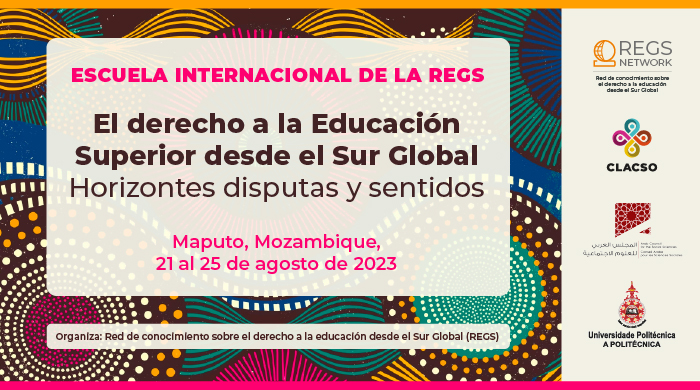

«O Direito ao Ensino Superior no Sul Global: Horizons, Disputes and Meanings»
Organized by the Knowledge Network on the Direct Education of the Global South (REGS).
Maputo, Moçambique | August 21-25, 2023
The Rede de Conhecimento sobre o Direito à Educação do Sul Global (REGS), formed by the Latin American Conselho de Ciências Sociais (CLACSO), or the Arab Conselho de Ciências Sociais (ACSS) and other institutions, invites students of Master's and Doutoramento, political decision-makers and representatives of organizations of society Civil servants committed to the education of the Global South will be candidates to participate in the REGS International School , under the theme: « The Direction of Higher Education in the Global South: Horizons, Disputes and Meanings », which will take place from August 21 to 25, 2023 in Maputo, Moçambique.
The official languages of the School are either Spanish or Portuguese.
BASIS
The direction to education is a fundamental human direction that, driven by social movements and civil society, is expanded in breadth and complexity in the different stages of people's lives. Effective universal access to universities and higher education institutions is on the agenda of several governments, which see this expansion as a way to build more democratic societies, with dignity and justice. At the same time, these direitos are posted em causa or ameaçados our contexts. Access alone is not sufficient to guarantee the effective exercise of this right. It is also necessary to question the type of higher education to which there is access, analyze the content of the higher education curriculum, as well as the conditions in which it is offered, or what can facilitate or limit the permanence of groups that are historically marginalized in these spaces. A global perspective becomes a fundamental approach for critical reflection on education, asking how higher education can be used as a tool for emancipation in life, not just for the people who pass through it, but for society as a whole.
REGS has been working in recent years on the systematization of quantitative and qualitative information, with the objective of understanding the situation of access and permanence in the higher education system, of people who live in various forms of the Global South.
Foram produced documents that showed porous and unfinished maps of the tensions and difficulties faced by regions in relation to education. We discuss stories of various educational experiences that show the inequalities faced by different countries, with the intention of promoting encounters and generating a network to make visible the brands that concentrated capitalism leaves in educational trajectories.
The impact of factors such as poverty, place of residence, gender inequalities, indigenous or religious identities, legal status of the State, deficiencies in the prison context, among other elements, entry and non-transit in the educational system, was also analyzed. We also explored and deepened the analysis of experiences and projects that work to confront and reverse these inequalities.
Based on research and reflection on these questions, REGS hopes to continue to create experiences for dialogue and promote the generation of exchanges on the direction of education from the Global South.
THEMATIC AXES
- Production of knowledge on the educational systems of the Global South:
Here we try to problematize the dominant perspective that focuses only on certain quantitative indicators, sublinhar the need for crossed perspectives as proposed for the approach to intersectionality, and how to demonstrate the diversity that exists in the three regions, not that it says respect for the information available and the limits that it places for the understanding and management of both. educational systems.
2. Experiences and alternative projects :
We include in this list the initiatives promoted by civil society organizations, popular movements, students, teachers and other forms of groups that promote educational alternatives, in order to analyze their scope both in their formulation and in their implementation.
3. Transformative and inclusive public policies and institutional actions :
Here we propose to reflect on institutional initiatives – two central or local governments, such as universities and institutes – that develop social inclusion proposals and promote direct education of diverse populations through schemes that facilitate access and permanence, such as study bags, quotas, restructuring of programs and processes, etc.
SCHOOL CHARACTERISTICS
The REGS International School is a face-to-face space for dialogue, exchange, integration and regional solidarity between post-graduation students, representatives of civil society organizations and those responsible for public policies. The school will address questões related to the direction of education in the Global World. Students will be selected on the basis of academic excellence and professional experience in movements or social organizations, from a multidisciplinary and multiprofessional approach.
OBJECTIVES
- Reflect on the category of «Sul Global», as its potentialities, limits and implications for the field of education in the perspective of direct education;
- Provide a space for exchange, learning and dialogue on the situation in global education, with special emphasis on higher education;
- Exchange knowledge among the participants, about the current situation of the educational systems in the Global South, the inequalities that affect access to permanence, not superiority, and the opportunities that exist for betterment;
- Analyze different historical and current alternative experiences in the Global South, which aim to address and reverse existing educational inequalities;
- Contribute to the construction of networks of academics, social activists and public policy representatives interested in the democratization of higher education from a perspective of social justice and equity.
ORGANIZING INSTITUTIONS:
- Latin American Council of Social Sciences (CLACSO)
- Arab Council for Social Sciences (ACSS)
- Universidade Politécnica (A Politécnica), Moçambique
ACADEMIC COMMITTEE
- Cibele Rodrigues (member of the CLACSO Working Group on Educational Policies and Direito à Educação), Brazil
- Javier Campos Martínez (member of the CLACSO Working Group on Educational Policies and Direito à Educação), Chile
- José Cossa (member of the CLACSO Working Group on Educational Policies and Direito à Educação), Moçambique
- Mariana García Palacios (co-coordinator of the CLACSO Educação e Interculturalidade Work Group), Argentina
- Moushira Elgezeri (Associate Director of the Arab Council for Social Sciences ACSS), Lebanon
- Noelia Enriz (co-coordinator of the CLACSO Working Group on Education and Interculturality), Argentina
- Pablo Vommaro (Research Director of CLACSO), Argentina
- Patricia Ames (researcher at the Center for Sociological, Economic, Political and Anthropological Research – CISEPA PUCP), Peru
- Belchior Canivete (member of the Scientific-Pedagogical Directorate, Polytechnic University), Moçambique
- Carlito Companhia (Faculdade de Letras e Ciências Sociais, UEM), Moçambique
- Innocent Mutimucuio (Director, Instituto Superior de Gestão, Ciências e Tecnologias – ISGCT, Universidade Politécnica), Moçambique
- Francisco Noa (Assessor, Polytechnic University), Moçambique
- Christian Macuamule (Vice-Reitor, Universidade Politécnica), Moçambique
- Ana Carolina Hecht (co-coordinator of the CLACSO Working Group on Education and Interculturality), Argentina
ORGANIZING COMMITTEE
- Cecilia Gofman (Directorate of Investigation, CLACSO), Argentina
- Iris Victorino (Scientific-Pedagogical Directorate, Polytechnic University), Moçambique
- Arcenia Chale (Direcção de Cooperação Universitária, A Politécnica), Moçambique
- Isabel Humbane (Executive and Academic Secretariat, Instituto Superior de Gestão, Ciências e Tecnologias – ISGCT, Universidade Politécnica), Moçambique
- Briolanja Langa (Higher Institute of Higher Studies and Business – ISAEN – Universidade Politécnica), Moçambique
- Tânia Wachene (Instituto Politécnico Superior / Universidade Politécnica), Moçambique
COLLABORATING INSTITUTIONS
- Open Society Foundation (OSF)
- Institute of Education Sciences, Universidad Austral de Chile
- Postgraduate Program in Education, Cultures and Identities (Ufrpe/Fundaj)
- Center for Sociological, Economic, Political and Anthropological Research – CISEPA PUCP
- Faculty of Letters and Social Sciences, Universidade Eduardo Mondlane (FLCS) – UEM
- Interdisciplinary School of Higher Social Studies (EIDAES – UNSAM)
- The School will be organized in the form of Painéis, Dialogues and Workshops.
- In workshops, students will work in groups on each of three thematic topics, in order to reflect on the Direction to Global Education in a transversal way.
A certificate of participation will be awarded to students of the International School who participate in all the proposed activities.
Who can be a candidate:
- Students of Mestrado or Doutoramento with dissertação/tese projects related to the topic of the School;
- Representatives or members of organizations and/or social movements that work or have worked on matters relevant to the subject of the School from different approaches and experiences;
- Representatives of public or private institutions that work with public policies relevant to the subject of the School.
The candidate's work must be included in two of the three thematic subjects planned for the School. In the case of social activists, movements or social organizations and representatives of public policies, they must present a letter of support indicating the reasons why they wish to participate in the School and the possible contributions that it can make for the institution they represent. In this sense, the candidate's area of work must be intimately linked to at least two 3 proposed thematic areas.
An international juridical committee, composed of members of the Academic Committee of the event and other designated guarantors, will proceed to evaluate the candidatures and select the two participants.
The evaluation will be based on academic, geographical and institutional criteria, in order to guarantee the presence of participants from various countries and institutions.
The selected participants who are not residents of Maputo will be entitled to a bag in the form of accommodation in divided rooms and a subsidy for meals outside the venue of the event during the period of activities (August 21 to 25, 2023).
45 participants will be selected, being:
- There were 30 students from Mestrado or Doutoramento and/or public policy makers and/or representatives of social organizations from Africa (who do not reside in Maputo, the host city of the School), Latin America, Caraíbas, the Middle East and Asia.
- There were 15 students from Mestrado or Doutoramento and/ou public policy makers and/or representatives of social organizations, residents of Maputo.
The results of the candidatures will be published on the REGS website https://www.clacso.org/regs/ and the Polytechnic University http://www.apolitecnica.ac.mz on July 14, 2023.
The legal decision will be irrevocable and not subject to appeal.Interested parties should inquire on the CLACSO site, https://www.clacso.org/regs/ through the submission of an online form, submission of their CV, a letter of motivation, a summary of their research project (not in the case of post-graduation students) and a letter of support from their institution (not in the case of social activists, movements or social organizations responsible for public policies) to or email: [email protected]
Email inquiries: [email protected]
RESULTS – Escola Internacional REGS: O Direito ao Ensino Superior no Sul Global: Horizons, Disputes and Meanings

We would like to thank all of the master's and doctoral students, policy makers and representatives of social organizations for their warm welcome to this registration call.
We received 48 candidatures that were endorsed by an international juri, made up of specialists from 6 countries: Ana Carolina Hecht (Argentina), Belchior Canivete (Moçambique), Cibele Rodrigues (Brazil), Cristiano Macuamule (Moçambique), Javier Campos Martínez (Chile), Jose Cossa (Moçambique), Mariana García Palacios (Argentina), Noelia Enriz (Argentina) and Patricia Ames (Peru). The Avaliação Committee considers the quality, relevance and coerência of registrations in accordance with the terms of the call.
After verifying that most of the registrations were of excellent relevance and complete, the Committee selected the following to participate in the School:
|
Name |
Last Name |
Institution of belonging |
Country of residence |
|
Adriana |
da Costa Barbosa |
Federal University of Espírito Santo |
Brazil |
|
Alicia Beatriz |
Acin |
University Program in Prison – FFyH – National University of Córdoba |
Argentina |
|
Anayanci |
Fregoso Centeno |
University Center for Social Sciences and Humanities – University of Guadalajara |
Mexico |
|
Angelica |
García González |
National Autonomous University of Mexico |
Mexico |
|
Aristides |
Obando Cabezas |
Foundation for the Support of Higher Education for Afro-descendant Populations |
Colombia |
|
Carlos andres |
Pastor Pazmiño |
Higher Technological Institute of the Social, Popular and Economy Solidarity |
Ecuador |
|
Cindy Gianella |
Tutiven Desintonio |
National Autonomous University of Mexico |
Mexico |
|
Dani Eduardo |
Vargas Huanca |
National Organization of Aymara, Amazonian and Quechua Communities (OBAAQ) |
Peru |
|
Daniela Vanesa |
Perrotta |
National University of the Arts |
Argentina |
|
Diego Ramón |
García |
Directorate of Higher Education – General Council of Education – Province of Entre Ríos |
Argentina |
|
Eliana |
Dugarté |
Universidad Austral de Chile |
Chile |
|
Eusebia |
Solís |
Popular Education Network Among Women of Latin America and the Caribbean (REPEM LAC) |
Panama |
|
Gisela. |
Sasso |
Faculty of Journalism and Social Communication (FPyCS) of the National University of La Plata |
Argentina |
|
Henrique Andrade |
Henry |
Associação Regional de Agroecologia dos Povos da Cabruca e da Mata Atlântica – Teia Dos Povos da Bahia |
Brazil |
|
Henry Ernest |
Salazar Carrillo |
University Francisco Jose de Calda |
Colombia |
|
Jose David |
Rivera Escobar |
University Francisco Jose de Calda |
Colombia |
|
Jose Pablo |
Prado Cordova |
Faculty of Agronomy – University of San Carlos of Guatemala |
Guatemala |
|
Luz Angela Elizabeth |
Barrera Bohorquez |
Higher School of Public Administration - National Pedagogical University |
Colombia |
|
Magali |
Ramos Jarrin |
University of Cambridge |
Ecuador |
|
Mahira |
González |
University of the Republic |
Uruguay |
|
Marcelo David |
Ochoa |
National University of General Sarmiento |
Argentina |
|
Maria Camila |
dos Santos Rocha |
Federal Rural University of Pernambuco |
Brazil |
|
Mateo |
Rico Dolls |
University of Salamanca |
Colombia |
|
Matias |
Mendieta Duarte |
Positive Youth and Adolescent Network Latin America and the Hispanic Caribbean – J+LAC |
Paraguay |
|
Mauricio |
Humberto Díaz Araya |
Pontifical Catholic University of Valparaíso |
Chile |
|
Mirella |
Guimarães Badarane |
Federal Rural University of Pernambuco |
Brazil |
|
Noelia |
Celeste Cuevas |
Institute for Public Policy Analysis – National University of La Rioja |
Argentina |
|
Oli Yojaydy |
Maturana Correa |
Technological University of Chocó Diego Luis Córdoba |
Colombia |
|
Rodrigo Andrés |
Mardones Carrasco |
Department of Integrated Arts – University of Playa Ancha |
Chile |
|
Yanderi Josefina |
Fernandez Hernandez |
Commission for Access and Permanence of Indigenous Peoples (CAPPI) – Federal University for Latin American Integration (UNILA) |
Brazil |
If some of the selected people fail to appear, the following list of candidates will be considered:
|
Name |
Last Name |
Institution of belonging |
Country of residence |
|
Luis Álvaro |
Gallardo Eraso |
Foundation Center for Studies School for Development |
Colombia |
|
Maria Soledad |
Marquez |
National Commission for University Evaluation and Accreditation (CONEAU) |
Argentina |
|
Nadia |
Ksybala |
National University of Southern Patagonia |
Argentina |
|
Veronica |
Curly |
University National Tres de Febrero |
Argentina |
|
Victoria |
Allende |
National School of Community Organization and Popular Economy (ENOCEP) – Training Secretariat of the Union of Workers of the Popular Economy (UTEP) – (MTE) |
Argentina |
Até 15 students of master or teacher and/or formulators of public policies and/or representatives of social organizations, residents in Maputo, Moçambique, will be added to this selection to participate in the School.
This decision is final and irrevocable.
July 7, 2023

