
“It is time for public policies to prioritize gender-based violence.”
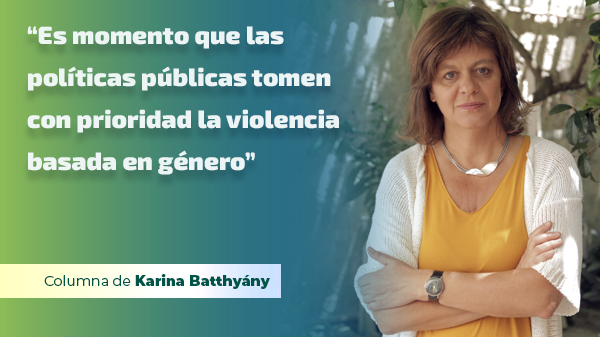
(Transcription of Karina Batthyány's Column)
(in InfoCLACSO – November 30, 2022)
The November 25 is the International Day for the Elimination of Violence against WomenIndeed, it is considered a symbolic date to denounce the violence perpetrated against women, against people discriminated against because of their gender, and to demand policies to end this violence and eradicate gender-based violence. It originated at a meeting of the Latin American Feminist Movement in 1981, to commemorate the date the Mirabal sisters were assassinated in the Dominican Republic.
Our Latin American and Caribbean region faces serious problems due to the entire post-pandemic situation we have been going through since 2020, but we must not forget this other pandemic that has been affecting us for years, which is violence against women and girls and is one of the most serious violations of human rights in Latin America and the Caribbean.
Today, we can say that this violence affects one in three women in the Latin American and Caribbean region during their lifetime. This is shown by international studies on the subject. These are undoubtedly alarming figures that should prompt us to reflect quickly, but above all, to take action, to develop policies and measures that will allow us to overcome this situation.
Furthermore, let's remember that this situation, which predated the COVID-19 pandemic, was exacerbated during the worst moments of the pandemic (the lockdowns). Specifically, we observed an increase in gender-based violence and, moreover, an insensitivity in the policies implemented by governments to address this issue. In other words, it didn't occur to anyone, when the lockdowns were decreed, that for many women, being confined with their abusers or potential abusers would become a death trap.
Gender-based violence is an extreme manifestation of gender inequality, affecting women and girls primarily because of their gender and their subordinate position in society. The consequences of gender-based violence for its victims are undoubtedly devastating and long-lasting. It's not just the immediate impact of the violence itself, but also the lingering effects on the physical, mental, and emotional well-being of women and girls.
Furthermore, this violence knows no geographical or cultural boundaries: it is a form of violence that is sadly globalized, that does not distinguish between classes, races, ethnicities, age groups, or different groups of belonging, and that is directed at women and girls simply because they are women and girls. It manifests itself in different dimensions: physical, sexual, emotional, economic, and institutional violence, among others.
There is also no specific profile of victims of violence, because simply being a girl or a woman makes one a potential victim of this violence. Recent data published by ECLAC through its Gender Equality Observatory for Latin America and the Caribbean indicates that in 2021 there were almost 4.500 women victims of femicide in the 29 countries and territories of the region that report information on this issue. These victims of femicide, or feminicide, are undoubtedly the most dramatic and extreme forms of this expression of violence.
In addition, there are approximately 12 violent deaths of women due to gender-based violence every day. On a day like today, we will lose 12 more women, victims of femicide.
Undoubtedly, Latin American and Caribbean states have taken some steps in recognizing this problem and have also expressed some policies and regulations, made progress in approving laws and protocols, and in building (in many countries) specific institutions to address it, but none of this has been enough. Because the most recent data shows that the phenomenon is not decreasing. Gender-based violence and femicides remain just as intense.
Looking at the 2021 figures, of the 18 Latin American countries or territories that provided information—and it's important to remember that the issue of data availability is problematic here, because the recorded data always includes underreporting, meaning cases of violence or femicides that go unreported or unregistered in official statistics—we can see that of the 18 Latin American countries or territories that provided information, 11 had a rate equal to or greater than one femicide victim per 100 women. The highest femicide rates in Latin America in 2021 were recorded in Honduras with almost five cases per 100 women; the Dominican Republic with nearly three cases per 100 women; El Salvador with two and a half cases per 100 women; Bolivia with nearly two cases; and Brazil in the same situation.
Now if we look at the Caribbean, we see that in eleven countries and territories that also provided information on this point, Belize and Guyana presented the highest rates of femicide (3,5 and two per 100 thousand women in these Caribbean countries).
I also want to mention this phenomenon in terms of age, because the available figures show us very clearly that adolescents and young women, between 15 and 29 years old, make up the age group in which the largest proportion of femicide cases are concentrated, according to data from the ECLAC International Gender Observatory.
Furthermore, there is something that should make us reflect on an age group: practically 4% of all these femicides correspond to girls under 14 years of age.
When we talk about girls and adolescents, gender-based violence, and particularly femicides, also affects children and adolescents in terms of the loss of their mothers or caregivers, who are victims of gender-based violence. In other words, children are left without their mothers or caregivers because of this problem or this pandemic affecting our region.
Much important work remains to be done regarding statistical information, specifically to accurately provide data on how this pandemic of gender-based violence is affecting the region. There has been improvement, according to the ECLAC International Gender Observatory, but there is still a long way to go.
At the XV Regional Conference on Women in Latin America and the Caribbean, held in Buenos Aires a few weeks ago, the Latin American and Caribbean member states of ECLAC reaffirmed their commitment to achieving a transformative recovery with gender equality, focused on the sustainability of life and transitioning towards a care society. When we consider this commitment, one of the central elements is clearly to continue working on adopting and implementing laws, policies, action plans, and educational programs for awareness-raising, prevention, and support regarding gender-based violence. This includes working towards the prosecution and eradication of these forms of violence that affect women, adolescents, and girls in all their diversity, in different contexts, and in all their manifestations.
This resolution adopted at the last Regional Conference on Women is important. It is time for the states of the Americas and the Caribbean to finally address this issue with absolute priority and seriousness, understanding that this is indeed a pandemic that permanently affects our region. Public policies, plans, programs, and actions developed or promoted by states are absolutely central to preventing and eradicating gender-based violence. And here, the state is not just another actor; it is a leading actor in terms of these policies against gender-based violence.
-I'm left with this particular need: without data, the phenomenon of gender violence cannot be clearly understood, and there is a great risk that some public policies will not give it enough attention…
Yes. In any case, they underreport the impact shown by the numbers, which are already very significant. We know that what they show is less than what actually happens because some reports go unreported or some cases don't reach official records. Therefore, they aren't included in these statistics. The point is to show the importance and the gravity of this issue, and ultimately, to demand that the states of Latin America and the Caribbean guarantee the right of all women and girls to live a life free from all forms of violence. That should be the primary commitment of the states in our Latin American and Caribbean region.
If you would like to receive more information about CLACSO's training programs:
[widget id=”custom_html-57″]
to our email lists.

