
"Integration and cooperation at the regional level are more necessary than ever."
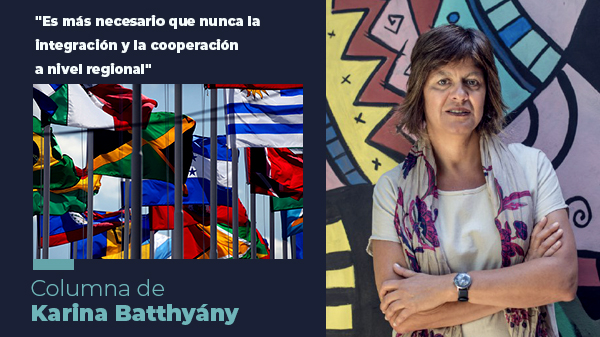
(Transcription of Karina Batthyány's Column)
(In InfoCLACSO – August 4, 2021)
I propose we talk about Regional Integration and Cooperation. The first point I want to raise regarding Regional Integration (which we've already discussed in other columns) is that if anything has become very clear in the context of this ongoing pandemic, it's that the search for solutions, the search for alternatives to the various problems we face as a region, will not be done in isolation. In other words, it cannot be done individually, either at the level of people or collectively, such as by states or countries.
Regional integration and cooperation are absolutely more necessary than ever. Therefore, the issue of regional integration is once again on the agenda, and with a profound sense of urgency for the Latin American and Caribbean region. And of course, CLACSO supports these processes of regional integration and cooperation, among other reasons, because we are convinced of the richness of our Latin American and Caribbean region in terms of its human, cultural, social, and scientific capacities, enabling us, as a collective and as a region, to find alternatives.
However, when we say Latin America and the Caribbean, we also know that we are talking about a region, a Latin America that is both one and many at the same time. It is one because we share a community of interests, culture, projects, and aspirations, but we must also acknowledge the diversity within our Latin American and Caribbean region: a diversity of languages and cultures. It is precisely in the blending of these diversities that we believe the best version of our Latin American and Caribbean region lies.
We must acknowledge this diversity and, from there, address the challenges of regional integration. These challenges must be analyzed from a geopolitical perspective, as well as considering the current context and the historical evolution of regional integration. In particular, from our perspective—the social sciences and humanities—we must also identify the key issues for Latin American and Caribbean social sciences within this regional framework.
The first issue is inequality, the fact that this is the most unequal region in the world, and this must be one of the key topics: inequality permeated by multiple dimensions such as gender, ethnicity, urban and rural status, education, age, and a long list of other factors that we have been addressing here in our columns. We need to approach this issue of inequality from a regional perspective, not only to better understand it but also because that is where we will find the crucial alternatives needed to overcome this situation of inequality.
Furthermore, we also have other key issues, such as the current state of democracies and the processes of political instability in our region, which we must also place on the regional discussion agenda. Of course, there is also the issue of the environment and climate change: how to protect our continent's environment, the biodiversity that characterizes us, and how to directly address the environmental and social consequences of global climate change in the Latin American and Caribbean region.
We also address issues related to migration and human mobility, which we have discussed here as a human right. Understanding these migratory processes, which are undoubtedly a social phenomenon with a significant impact on the current reality of Latin America and the Caribbean, is crucial, and of course, the dimensions of inequality also emerge. Furthermore, we must raise (a specific challenge for CLACSO) the need to discuss the processes of knowledge generation, scientific development, and technological development, which are so necessary in our region and which became very evident during the pandemic: the need to strengthen scientific systems in Latin America to avoid these levels of dependency. For example, another topic we address here (in InfoCLACSO) is vaccines, especially access to vaccines for the Latin American population.
Ultimately, when we talk about Latin American and Caribbean Integration and Cooperation, we are discussing the project of Latin America as a region, as a continent, and the construction of shared interests, drawing on the various lessons we have learned over the years to build a strategic vision for the future. This vision will allow us to understand what has happened in Latin America, where we are headed, and what we can do to build or strengthen democratic alternatives that overcome the exclusionary models that, among other things, determine the unfortunate condition of being the most unequal region on the planet.
In that regard, I want to remind you that CLACSO, together with CELAC (Community of Latin American and Caribbean States), also published a report over a year ago seeking these alternatives or proposing some possible paths toward them, where the key words are democracy, solidarity, interdependence, and co-responsibility. And where, basically, in five or six sentences, what we established was the search for alternatives in terms of redesigning the economic model, proposing debt reduction and the need for a basic citizen's income, strengthening the quality of our democracies, consolidating universal access to healthcare, building a new relationship with the environment, rethinking human mobility and migration, reducing or at least narrowing the existing gender gaps in our region, and also proposing the need to reformulate the link between the social sciences and politics, to draw on the results that the social sciences provide us in terms of research and knowledge, elements for better decisions and the better construction of these alternatives.
In short, we are at a point where building alternatives and offering alternative interpretations of reality are urgently needed. We believe that critical reflection and the production of knowledge from the social sciences are absolutely fundamental to building the future that I am sure we all desire. Ultimately, it means applying what at CLACSO we consider one of the guiding principles in all our actions: knowledge, but for social transformation.
In this sense, then, it is important to highlight once again the importance of Regional Integration and Cooperation and of organizations such as CELAC, which today represent one of those spaces for integration and cooperation without any exclusion in Latin America and the Caribbean.
That is why we insist that always, always, but today it became clearer than ever with the consequences of the pandemic, that the solutions can never be individual and isolated but collective and we need to empower and integrate ourselves as a region.
If you would like to receive more information about CLACSO's training programs:
[widget id=”custom_html-57″]
to our email lists.

