
“It is essential to promote open Latin American science”
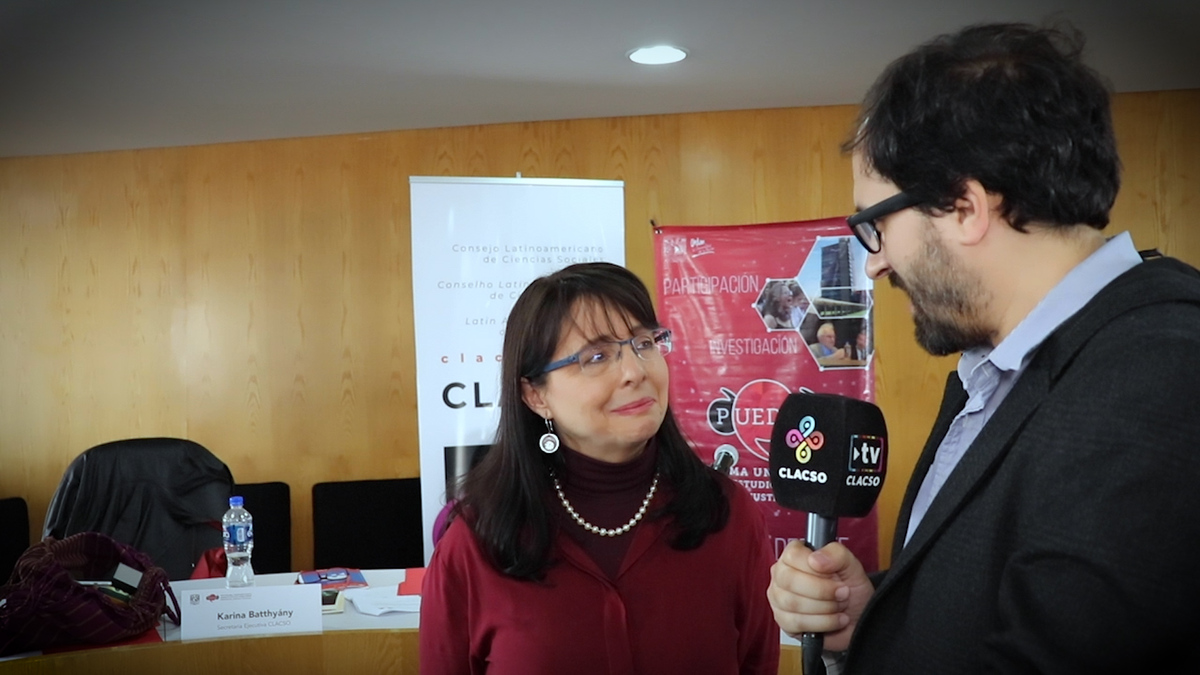
María Elena Álvarez-Buylla Roces, Director of the National Council of Science and Technology of Mexico (Conacyt), participated on February 7 and 8 in the Conversation “Neoliberal Authoritarianism or Democratizing Democracy?: The Dispute for the Future in Latin America”, jointly organized in Mexico City by CLACSO and the “University Program of Studies on Democracy, Justice and Society” (PUEDJS-UNAM).
In that context, interviewed by CLACSO TV, she considered it "essential to promote an open Latin American science, to speak more in our Spanish and native languages and to understand each other more than trying to communicate through a language that we do not speak well."
Interviewed by Gustavo Lema
The director of Conacyt elaborated, saying, “We must break down reductionism, the barriers between different disciplines, and this limitation of Western science, especially Western technoscience, in truly understanding the complex phenomena behind all the problems facing the region. Two challenges have been identified: first, to break this unidisciplinary vision, because problems are not confined to a single discipline, but are multidisciplinary, interdisciplinary, transdisciplinary, and complex. Then, we also face the challenge, from the humanities, sciences, and technologies, of transforming reductionist paradigms into scientific paradigms that understand the systemic and the complex, while also incorporating knowledge that is not generally formally included in scientific and technological practice. This knowledge has demonstrated to the world that it has much to contribute to solving some of the challenges presented by today's environmentally devastated and turbulent world.”
In another vein, María Elena Álvarez-Buylla Roces stated: “We are experiencing a second wave of regime change in Latin America, particularly in Argentina and Mexico, toward a transformation with promise. I say with promise because we must demonstrate an improvement in living conditions for all Mexicans and Argentinians. That is, we must break with neoliberalism, which has exacted such a heavy toll on our nations. But there is much to learn from other nations that are unfortunately once again suffering coups d'état, as is happening in Bolivia, and from other nations that have exercised this transformative impulse, such as Brazil and Ecuador, and which have valuable experience. Therefore, it is essential to organize events like these, initiatives that allow us to accumulate these experiences, learn from them, and also share the strengths we have in Latin America. The discussion focused on biocultural richness: it is fundamental to promote open Latin American science, to speak more in our Spanish and Indigenous languages, and to understand each other rather than trying to communicate through a language that none of us speaks well.”
If you would like to receive more information about CLACSO's training programs:
[widget id=”custom_html-57″]
to our email lists.

