
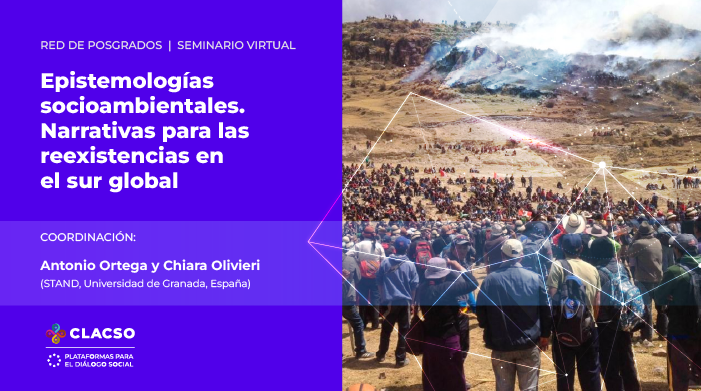
Socio-environmental epistemologies. Narratives for re-existence in the global south
Seminar 2326
Coordination: Antonio Ortega and Chiara Olivieri (South Training Network Action of Decoloniality, University of Granada, Spain)
Teaching Team: Chiara Olivieri (University of Granada, Spain) – Luis Sánchez Vázquez (University of Granada, Spain) – Diego Checa Hidalgo (University of Granada, Spain) – Ayelen Dichdji Cear – (University of Quilmes, Argentina) – Adrián Gustavo Zarrilli (Cear – University of Quilmes, Argentina) – Alberto Matarán Ruiz (University of Granada, Spain) – Pablo Corral Broto (Université La Réunion, France) – Gennaro Avallone (Università Di Salerno, Italy) – Jason Moore (Binghamton University, USA) – João Alveirinho Dias (Universidade Do Algarve, Portugal) – Davis Pereira De Paula (Universidade Do Estadual Do Ceará, Brazil) -Joana Gaspar De Freitas (Universidade De Lisbon, Portugal) – Ana Cristina Roque (Universidade De Lisboa, Portugal) – Juliana Merçon (Veracruzana University, Mexico)
Start: 28/08/2023 | Registration: 23/06/2023 to 27/08/2023
Workload: 12 weeks – 90 hours.
STAND South Training Network Action of Decoloniality is an interdisciplinary research group born from the collective desire to generate research synergies in the fields of social sciences, environmental sciences, and humanities. Therefore, we have set out to foster comparative reflection with sectors both within and outside academia on our core areas of work: decolonial studies, environmental knowledge, and processes of building decolonial resistance in the context of human rights and peace processes. Building new social projects is our challenge in the field of social research, and we believe we can foster future collaborations. This commitment to situated research, both socially and politically, compels us to break with and transcend Eurocentric frameworks of thought, and we are generating research from Latin American contexts—as demonstrated by our active projects—as well as from Asian and African contexts. We are committed to the concept of Socio-Environmental Epistemologies. Narratives for Reexistence from the Global South is a training forum for researchers from Spain, Mexico, Portugal, and Argentina with projects in American, African, and European contexts that examine the relationships between human societies and nature throughout recent history. We structure concepts methodologically at the intersection of Environmental History, Political Ecology, and Peace Research to build inter-epistemic boundary knowledge.
From the STAND Group Research Work, which as an Associated Institution of CLACSO leads this virtual training proposal, we as team 3 have been developing extensive research work in the field of intersection and ecology of knowledge between environmental history and decolonial studies. Our proposal presents several elements that we consider to be of interest. First, the dialogue between decolonial research methodology and elements of research in Environmental History. A second element of high value we consider to be our intuitive view of the Global South by launching research laboratories in Mexico, Palestine, Ecuador and China to understand, by adding forces and efforts of the participatory research methodology (the third axis of methodological intersection) that can provide students with a powerful view of the forms of biocultural resistance and the narrative of socio-environmental violence in these territories. With all this in mind, we look very closely at the research processes on how capitalist modernity has impacted communities in different places, times and spaces. Destruction of the biocultural memory of these territories both through the deprivation of territorial identity and through the very practices of violence and extermination that Nation States have carried out in these places. To achieve this, we have a broad and cross-disciplinary background in the team, from the fields of Contemporary History, Geography and Political Ecology, and Philological Studies in both Asian and Arab contexts, which are some of the points highlighted by the team. We investigate, but also how our own identity as a Group highlights, we conduct research to promote critical and denunciatory perspectives, to create citizen awareness about the impacts of these processes of ecocide or epistemicide. They erase the memory of the territory, the awareness of place, of belonging to the identity of the space as a first element with which to dismantle any praxis of resistance. To this end, with virtual training we are committed to creating a community of knowledge and recognition in the act of denunciation that allows us to continue building networks towards the future with the knowledge and collaborative practices that can be articulated from the work of the Research Group. This step represents the realization of an already complex task in the training of researchers, which our curriculum supports in Master's degrees in History, Master's degrees in Development Cooperation, Master's degrees in Conflict Resolution and Peace Management, as well as in East Asian Studies, with which we can guarantee a training capacity from which this proposal draws and which can be an important step further in the same. This training process, if it has the endorsement of CLACSO, is the initial step in processes that can be broader with the tasks of the Group that endorses it and the multiple research projects underway, but tending to promote, from the responsibilities of the Principal Investigator in the field of Doctoral Training from the University of Granada, a process of even greater depth and international dimension towards the future. For all these reasons, specific training with a capacity for interdisciplinarity and ecology of knowledge, deep knowledge in relation to the modules proposed as an expanded translation of doctoral training areas already underway in our respective teaching centers, is why we consider that we are facing a proposal 4 that may have relevance and interest for the CLACSO knowledge community.
GENERAL OBJECTIVE To express the overall objective of the course. This Virtual Training project has a series of General and Specific Objectives, which we formulate below.
1. Training in Decolonial Research Methodologies incorporating environmental knowledge specific to Environmental History research. A specific bibliography with extensive research in the relevant fields is proposed for this purpose.
2. To build and respond to the proposed title for our projects, the Team has brought together an interdisciplinary training that combines methodological tools from the field of historical, philological and geographical studies put at the service of decolonial research.
3. With our focus on the Global South and our extensive training and research experience accumulated over the past two decades as a Research Group and recently affiliated institution of CLACSO, we can offer a profound look at the processes of biocultural resistance developing in the Americas, Asia, and the Middle East. Therefore, we can build a community of researchers willing to step outside their comfort zones and join us in creating participatory research on these selected laboratories.
4. In the field of Methodologies we offer a wide range that includes methodologies specific to the field of Environmental History, Critical Geography, History of Peace and Conflict Resolution, as well as Human Rights Research.
5. To implement, with all the methodology indicated above, an interaction process that has as its working matrix the decolonial research that unfolds in our project in the working laboratories from which we build our research, in the South in the Global Souths.
SPECIFIC OBJECTIVES
That the students: -
1. To design a community of researchers for the future who can own and control research tools with which to launch new research projects from their places and territories.
2. To offer the CLACSO Community training that incorporates logics from Global Geopolitics in Asia and the Middle East, which are new and emerging fields in the CLACSO Research Groups in which we want to insert and support our proposals.
3. To make available to the participants in the Course audiovisual materials from the working funds of the STAND Research Group with the presence of researchers from Universities such as Georgetown, which will be support and in-depth materials for the seminars we teach in each module.
4. To incorporate into our research diverse components from the field of environmental studies, but including elements such as ethno-territorial or religious conflicts for a better and more appropriate understanding of phenomena of intense conflictual dimension today.
- Looking to the Global South: Towards a Decolonial Methodology Applied to Re-existences.
- A way to face the century of collapse: a decolonial analysis of socio-ecological conflicts and transitions
- Environmental conflicts and injustices: Perspectives and contributions from the Global South
- Chinese colonialism. Modernizing megaprojects and the desertification of natural and human resources.
- The Palestinian armed struggle against the colonial megaprojects of Israeli settlements in the West Bank
- Decolonial ecologies and mulatto, creole, mestizo, and creole environmental histories.
- Epistemologies of action: knowledge in movements for socio-environmental justice
- Major material transformations and neocolonial narratives. Environmental conflicts in South America (1990-2019)
- Challenges of coastal management: the contribution of a history of the dunes
- Phytochemical knowledge and practices in sub-Saharan Africa: society and territory, biodiversity and knowledge transfer
- Empires of knowledge, colonies of cheap nature.
- Álvarez, L. and Coolsaet, B. 2018: Decolonizing Environmental Justice Studies: A Latin American Perspective, Capitalism Nature Socialism, DOI: 10.1080/10455752.2018.1558272
- Awad, ME 1984. “Non-violent resistance: A strategy for the Occupied Territories,” Journal of Palestine Studes 13(4): 22-36. DOI: 10.2307/2536988
- Checa Hidalgo, D. 2016. "Resisting the occupation of the Palestinian Territories. Opportunities and challenges of non-violent struggle", Miscellany of Arab and Hebrew studies. Arab-Islamic Section 65: 3-20.
- Clarke, M. 2017 (July 20). “The Belt and Road Initiative and China's Xinjiang Dilemma: 'Connectivity' Versus Control?” The Central Asia-Caucasus ANALYST. https://www.cacianalyst.org/publications/analytical-articles/item/13458-the-belt-androad-initiative-and-china's-xinjiang-dilemma-“connectivity”-versus-control?.html
- Domínguez De Olazábal, I. 2019. “The influence of postcolonialism on the study of Israel/Palestine: from the anticolonial perspective to the decolonial framework, passing through settler colonialism”, International Relations 42: 95-117.
- Farrés Delgado, Y.; Matarán Ruiz, A. 2014. “Towards a transmodern and decolonial urban theory: an introduction”. Polis. Latin American Journal 13(37): 339-361.
- Matarán Ruiz, A. 2011. “The local project in the Ibero-American sphere: towards a territorial synthesis of good living”. In Magnaghi, A. The local project. Barcelona: Polytechnic University of Catalonia.
- Olivieri, C. 2018. “Steppe and Silk Roads in the Mirror of the Xinjiang Uyghur Autonomous Region. Fluid Borders and Construction of Historical-Identity Narratives”. Quaderns de Filologia: Estudis Literaris, 23:23-38.
- Pérez Rincón, M. 2018. “Environmental Justice as a strategic line of Ecological Economics: how to highlight environmental injustices?” Management and Environment 21(1): 57-68.
- Riechmann, J.; Carpintero, O.; Matarán, A. 2015. The uncertain steps from here to there: socio-ecological alternatives and post-capitalist transitions. Granada: Editorial UGR.
- Riechmann, J.; Matarán, A.; Carpintero, O. 2018. To avoid barbarism: trajectories of ecosocial transition and collapse. Granada: Editorial UGR.
- Sautman, B. 2000. “Is Xinjiang an Internal Colony?” Inner Asia, 2(2): 239-271. ‣Rudelson, JJ 1997. Oasis identities: Uyghur nationalism along China's Silk Road. New York: Columbia University Press
- Temper, L., Demaria, F., Scheidel, A., Del Bene, D., Martínez-Alier, J., 2018. “The Global Environmental Justice Atlas (EJAtlas): ecological distribution conflicts as forces for sustainability.” Sustainability Science 13: 573-584.
- Tetrault, D. et al. Socio-environmental Conflicts and Alternatives of Civil Society. Guadalajara, ITESO https://rei.iteso.mx/handle/11117/425 ‣Ortega Santos, A. et al. (2007) “Peasant Protest as Environmental Protest, 18th-20th Centuries” Agrarian History. 17 - 42, pp. 277 - 301. 2007 6 ‣Mulligan, M.; Adams, W. 2003. Decolonizing Nature. Strategies for Conservation in a Postcolonial Era. Earthscan Pub
- Yu, H. 2017. “Motivation behind China's 'One Belt, One Road' Initiatives and Establishment of the Asian Infrastructure Investment Bank.” Journal of Contemporary China, 26(105): 353-368.
|
|
Discount for one payment until 25/08 |
In one payment after 25/08 |
|
CM Plenos |
$75 |
$150 |
|
CM Associates |
$95 |
$190 |
|
No link |
$95 |
$190 |
FAQ
The basic requirements for taking a seminar are:
- Availability of at least 4 hours per week to dedicate to the seminar course.
- Internet access.
- Reasonable handling of communication and computer tools.
- Language proficiency in the language in which the course will be taught. The official languages are Spanish and Portuguese.
|
|
Discount for one payment until 25/08 |
In one payment after 25/08 |
|
CM Plenos |
$75 |
$150 |
|
CM Associates |
$95 |
$190 |
|
No link |
$95 |
$190 |

