
Southern epistemologies
8th Turma (2023-2024) – VIRTUAL MODALITY
Specialization: 40 credits, 360 hours / classroom
International course: 9 credits, 90 hours/classroom
Duration: April 2023 and March 2024.
The certification of the Specialization and the International Course will be carried out by the Latin American Faculty of Social Sciences (Flacso Brasil) and the Latin American Council of Social Sciences (Clacso).
ACADEMIC COORDINATION:
Karina Bidaseca (CLACSO, Universidade Nacional de San Martín and Universidade de Buenos Aires, Argentina) and María Paula Meneses (Universidade de Coimbra, Portugal)
GENERAL MANAGEMENT
Rita Gomes do Nascimento (FLACSO Brazil) and Karina Batthyány (CLACSO)
We live in turbulent and complex times. As Epistemologias do Sul, proposed by Boaventura de Sousa Santos, propose an expansion of the political imagination to além the intellectual and political exhaustion of the global North. This exhaustion translates into the inability to face the challenges of this century and the threats to democracy, rights and human dignity. The global world, the world we will discuss in this course, is a metaphor for human suffering caused by major forms of oppression - capitalism, colonialism and patriarchy - and various forms of mourning and resistance to these forms of oppression. . Nesse sense, as Epistemologias do Sul attempt to expand the possibilities of rethinking the world from two knowledges and practices of the Global South, challenging the attempts of epistemicidio, linguicídio or epistêmica subalternização. Nesse cenário, as Epistemologias do Sul provide theoretical and methodological instruments that allow the development of a critical diagnosis of the present that has as a constitutive element the possibility of reconstructing, formulating and legitimizing alternatives for a more just and free society.
A Especialização eo Curso Internacional assentam em três eixos fundamentalis assentes nas Epistemologias do Sul:
- That the interpretation of the world surpasses the Eurocentric interpretation of itself;
- That it is not possible to have global social justice without global cognitive justice;
- That the emancipatory transformations produced in the world cannot be limited to grammars and frameworks developed by critical theory focused on the global North; On the contrary, the Epistemologies of the South demand a diversity of knowledge that sustains the social struggles that it is important to (re)conform and value.
This training space, aimed at promoting South-South interdisciplinary dialogues, seeks to record and interpret the knowledge that sustains social struggles in our times and in our societies. This knowledge is not just academic; I know about artists, people from Campo, activists, among many others. At the same time, it aims to study the Global World in all its diversity, a South that metaphorically translates a vast field of economic, social, cultural and political innovation of increasing diversity, in which the dialogues between knowledges translate the conditions of plurality.
Students trained in specialization must:
- Understanding the main characteristics that define modern societies does not mean respecting the social and political quests that characterize the diversity of the global South.
- Identify the institutional conditions, as well as the government instruments for the promotion of public policies committed to defending human rights.
- Record and interpret the knowledge that sustains social struggles in our time and in our societies.
- Develop theoretical-argumentative production skills on the topics worked on throughout the course.
The Specialization of the International Course is intended for graduates; post-graduation students; activists and activists of union organizations, social movements and political parties; public officials; printing workers; members and managers of organizations not governed and professionally interested in the matter.
A university diploma is required.


Center for Social Studies, University of Coimbra, Portugal


Centre for Social Studies, University of Coimbra, Portugal


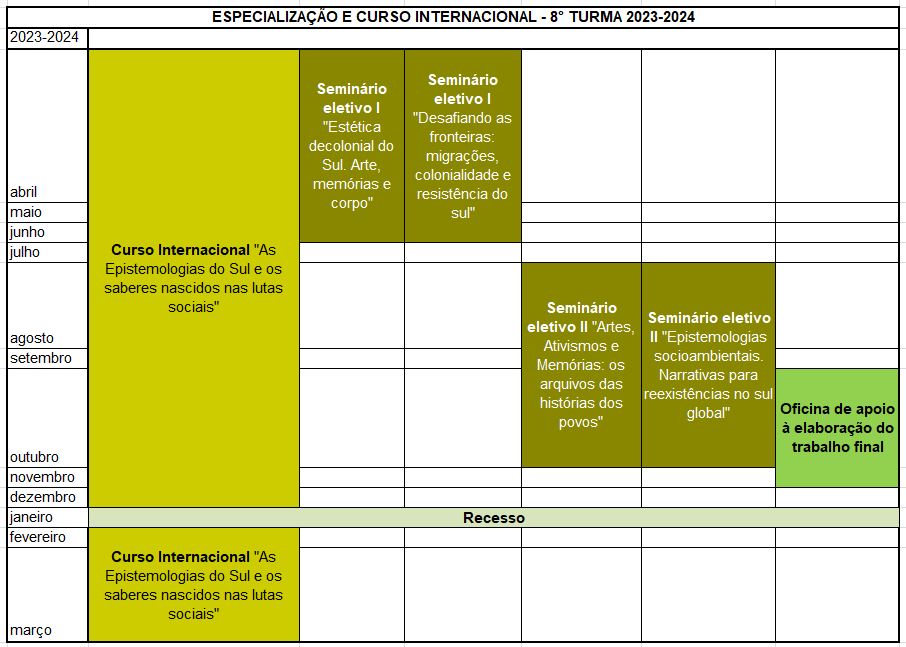
A Especialização em Epistemologias do Sul has a duration of 12 months and requires the completion of:
- An international course
- Two elective virtual seminars for curricular offerings
- A support office for the elaboration of final integrative work
- Preparation of a final integrative work
The Specialization has a total workload of 360 hours/classroom and is certified by CLACSO and FLACSO Brazil.
The International Course can be done independently without the need for registration in the Specialization program. It lasts 12 months, has a total workload of 90 hours/classroom and is certified by CLACSO and FLACSO Brazil.
Students will receive support from academic tutors who will accompany the course in different curricular areas and guide the completion of final work.
CLARIFICATION: Enrolling in the complete Specialization does not require enrolling separately in the International Course.
The curricular spaces will be offered in both Spanish and Portuguese. Likewise, the bibliography may be offered in the two official languages of the course. As two students intervene, our discussion forums can also be different languages. The final integrative work may be in Spanish or Portuguese.
As Epistemologies of the South and the knowledge born in social struggles
This international course on the Epistemologies of the South aims to present and debate knowledge produced in the South, a basis for reflection for social transformation in the current times. In other words, as I study the various possibilities revealed after the Epistemologias do Sul, this course has as its theoretical and methodological objective the overcoming of the characteristic model of modern Eurocentric thought, namely, the abyssal thought.
Knowing from South to South requires a different political and epistêmic orientation. The Global South, the central theme of this course, seeks to reconfirm and validate the knowledge produced by the oppressed, by women and men who suffer from injustice, oppression, domination, exclusion, caused by capitalism, colonialism and patriarchy. As Epistemologies of the South, as a metaphor for the exclusion, silencing and destruction of people and knowledge, we seek to embody the knowledge and experiences of the global South, based on methodological and reflective assumptions in dialogue, in opposition to any ethnocentric proposal.
The teachers of the course will try to problematize, from different geopolitical and epistemic places, the conditions for a horizontal dialogue between knowledges, for the ecologies of knowledges. These dialogues and the lições that they contain reflect the innovations that occur in countries and regions of the global South. This demanding commitment presupposes availability for mutual recognition, intercultural understanding, political and ideological convergence, and respect for identity and celebration of diversity, as conditions for a more democratic dialogue in the global world.
Building knowledge from the Epistemologies of the South requires other working methodologies. Learning as one's own, in its diversity, means going beyond conventional academic knowledge. Building dialogues between different knowledges and struggles seeks to give visibility to the people and social groups whose practices are only built from this knowledge. Only then will it be possible to develop alternative narratives that question the impossibility of thinking about differences (sexual, ethnic, racial, class, caste, religious, etc.) with equality, an intimate connection between local and global, projects of other economies and other political societies. In the second part of the course, it is proposed to map, present and discuss a variety of work methodologies anchored in the body of knowledge developed from the perspectives of Epistemologies of the South, privileging the ecology of knowledge of knowledge and the possibilities of intercultural translation between knowledge born in struggles.
Summary: This office aims to support the preparation of the final work of the Specialization in Epistemologies of the South. It will serve to support the identification of the subject of the final work, interlinking the topics addressed throughout the International Course, such as the research interests and the students' own paths. It seeks to subsidize the identification and justification of the topic to be discussed; consolidate the conceptual and methodological tools worked on and support the production of the final work that can be both written and audiovisual, performative or of another genre.
Coordinator: Karina Bidaseca (CLACSO, Universidade Nacional de San Martín and Universidade de Buenos Aires, Argentina)
first semester
Summary: The seminar proposes a journey between some contemporary theories on migration and its readings from Latin America, as around material and symbolic places of modern-colonial and historical history, such as the Mediterranean Sea and the internal circuits of the diaspora. Africa to Latin America. Categories such as intersectionality and even differential, contemporary migration policies, conflicts and experiences of struggles around borders will be deepened.
Coordinator: Karina Bidaseca (Universidade Nacional de San Martín, Universidade de Buenos Aires, Argentina) and Maura Brighenti (Universidade Nacional de San Martín, Argentina).
Summary: The objective of this course is to discuss how the coloniality of power increases in bodies marked by gender and social class. Coloniality is an open wound that reflects on our bodies as an indissoluble mark. We propose that a situated and liberating aesthetic as practiced by the artists considered here makes it possible to break the legacy of victimization and violence. In this course we place this paradigm in dialogue with other writings that also reflect on the importance of a situated and liberating aesthetic. A major contribution of the course is to expose students to a wide network of theorists who construct different interpretations of the thinking placed on the coloniality of power. Based on this, students will review critical theories about decolonial aesthetics and how it is applied to the following artists: Ana Mendieta, Zanele Muholi, Regina José Galindo, Shirin Neshat, Fatima Mernissi, Teresa Margolles, Adriana Varejao, Joyce Kozlof, Mona Hatoum, among others.
Coordinator: Marta Sierra (Kenyon College, United States) and Karina Bidaseca (CLACSO, Universidade Nacional de San Martín and Universidade de Buenos Aires, Argentina)
Second semester
Summary: In many societies of the global South, deeply marked by the colonial relationship, the knowledge about their history is built on assumptions, methodologies and sources that perpetuate the maintenance of Eurocentric perspectives. This is a colonial heritage that is intended to be replaced by an agenda for the production of plural knowledge and intercultural translations, starting from an analytical perspective on oral, collective and personal histories, starting from the arts and two creative spaces.
The seminar presents research carried out in various social and political contexts, reflecting on how to educate new generations about the histories and struggles for social justice that are found in the cultural and artistic expressions such as cinema, literature, theatre, music, plastic arts, oral narratives, street arts, privileged groups for communicate, produce knowledge about these stories and their cultural identities.
Coordination: Marisa Ramos Gonçalves, María Paula Meneses and Iolanda Vasile (CES – Center for Social Studies, University of Coimbra)
Summary: A South Training Network Action of Decoloniality (STAND) is an Interdisciplinary Research Group born from the collective desire to generate research synergies in the field of social, environmental and human sciences. For everything, we proposed to sponsor processes of comparative reflection with sectors within and fora da academia naqueles that são our eixos centrois de trabalho: colonial studies, environmental knowledge and processes of construction of decolonial resistance in the field of human rights and peace processes. Building new social projects is our challenge in the field of social research to which we can contribute. This commitment to socially and politically situated research obliges us to break and transcend Eurocentric spheres of thought and we are generating research both in the Latin American context - our active or demonstration projects - and in the Asian and African context. The commitment is as the concept of Socio-environmental Epistemologies. Narratives for the ReExistência do Sul Global is a formative meeting point for researchers from Spain, Mexico, Portugal and Argentina with work projects in American, African and European contexts that are discussed about the forms of relations between human societies and nature throughout recent history. We structure concepts from a methodological point of view at the intersection between Environmental History, Political Ecology and Peace Research for the construction of knowledge of interepistêmic borders.
Coordinator: Antonio Ortega (South Training Network Action of Decoloniality, STAND, University of Granada, Spain)
CM Plenary: you belong to a Plenary Member Center of CLACSO
Associate CM: You belong to an Associated Center of CLACSO.
Without link: You do not have any links to CLACSO.
|
Payment in a parcel until 10/04 |
Payment on a parcel after 10/04 |
Payment in 3 parcels | |
| CM Pleno | $460 | $570 | USD 750 (3 x USD 250) |
| CM Associate | $590 | $700 | USD 1020 (3 x USD 340) |
| No connection | $660 | $960 | USD 1290 (3 x USD 430) |
In all cases, payment may be made by letter of credit, deposit or bank transfer.
The certification of the Specialization and the International Course will be carried out by the Latin American Faculty of Social Sciences (Flacso Brasil) and the Latin American Council of Social Sciences (Clacso).
CM Plenary: You belong to a Plenary Member Center of CLACSO.
Associate CM: You belong to an Associated Center of CLACSO.
Without link: You do not have any links to CLACSO.
| Payment in a parcel until 10/04 | Payment on a parcel after 10/04 | Payment in 3 installments | |
| CM Pleno | $175 | $230 | USD 315 (3 x USD 105) |
| CM Associate | $235 | $290 | USD 420 (3 x USD 140) |
| No connection | $300 | $360 | USD 540 (3 x USD 180) |
In all cases, payment may be made by letter of credit, deposit or bank transfer.
The Specialization of the International Course is intended for graduates; post-graduation students; activists and activists of union organizations, social movements and political parties; public officials; printing workers; members and managers of organizations not governed and professionally interested in the matter.
A university diploma is required.
You must pre-enter the form available on the website. Registration will be open between December 2022 and April 2023 through this site.
Upon completion of the registration process, you will receive confirmation by e-mail. On the start day of the course, access data to the virtual platform will be sent.
If any of the mandatory training sessions are not completed, in all cases, an additional amount must be paid to recover the aforementioned credit.
Exceptional criteria: In exceptional cases (health, family or humanitarian questions) in the first two months of the start of the Specialization, someone may request a leave of absence and resume it the following year. In all cases, the reasons justifying the request must be presented in writing. Two months after the start of the course, it will no longer be possible to request this procedure.
It will only be possible to refund the payment value in cases where CLACSO and Flacso Brasil cancel the holding of some seminar.
The classrooms will run from April 2023 to March 2024.
All students will receive the necessary instructions to access the classrooms, bibliography and discussion forums through the virtual platform.
The navigation access to the Virtual Training Space happens in a simple and clear way. In any case, a technical and academic support team will always be at your disposal.
You must approve the International Course, two (2) eletive virtual seminars, the support office to carry out the final work and carry out the final integrative work.
Without exception, to receive the specialization certificate all training spaces must be completed and approved.
To obtain the certificate of completion of the Specialization, it is necessary to carry out a final monographic work. The methodological office will provide and visa accompanies you in the completion of the final work.
You must participate in the classrooms and activities proposed by the teachers and do the final monographic work.
However, the Specialization in the International Course requires credentials from Flacso Brasil and CLACSO. The specialization has a total workload of 360 hours and an international course of 90 hours. The sending of two certificates of completion of both activities and the approved disciplines of the Specialization will be done digitally and is completely free.
The International Specialist diploma and analytical certificate, printed and apostilled, are only issued by the General Secretary of the Flacso, located in Costa Rica. Students who wish to manage the issuance and delivery of the aforementioned documents will find the values and procedures to follow by entering the Flacso Brasil site: https://flacso.org.br/emissao-de-diplomas-certificados-e-historicos-de-notas-2/
Or someone will be able to request and pay for the issuance and delivery of the apostilled diploma of International Specialist, which is issued by the General Secretary of the Flacso, located in Costa Rica. Next, someone must carry out the validation process in accordance with the regulations in force in each country. The values and procedures for issuance and delivery of the apostilled diploma can be consulted on the Flacso Brasil site: https://flacso.org.br/emissao-de-diplomas-certificados-e-historicos-de-notas-2/
See the table of prices and modalities, available above, in the item Payment Methods
In case, once the Specialization has been satisfactorily concluded, an additional fee must be paid for the international certification issued by the Secretary-General of the Flacso.*
*The issuance of the printed diploma, together with the grade history, costs USD 222,00 (two and twenty dollars). The value includes the sending of two printed and assigned documents for the student's residential address. The procedures for issuing and sending the international diploma can be consulted on the Brazil Flacso page: https://flacso.org.br/emissao-de-diplomas-certificados-e-historicos-de-notas-2/
If you are not sure, please contact us through two e-mails [email protected] or [email protected]
Send a WhatsApp to +5491138801388
For discounts for groups and institutions, you can contact us at [email protected]
More specializations and international courses
If you would like to receive more information about CLACSO's training programs:
[widget id=”custom_html-57″]
to our email lists.

