
Teaching Social Sciences
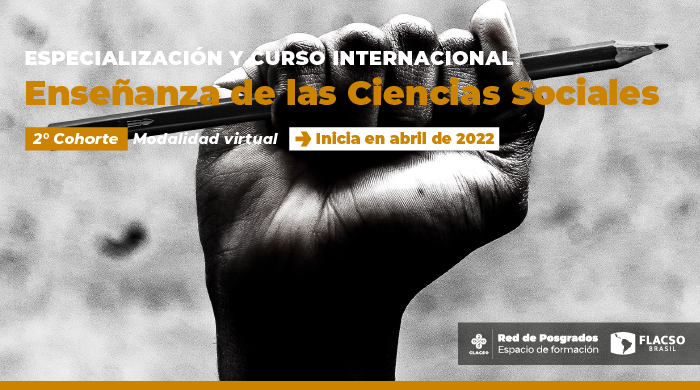
2th Cohort (2022-2023)
VIRTUAL MODALITY
Specialization: 40 credits, 360 lecture hours
International course: 9 credits, 90 hours/lecture
Duration: April 2022 to March 2023
The certification of the Specialization and the International Course will be carried out by the Latin American Faculty of Social Sciences (Flacso Brazil) and by the Latin American Council of Social Sciences (CLACSO).
GENERAL COORDINATION:
Inés Dussel (DIE-CINVESTAV, Mexico) and Nicolás Arata (CLACSO and University of Buenos Aires, Argentina)
ACADEMIC COMMITTEE:
Inés Dussel (DIE-CINVESTAV, Mexico and National Pedagogical University, Argentina)
Nicolás Arata (CLACSO and University of Buenos Aires, Argentina)
Rebecca Igreja (FLACSO and University of Brasilia, Brazil)
Rogério Heasbert (Fluminense Federal University, Brazil)
Odile Hoffmann (Institut de Recherche pour le Développement, France)
TEACHING TEAM:
Enrique Leff (UNAM, Mexico) | Gerardo Caetano (Udelar, Uruguay) | Myriam Southwell (UNLP and FLACSO, Argentina) | Alicia De Alba (UNAM, Mexico) | Rogério Heasbert (UFF, Brazil) | Rita Segato (UnB, Brazil-Argentina) | Adriana Puiggrós (UNIPE and UBA, Argentina) | Elsie Rockwell (CINVESTAV, Mexico) | Anne-Marie Chartier (INRP, France) | Darío Pulfer (UNIPE, Argentina) | Pablo Yankelevich (CEH-Colmex, Mexico) | Martha Cecilia Herrera (UPN, Colombia) | Ana Longoni (MACBA, Spain and UBA, Argentina) | Antonio Ibarra (UNAM, Mexico) | Lilia Moritz Schwarcz (USP, Brazil) | Enrique Dussel (UNAM, Mexico) | María Laura Canciani (UBA, Argentina) | Rebecca Lemos Igreja (FLACSO and UnB, Brazil) | Patricia Ferrante (UNIPE, Argentina) | Edgar González Gaudiano (UNED, Mexico) | Aldana Telias (UBA, Argentina) | Odile Hoffmann (Institut de Recherche pour le Développement, France – Mexico) | Isabelino Siede (Unlp, Argentina) | Camilo Negri (FLACSO and UnB, Brazil) | Sebastián Plá (IISUE, Mexico) | Manuel Becerra (UNIPE, Argentina) | Inés Dussel (DIE-CINVESTAV, Mexico) | Nicolás Arata (CLACSO and UBA, Argentina)
PEDAGOGICAL COORDINATION:
Camila Downar (CLACSO)
In recent years, the field of social science and humanities didactics has consolidated itself as a training ground, a center for research, and a hub for developing innovative teaching approaches. These initiatives, driven by academic networks, research teams, and university departments, are taking place against a backdrop of intense attacks on the social sciences and humanities. These attacks manifest themselves through budget cuts, media campaigns, and ideological persecution based on a rampant anti-intellectualism. This assault has a particularly strong impact on Latin America and the Caribbean, where societies grapple with some of the highest levels of inequality on the planet (reflected in numerous indicators, such as gender-based violence, difficulties accessing a healthy environment, and basic labor rights).
Indeed, this is precisely where knowledge and expertise aimed at deconstructing these situations of inequality and disseminating ideas and projects to combat and eradicate them must be most present and developed. What the colossal crisis unleashed by the coronavirus pandemic exposes, and cannot ignore, is the practical importance of the theoretical contributions developed by the social sciences and humanities in addressing complex problems, especially in a region that has been relegated to the periphery of global scientific knowledge.
In this vein, the Specialization offers a training space that articulates updated perspectives on the problems, readings, and concepts of the social sciences with the processes of renewal—both pedagogical and didactic—that allow them to be addressed as objects of teaching. This approach requires highlighting and valuing the specificity (both in terms of its quality and its critical character) of the knowledge produced by the social sciences in the region. It also seeks to challenge the inferiority complex and academic and epistemological subordination that the social sciences of the region experience in relation to Eurocentric knowledge, and its effects on teaching. Finally, it aims to contribute to the processes of depatriarchalization, decommodification, and decolonization that weigh on our societies (Sousa Santos, 2018).
Social science education has a fundamental role to play in disseminating concepts, perspectives, and methods appropriate for producing knowledge about society in the region. This knowledge should allow us to move beyond traditional national frameworks and establish a critical, well-founded, and rigorous understanding that contributes to integration processes. For this role to unfold and achieve greater and more effective learning outcomes for students, social science education must be strengthened both conceptually and didactically, and its questions and classroom practices must be updated.
General objectives
The Specialization aims to articulate the problems, readings and concepts of the social sciences and humanities, with the processes of renewal of pedagogical approaches and didactic strategies, promoting the teaching of social sciences from a critical perspective and in tune with the productions of the Latin American and Caribbean field of studies.
Specific objectives
- To promote a conceptually and methodologically renewed approach to teaching social sciences, in dialogue with the challenges posed by working at different levels of education and in different educational institutions.
- Promote social science teaching strategies from a wide variety of thematic approaches and from multiple levels: local, national and regional, framed and in discussion with the productions and approaches of the global context.
- Develop thematic, disciplinary and conceptual approaches that contribute to building a toolbox for the design of classes and training proposals in social sciences and humanities from a regional perspective, taking into account the new socio-technical environments.
- To promote a new perspective on the teaching of social sciences, taking into account the challenges posed by the different situations and particularities of the teaching spaces in the region.
The Specialization and International Course is aimed at educators, teachers, and professors of the formal education system; students of pedagogical universities and teacher training institutions in the region; those responsible for public policies related to education and members of social movements whose actions are oriented towards the field of popular education interested in renewing their theoretical-methodological and didactic perspectives in relation to the teaching of social sciences at different educational levels and modalities, within and outside the formal education system.
The International Course will last one year and requires, for accreditation, participation in discussion forums and the completion of a final project.
The Specialization in Teaching Social Sciences will last one year and requires for its accreditation, in addition to the completion and approval of the International Course; the accreditation of 2 elective virtual seminars from the curriculum; a methodological workshop and a final specialization project.
The Specialization and the International Course will take place between April 2022 and March 2023.
The online seminars and classes of the International Course will be offered in either Spanish or Portuguese. These are the languages used by the professors and tutors, but this does not mean that they are native speakers.
The bibliography will be provided in the official languages of the course – Spanish and/or Portuguese – depending on availability. Student contributions to the discussion forums must also be in these languages. The final monograph may be submitted in either Portuguese or Spanish.
Students in the Specialization and International Course will have the support of academic tutors who will accompany them through the virtual seminars and guide them in completing their final projects.
The online seminars will be offered in Spanish, Portuguese, or English. The course materials may be provided in any of the three official languages of the course, depending on availability. Student contributions to the discussion forums may be in these languages. The final research paper may be written in Spanish, Portuguese, or English.
International Course: Teaching Social Sciences from a Latin American and Caribbean Perspective: Challenges, Approaches and Tools
Abstract: This International Course revisits and promotes a series of debates surrounding the teaching of social sciences from a Latin American and Caribbean perspective. The proposal draws on and recovers the tradition of critical pedagogies, starting from a problematization of established teaching spaces and methods, and the search for and recovery of pedagogical alternatives (Puiggrós, 1990). It also emphasizes the importance of linking research processes and results with didactic interventions and proposals, focusing on lesson design as an act of research where knowledge and skills are brought into play with the purpose of their critical transmission. Thus, to organize the formative processes and dimensions, the proposal addresses, in an integrated manner, issues related to the teaching of social sciences and humanities, prioritizing three dimensions: 1. Fields of knowledge: studying the ways in which history, geography, civic education, and other subjects have been and can be taught. 2. Conceptual approaches: bringing into account the debates surrounding central categories of Latin American social sciences (memory, race, good living, among others) 3. Didactic approaches and curricular perspectives: recovering teaching strategies and methods specific to critical pedagogies and their relationship with contemporary curricular debates.
Classes and teachers:
- Challenges of teaching social sciences for regional integration - Gerardo Caetano (Uruguay).
- Teaching today: keys to interpreting a complex world in intergenerational dialogue. - Myriam Southwell (Argentina).
- Theories and debates surrounding the Latin American curriculum. - Alicia De Alba (Mexico).
- New perspectives for addressing spatial dimensions in Latin America. - Rogério Heasbert (Brazil)
- Race, ethnicity, class and gender from a colonial perspective. - Rita Segato (Argentina).
- Another way of thinking: the alternative approach of Good Living. - Freddy Álvarez (Ecuador-Mexico).
- Teaching Social Sciences from an Environmental Perspective - Enrique Leff (Mexico)
- Education in Latin America: Post-Pandemic Challenges - Adriana Puiggrós (Argentina)
- Teaching history from an ethnographic perspective. - Elsie Rockwell (Mexico)
- Curriculum innovation and pedagogical practices. - Anne-Marie Chartier (France)
- Recent history: how to teach it? - Pablo Yankelevich (Mexico)
- Teaching the recent past in Latin America - Martha Cecilia Herrera (Colombia)
- Museum situated: archive of the commons, space for influence and articulation, forum for public debates. - Ana Longoni (Spain/Argentina)
- The nation, the region, the transnational. The American experience before and after nations. - Antonio Ibarra (Mexico)
- The study of authoritarianism in the region. - Lilia Moritz Schwarcz (Brazil)
- The interview and the biography in the social sciences. - Leonor Arfuch (Argentina)
- Latin America: How to think about it in an interconnected world? - Enrique Dussel (Mexico)
- History as contemporary literature - Ivan Jablonka (France)
Professors: Inés Dussel (DIE-CINVESTAV, Mexico) and Nicolás Arata (CLACSO/UBA, Argentina)
Summary: The methodological workshop is a training space designed to guide the development of the final monograph for the specialization course. It will support students in defining their object of analysis, translating it into a viable research problem, constructing a work plan, developing argumentative frameworks, and establishing analytical conclusions. These tasks will be carried out individually and collectively through peer exchange and with the workshop instructor, following a discussion forum format.
Professors: Rebecca Lemos Igreja (University of Brasilia, Brazil), Odile Hoffmann (IRD/France and CIESAS/Mexico) and Camilo Negri (University of Brasilia, Brazil)
Abstract: This seminar will address the teaching of social sciences from a practical perspective, focusing on the role of the social sciences and social scientists in interpreting reality and seeking solutions to contemporary problems. This approach centers on research experiences, discussions about the development of critical thinking, and the construction of social categories within their historical, sociocultural, and economic contexts. Furthermore, the seminar includes a reflection on job market opportunities and avenues for social scientists to engage with society. The proposal is to examine the practical application of social sciences in Latin America from various disciplines, such as anthropology, sociology, political science, law, and geography, among others. This will involve the contributions of researchers who have reflected on this topic, always in connection with national and international academia, technical fields, research, and teaching.
We will begin by briefly addressing the phenomena of the internationalization of the social sciences, questioning the role of Latin American social sciences in the world, their spheres of action and intervention, and the forms of scientific evaluation. We will also discuss measures of academic productivity and scientific ethics. We will then reflect on how positions of domination and asymmetry are managed among the actors involved in research, including the broader political and academic context. These constructs influence research methodology, content, results, and evaluations. The aim is to conduct this reflection based on concrete situations and case studies, questioning research methodologies and techniques. Finally, the seminar will discuss the selection and construction of social categories. The idea is to consider, based on research experiences, how social scientists reflect on the categories they use, how these evolve according to research topics and contexts, and the development of public policies.
Professors: Isabelino Siede (National University of La Plata, Argentina)
Abstract: The purpose of civic education has been present in American educational systems since their founding mandates, as all schooling was conceived as a means of preparing for the exercise of popular sovereignty, with the limitations that this implied in each context. This long-standing presence in the school curriculum has, however, coexisted with a limited development of didactic criteria to address this particular object of instruction. As the 21st century progresses, it becomes necessary to review what it means to educate for citizenship and what tools are useful for this task. In this seminar, we aim to review some of the curricular debates on civic education and propose some methodological alternatives for teaching it.
In the context of a social order that demands loyalty, cohesion, and adherence to the law, educating for freedom seems, on the surface, impossible. This justifies the questions we repeatedly ask ourselves from an emancipatory perspective: How do we educate a free individual? How do we educate a critical citizen? Can schools, as institutions biased by the logic of the State, teach freedom? We are convinced that knowledge can be a tool for freedom, but some teaching approaches foster this quality while others do not. Understanding education as a space for cultural provocation leads to the classroom becoming a realm of questions, dissent, arguments, and collective constructions, where everyone feels invited to recreate the foundations of life in society.
Professors: Darío Pulfer (Pedagogical University, Argentina) and Nicolás Arata (CLACSO)
Abstract: This seminar addresses the issue of using reliable sources and accessing information for classroom use. One of the defining characteristics of contemporary societies in the internet age is the availability of information. However, this availability does not directly translate into the use and appropriation of materials by different users, primarily teachers. This seminar aims to present a range of resources available in digital repositories, considering them as tools for large-scale cultural transmission. It seeks to leverage these resources to enrich the user experience and enhance pedagogical opportunities for schools, libraries, museums, media outlets, and cultural centers.
Abstract: Geography has been present in the school curriculum as part of the educational process for children and young people. For a long time, its teaching was linked to the consolidation of territorial nation-states through learning the characteristics of the physical and human geography of the various natural regions. This “traditional” approach uses outdated material and generates short-term, rote learning processes that are detached from students' immediate context and the complexity of contemporary social reality. Currently, these perspectives are being challenged by the development of a critical pedagogy and geography that seeks to transform the realities of children and young people at different scales, often beginning with everyday life. This seminar addresses the emergence of critical pedagogy in Latin America, along with the origin of a critical thinking of geography, which is nourished on this side of the continent by postcolonial, decolonial, Marxist and anarchist thought concerned with social differences expressed in social class, sexual diversity, skin color that question climate change, the right to the city, the protection of nature, the mechanisms of reproduction of inequality, global disputes for strategic natural resources, etc.
Professors: Edgar González Gaudiano (UNED, Mexico), María Laura Canciani and Aldana Telias (UBA, Argentina)
Abstract: Environmental education is an emerging and interdisciplinary field of political-pedagogical intervention, embedded in broader historical and social processes, with specific features and characteristics. It arose in response to the acceleration and deepening of the environmental crisis and gained global visibility in the mid-20th century. Today, we are experiencing an unprecedented environmental and climate crisis in human history. Environmental conflicts are intensifying in increasingly deprived territories, and younger generations foresee uncertain, unequal, and discouraging futures, thus activating their participation in the public sphere. In this context, it is essential to revisit the question of how and why to educate in this context of environmental and climate emergency. We propose to present a pedagogical approach called the Pedagogy of Environmental Conflict, which aims to integrate the environmental dimension into the teaching of social sciences, promoting a critical, comprehensive, situated, and community-based environmental education. This approach fosters an understanding of the complex social, historical, and cultural framework within which environmental and territorial conflicts unfold. It seeks to generate teaching practices that critically examine the multiple forms of extractivism, their dynamics, disputes, and controversies, while simultaneously challenging the hegemonic patterns of knowledge construction and transmission that have become entrenched in the school system. We aim to promote an environmental perspective within educational organizations that can challenge, unsettle, move, and mobilize individuals and their practices. Fundamentally, we strive to provide tools for developing participatory environmental projects that aim to build a more just, dignified, and sustainable society based on environmental rights.
Professors: Sebastián Plá (IISUE, Mexico)
Abstract: This seminar aims to address the different school versions of the past and their curricular manifestations in relation to academic production, the public uses of history, the role of commemorative dates and patriotic rituals, and the challenges of teaching recent history, socially relevant issues, among other topics. It seeks to revisit long-standing problems linked to the complex issue of history in the service of national identities, considering them through the lens of regional integration aspirations; the processes that the countries of the region have undergone in the last two centuries; and new ways of thinking about history teaching in the context of Latin American educational reforms of recent decades. The seminar will provide a space for reflection to critically analyze historical narratives in the region's school systems from diverse pedagogical, historical, and research perspectives on history teaching in the region. The following themes will be addressed: the historicity of school versions of the past; the construction of Latin America: locality, nation, and region in the formation of collective identities; The different theoretical positions of the didactics of history and social sciences, the relationships between history, social sciences and socially relevant problems; absences and omissions in the teaching of history; challenges of teaching recent memory; the performativity of history in national holidays and rituals; and the comparative study of curricular reforms in history and social sciences in the last twenty years.
Professors: Inés Dussel (DIE-CINVESTAV, Mexico), Patricia Ferrante and Manuel Becerra (UNIPE, Argentina).
Abstract: This seminar addresses the challenges of digitization in knowledge production and teaching within the social sciences. It revisits debates surrounding the digital humanities, particularly regarding new sources and methods for producing and circulating records of social processes, and analyzes their repercussions for social science education. The seminar will delve into widespread practices using digital media, such as internet searches and the use and production of audiovisual materials, considering both the possibilities they offer and the limitations or difficulties they present for working with social science concepts and language. The seminar will examine classroom examples and encourage critical reflection on new teaching methodologies in this field.
| SPECIALIZATION AND INTERNATIONAL COURSE - COHORT 2022-2023 | |||||||
| 2022-2023 | Virtual Courses | ||||||
| April | International Course on Teaching Social Sciences from a Latin American and Caribbean Perspective: Challenges, Approaches and Tools | Seminar I "Doing" social sciences from Latin America: teaching and research | Seminar I "Education for citizenship: approaches and purposes" | Seminar I "Archives, sources and digital repositories: preservation, access and possibilities of use in the classroom" | |||
| May | |||||||
| Jun | |||||||
| Jul | |||||||
| August | Seminar II "Teaching History from a Latin American Perspective: Problems and Challenges" | Seminar II "Critical Geopedagogies" | Seminar II "The teaching of social sciences in the face of the challenges of digitality" | Seminar II "Environmental education: an approach from the pedagogy of environmental conflict" | |||
| Sept | |||||||
| Oct | Workshop to support the preparation of the final project | ||||||
| Nov | |||||||
| dec | |||||||
| jan | |||||||
| Feb | |||||||
| March | |||||||
CM PlenosIf you belong to a Full Member Center of CLACSO.
CM Associates: Yes You belong to a CLACSO Associated Centre.
No linkIf you DO NOT has any of these links with CLACSO.
| One payment by 11/04 |
Discount for payments made by 20/02 |
Payment in 3 installments | |
| CM Plenos | $570 | $460 | USD 750 (3 x 250 USD) |
| CM Associates | $700 | $590 | USD 1020 (3 x 340 USD) |
| No link | $960 | $720 | USD 1290 (3 x 430 USD) |
In all cases, payment can be made by credit card, deposit or bank transfer.
CM PlenosIf you belong to a CLACSO Full Member Center
CM Associates: Yes You belong to a CLACSO Associated Centre
No linkIf you DO NOT has any of these links with CLACSO
| One payment by 11/04 |
Discount for payments made by 20/02 |
Payment in 3 installments | |
| CM Plenos | $230 | $175 | USD 315 (3 x 10⁵ USD) |
| CM Associates | $290 | $235 | USD 420 (3 x 140 USD) |
| No link | $360 | $300 | USD 540 (3 x 180 USD) |
In all cases, payment can be made by credit card, deposit or bank transfer.
The certification of the Specialization and the International Course will be carried out by the Latin American Faculty of Social Sciences (Flacso Brazil) and by the Latin American Council of Social Sciences (CLACSO).
To participate, you need to register through the website.
Registration will be open between December 12 and April 5.
Upon completion of the registration process, you will receive a confirmation email. On the first day of the course, you will receive your login credentials for the online platform.
If any of the mandatory training sessions are owed, in all cases, an additional amount must be paid in order to retake said credit.
If the student decides not to enroll in the Specialization or International Course before its formal start date, they may request a refund of their tuition fees. CLACSO will retain the equivalent of 10% for administrative costs.
Exceptional Criteria: In exceptional cases, and within the first two months of the specialization, students may request to withdraw from the cohort and resume it the following year. In all cases, the reasons justifying the request must be submitted in writing. No requests will be accepted after two months from the start of the course.
If the student decides not to enroll in the Specialization or International Course before its formal start date, they may request a refund of their tuition fees. CLACSO will retain the equivalent of 10% for administrative costs.
The classes will take place from April 2022 to March 2023.
All students will receive the necessary instructions to access classes, bibliography and discussion forums through the CLACSO Virtual Training Space.
Accessing and navigating the Virtual Learning Environment is very simple and user-friendly. In any case, a technical and academic support team will always be available to you.
You must pass the International Course, two (2) elective Virtual Seminars, the methodological workshop and complete the final integrative work.
To obtain the Specialization degree, you must complete a final monograph. The methodological workshop is mandatory and aims to support you in completing this final project.
You must participate in the classes and activities proposed by the teachers and complete the final monograph.
Yes, the Specialization and the International Course are certified by FLACSO Brazil and CLACSO. The specialization has a total workload of 360 hours, and the international course 90 hours. The certificate of completion will be sent digitally and is completely free of charge. The International Specialist diploma is issued by the General Secretariat of FLACSO, located in Costa Rica. The fees and procedures for issuing and sending the international diploma can be found on the FLACSO Brazil website: https://flacso.org.br/?page_id=24376
The Specialization and the International Course are accredited by FLACSO Brazil and CLACSO. The International Specialist diploma is issued by the FLACSO General Secretariat, located in Costa Rica. Fees and procedures for issuing and shipping the international diploma can be found on the FLACSO Brazil website: https://flacso.org.br/?page_id=24376.
See the table of prices and options above.
If you wish to obtain certification from FLACSO, you will need to pay an additional fee.*
* The issuance of the printed diploma, along with the academic transcript, costs USD 200,00 (two hundred dollars). This fee includes shipping the printed and signed documents to the student's address. The procedures for issuing and shipping the international diploma can be found on the Flacso Brazil website: https://flacso.org.br/?page_id=24376.
For any other inquiries, please contact [email protected] or [email protected]
Or send a WhatsApp message to +5491138801388
For group and institutional discounts, please contact [email protected]
More specializations and international courses
[widget id=”glob_block_5_widget-42″]
If you would like to receive more information about CLACSO's training programs:
[widget id=”custom_html-57″]
to our email lists.

