
Teaching History from a Latin American Perspective: Problems and Challenges
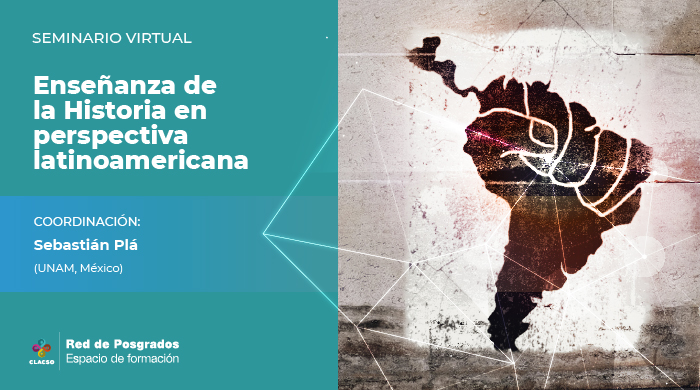
Seminar 2147
Coordination: Sebastián Plá (UNAM, Mexico)
Teaching team: Dr. Sonia Bazán (National University of Mar del Plata, Argentina) and Mtra. Michelle Ordoñez Lucero (National Autonomous University of Mexico).
Start: 08/09/2021 | Registration: 4/06/2021 to 06/09/2021
This seminar aims to address the different school versions of the past and their curricular manifestations in relation to academic production, the public uses of history, the role of commemorative dates and patriotic rituals, and the challenges of teaching recent history, socially relevant issues, among other topics. It seeks to revisit long-standing problems linked to the complex issue of history in the service of national identities, considering them through the lens of regional integration aspirations; the processes that the countries of the region have undergone in the last two centuries; and new ways of thinking about history teaching within the context of Latin American educational reforms of recent decades. The seminar will provide a space for reflection to critically analyze historical narratives in the region's school systems from diverse pedagogical, historical, and research perspectives on history teaching in the region. The following themes will be addressed: the historicity of school versions of the past; the construction of Latin America: locality, nation, and region in the formation of collective identities; The different theoretical positions of the didactics of history and social sciences, the relationships between history, social sciences and socially relevant problems; absences and omissions in the teaching of history; challenges of teaching recent memory; the performativity of history in national holidays and rituals; and the comparative study of curricular reforms in history and social sciences in the last twenty years.
This course is based on a pedagogy for social justice. This approach is not limited to a single theoretical framework, although its core principle is to challenge, confront, and dismantle the stereotypes, falsehoods, and misconceptions that underpin structural inequalities and discrimination based on social class, gender, phenotype, age, culture, and other differences among human beings. To achieve this, it draws on principles from political discourse analysis, decolonial theory, and the new philosophy of education.
The primary instrument used in this course is dialogue. Through dialogue, participants will explore the relationship between their teaching experiences and theoretical frameworks to discuss and reframe in-person and digital classroom practices through which the past and society are taught and given meaning. A variety of materials will be used, including academic readings, novels, performance art, online resources, and film. This diverse approach aims to inform and shape the teaching of history and social sciences within the context of digital humanities. Ultimately, the course will promote international collaboration among teachers to foster a collaborative, critical, and Latin American approach to teaching history and social sciences.
- The teaching of history understood as the public use of history
- Education and public uses of history
- Epistemology of the teaching of history in schools
- The school as a place of production of historical knowledge
- Curriculum, history and educational reforms in Latin America (1990-2020)
- Disciplinary competencies and epistemological imposition
- Functional history or 21st-century citizenship
- Historical counter-narratives and decoloniality
- Latin America as historical content
- Pasts and curricular justice in schools
- Epistemological justice and histories
- Gender perspective and meanings of the past in the classroom
- Past and present of poverty, inequality and social class
- Youth and social movements
- Subjectivation, technology and history in school
- Didactics of the South: Digital Humanities and the Teaching of History
- Revaluing education
- The content of the form
- Pandemic challenges and hybrid education
- A Latin American approach to teaching history
- Biesta, Gert. (2017) The rediscovery of teaching. New York: Routledge Taylor & Francis Group.
- Connell, RW (1997). Schools and social justiceMadrid: Morata
- Fraser, N. (2006). Social justice in the age of identity politics: redistribution, recognition, and participation. In N. Fraser and A. Honneth. Redistribution or knowledge?: a political-philosophical debate (pp. 17-88). Madrid: Morata
- García Luque, A. and A. de la Cruz Redondo. (2019). “The didactics of Social Sciences and the construction of alternative masculinities: textbooks under debate”, Clío y Asociados
- Levstik, L. (2011) Handbook of research in social studies educationNew York: Routledge.
- Masschelein, J. and M. Simons. (2014). Defending schools: a public issueBuenos Aires, Miño and Dávila
- Padilla Ay Ángela B., (2016) «Normalizing conflict and denormalizing violence: challenges and possibilities of critical teaching of the history of the Colombian armed conflict», Colombian Magazine of Education, no. 71, (2016).
- Pagès Blanch, J. and Moratalla Jávega, J. (2018). Recent history in the school curricula of Argentina, Chile and Colombia. Challenges of education for citizenship from the Didactics of Social Sciences. History and MEMORY, (17), 153-184
- Plá, S. (2012) “The teaching of history as an object of research”, Sequence. Magazine of history and social sciences, Mexico, Instituto Mora, no. 84, September-December, pp. 161-184
- Plá, S. (2014) Citizenship and competitiveness in history teaching: The cases of Mexico, Argentina, and UruguayMexico, Ibero-American University, Department of History
- Plá, S. (2016) “Curriculum, history and social justice. A comparative study in Latin America”, Colombian Magazine of Education, No. 71, Second Semester, pp. 53-77
- Plá, S. and J. Pagés (2014) Research on the teaching of history in Latin America, , Mexico, National Pedagogical University / Bonilla Artigas
- Plá, S. and SP Rodríguez Ávila (Cord.) (2017) Social knowledge for social justice: education and school in Latin America, , Bogotá, National Pedagogical University / La Carreta Editores.
- Torres Santomé, J. (2009) Curriculum justiceMadrid: Morata
- Young, M. (2008). Bringing knowledge back in: From social constructivism to social realism in the sociology of educationLondon: Routledge
|
|
Discount on one payment if paying by 31/8 |
In one payment from 1/9 to 6/9 |
|
CM Plenos |
$75 |
$150 |
|
CM Associates |
$95 |
$190 |
|
No link |
$95 |
$190 |
FAQ
The basic requirements for taking a seminar are:
- Availability of at least 4 hours per week to dedicate to the seminar course.
- Internet access.
- Reasonable handling of communication and computer tools.
- Language proficiency in the language in which the course will be taught. The official languages are Spanish and Portuguese.
|
|
Discount on one payment if paying by 31/8 |
In one payment from 1/9 to 6/9 |
|
CM Plenos |
$75 |
$150 |
|
CM Associates |
$95 |
$190 |
|
No link |
$95 |
$190 |

