
Confronting epistemic racism
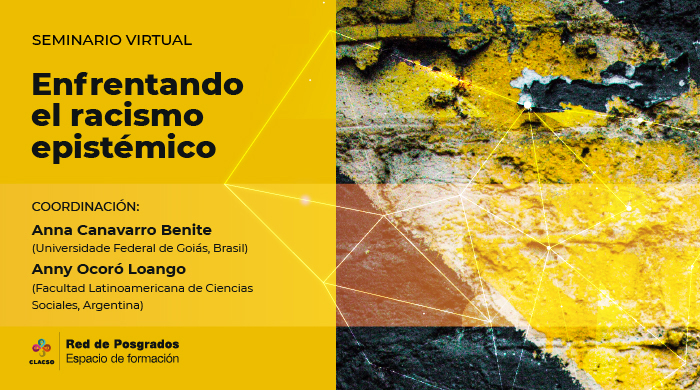
Seminar 2143
Coordination: Anna Canavarro Benite (Federal University of Goiás, Brazil) and Anny Ocoró Loango (Latin American Faculty of Social Sciences, Argentina)
Home: 30 / 09 / 2021 | Registration: 28/05/2021 al 29/09/2021
Workload: 12 weeks – 90 hours.
The concept of race, as a socially constructed attribute in time and space, still functions as a parameter to attribute people to the social structure.
These affirmative actions emerge as a strategy to combat racism and aim primarily to undermine the social structure that places Afro-descendants in disadvantaged economic and symbolic positions.
This proposal is based on the epistemological approach of Afrocentricity, in that the people of Africa and the diaspora must be the center of the study of social phenomena, therefore, the protagonists of their own history.
- The invention of black
- The invention of racism
- Contexts and historical concepts about racial relations in Latin America and the Caribbean
- Shifting the center to decolonize the mind
- Interculturality and intersectionality: Contributions to confronting epistemic racism and promoting epistemological pluralism
- role occupied by African populations and the diaspora in Latin American historiography
- Anti-racist education
- Affirmative action policies in South America and the Caribbean
- Black/Afro-descendant researchers in Latin America and the Caribbean and their spaces of resistance/existence
- Ethnic-racial inequalities and public policies: comparative perspectives in education
- ECLAC (2016). The matrix of social inequality in Latin America. Santiago: United Nations. Chapters 1 and 2. https://repositorio.cepal.org/handle/11362/40668
- Dubet, François. (2011). Rethinking social justice. Against the myth of equal opportunities. Buenos Aires: Siglo XXI.
- Gomes, Nilma Lino. (2008). Ethnic-racial diversity: for an emancipatory educational project. School Portraits, v. 2, p. 95-108.
- Gomes, Nilma Lino. Ethnic-Racial Relations, Education and Decolonization of Curriculums. Curriculum without Borders, v. 12, p. 98-109, 2012.
- Grosfoguel, Ramón. (2016). A structure of knowledge in Westernized universities: epistêmic racism/sexism and the four genocide/epistemicides of the long 16th century. Society and State, 31(1), 25-49.
- Gunther Dietz. Multiculturalism, interculturality and diversity in education. An anthropological approach (Mexico: Fondo de Cultura Económica, 2012), 279 pp. Chapter I and II.
- Hamminga, Bert. (2005). Epistemology from an African point of view. Translation for educational use by HAMMINGA, Bert. Epistemology from the African Point of View. In: HAMMINGA, Bert (ed.). Knowledge Cultures. Comparative Western and African Epistemology. Amsterdam: Rodopy, 2005, p. 57-84, by Khalil César Santarém da Silva and Amanda Balbino Pereira.
- Lemos Igreja, Rebecca. (2016). Combating racism and racial discrimination in Brazil: legislation and institutional action. Desacatos, (51), 32-49. Retrieved August 27, 2019
- Lima Nunes, Georgina Helena and Dos Santos, Sales Augusto. (2019). Quota system, fraud and hyper-racism in Brazil. National Autonomous University of Mexico-Institute of Social Research. Mexican Journal of Sociology 81, no. 3 (July-September, 2019): 637-663. Mexico City.
- Maio, Marcus Chor. (2004). Race, education and public health in Brazil: a debate on the hygienist thinking of the 19th century. In: MONTEIRO, Simone and SANSONE, Lívio (orgs). Ethnicity in Latin America: a debate on race, health and reproductive rights. Rio de Janeiro, Ed Fiocruz, 2004, p. 15-44.
- Mbembe, Achille (2016). Critique of Black Reason. NED, editions. (Introduction and Chapter I, pp. 25-82).
- Menéndez, Eduardo L. (2018). Racism, colonialism, and scientific violence. In: Colonialism, neocolonialism, and racism: The role of ideology and science in strategies of control and domination. National Autonomous University of Mexico, University City, Mexico City, Mexico. University Program of Studies on Cultural Diversity and Interculturality
- Munanga; Kabengele, Gomes; Nilma Lino. (2006). Or black leaf Brazil. São Paulo: Global. 2006. (Collection to understand).
- Ocoró Loango, Anny & da Silva, Maria Nilza. (2017). Afro-descendants and Higher Education. An analysis of the experiences, scope and challenges of affirmative action in Colombia and Brazil. UNESCO International Institute for Higher Education in Latin America and the Caribbean (IESALC), 2017. Higher Education and Society (SES). New stage. 25th Anniversary Collection. Vol. 20 anniversary edition, 25 years.
- Ocoró Loango, Anny. (2019). Between emancipation and decolonization: tensions, struggles and learning of black researchers in higher education. Revista Práxis Educacional, v. 15, n. 32, Apr./Jun. 2019, UESB, Bahia, Brazil.
- Oliva, Elene. (2017). Afro-descendant intellectuals: notes for a genealogy in Latin America. Tabula Rasa, (27), 45-65
- Oyewumi, O. (2010). Conceptualizing gender: the Eurocentric foundations of feminist concepts and the challenge of African epistemology. Africaneando. Journal of current affairs and experiences. No. 4, 4th quarter 2010
- Quijano, A. (2006). Don Quixote and the windmills in Latin America. DEI, Ecumenical Department of Research - Compiler/Editor. (Second period No. 127 September-October 2006) San José
- Thiong'o, Ngũgĩ wa. (2015). Decolonize the mind. Introduction and chapter I. Penguin Random House Grupo Editorial, SAU
- Thiong'o, Ngũgĩ wa. (2017). Shifting the Center: The Struggle for Cultural Freedoms. Rayo verde editorial. Chapters I and II.
- Trouillot, Michel-Rolph. (1995). An unthinkable history. The Haitian Revolution as a non-event, chapter 3. In, Silencing the Past. Published by arrangement with Beacon Press and International Editors' Co.
- Viveros, Mara. (2016). “Intersectionality: a situated approach to domination”, in Feminist Debate, vol. 52, October, pp. 1-17.
|
|
Discount for one payment until 13/09 |
In one payment from 14/9 to 20/9 |
|
CM Plenos |
$75 |
$150 |
|
CM Associates |
$95 |
$190 |
|
No link |
$95 |
$190 |
FAQ
The basic requirements for taking a seminar are:
- Availability of at least 4 hours per week to dedicate to the seminar course.
- Internet access.
- Reasonable handling of communication and computer tools.
- Language proficiency in the language in which the course will be taught. The official languages are Spanish and Portuguese.
|
|
Discount for one payment until 13/09 |
In one payment from 14/9 to 20/9 |
|
CM Plenos |
$75 |
$150 |
|
CM Associates |
$95 |
$190 |
|
No link |
$95 |
$190 |

