
Energy, transitions and power in Latin America and the Caribbean
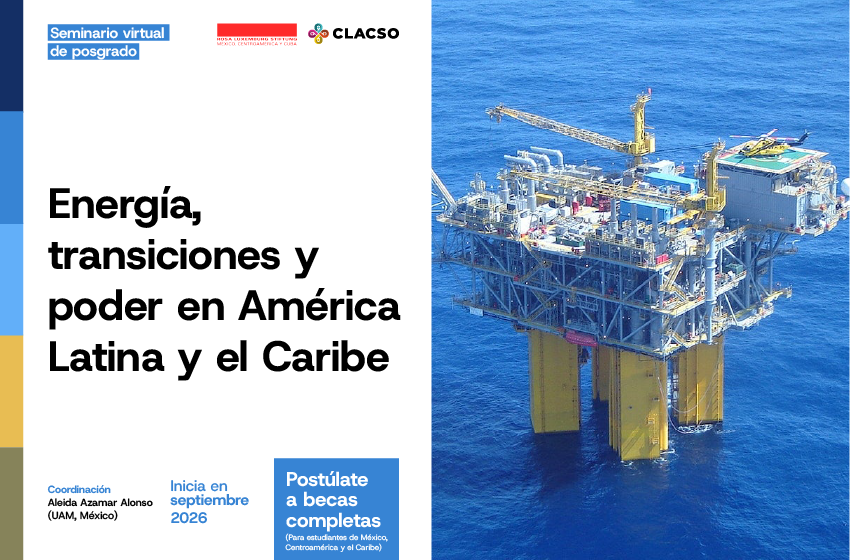
Seminar 2607
Coordination: Aleida Azamar Alonso (UAM, Mexico)
Teaching team: César Daniel Diego Chimal (UNAM, Mexico)
Start date : 17/09/2026 | Registration : 5/06/2026 to 16/09/2026
Workload: 10 weeks – 90 hours.
Organized by the Latin American Council of Social Sciences (CLACSO) with the support of the Rosa-Luxemburg-Stiftung Regional Office for Mexico, Central America and Cuba.
This seminar aims to provide critical training on energy transitions and climate change in Latin America from a geopolitical perspective, understanding these processes as spaces of struggle for power, territories, resources, and development directions. It begins with the recognition that the climate crisis and energy transitions are deeply conditioned by historical relationships of dependency, structural asymmetries, and the intervention of state, corporate, and financial actors, both internal and external to the region.
From a Latin American perspective, this work articulates the contributions of Political Ecology, Environmental Economics, and Ecological Marxism to analyze in an integrated manner how the reconfiguration of the global energy system, climate strategies, and new decarbonization agendas are reshaping regional geopolitics. These approaches intertwine to problematize the limits of dominant transitions, the emergence of new forms of extractivism associated with “clean” energy, climate financialization, and the tensions between mitigation, development, and socio-environmental justice.
This aims to provide theoretical and analytical training to postgraduate students, researchers, teachers and actors linked to public and social management, equipping them with critical frameworks to understand energy transitions and climate change from a geopolitical perspective.
The relevance of a seminar focused on analyzing energy, transitions, and power in Latin America is underscored by the critical context the region is currently experiencing, marked by structural transformations of the economic, political, and environmental order on a global scale. Latin America occupies a strategic position in this juncture due to its endowment of energy and mineral resources, which are acquiring centrality in a phase of global capitalist reconfiguration characterized by the resurgence of imperialism and the deepening of accumulation processes. In this scenario, the control, access, and appropriation of energy resources become a key axis of contemporary geopolitics, redefining relationships of dependence, subordination, and conflict among actors both within and outside the region.
In parallel, the region faces the accelerated deterioration of the climate system, which has intensified environmental impacts in Latin America, evidenced by rising average temperatures, more frequent heat waves, biodiversity loss, and the growing vulnerability of large segments of the population. These processes have generated divergent and contradictory responses in the region. On the one hand, neo-developmentalist discourses have strengthened, presenting the energy transition and climate action as opportunities for economic growth, relying on technological solutions, energy efficiency, and the expansion of new “green” markets, without questioning the structural foundations of the extractive model. On the other hand, openly denialist or climate-minimizing positions have emerged, portraying climate change as an obstacle to economic development and national sovereignty, thus deepening inaction and setbacks in environmental matters.
This scenario is marked by an ideological dispute and clash of political projects in Latin America. The region is experiencing a strong polarization between right-wing and far-right governments, which promote aggressive neoliberal agendas, dismantle the welfare state, and align themselves with conservative geopolitical projects led by the United States, and progressive initiatives that advocate for greater state intervention, redistributive policies, and discourses of sovereignty over natural resources, even though these latter projects do not always succeed in translating their proposals into structural transformations.
In a context of multiple crises and high conflict, the seminar's relevance is linked to the need to strengthen analytical, critical, and educational capacities in the face of a regional environment increasingly permeated by disinformation, reductionist interpretations, and the circulation of radical or authoritarian discourses. The complexity of debates on energy, transitions, and power demands rigorous theoretical and methodological tools that allow for the construction of informed diagnoses, the debunking of fake news, the questioning of technocratic or denialist explanations, and the confrontation of the political instrumentalization of environmental discourse. The seminar is conceived as a space for strategic training to equip students, researchers, and social actors with analytical capacities that contribute to a more informed, critical, and democratic public debate on energy transitions and the region's climate future.
Therefore, it is essential to create training spaces that allow us to understand energy transitions and climate change as non-neutral geopolitical processes, shaped by power relations, conflicts of interest, and disputes over the meaning of development. This seminar aims to address this need by offering theoretical and analytical tools from Political Ecology, Environmental Economics, and Ecological Marxism, enabling a critical examination of dominant transition models.
GENERAL PURPOSE
To critically analyze energy transitions and climate change in Latin America from a geopolitical perspective, understanding these processes as dynamics traversed by relations of economic and ideological power, territorial disputes and political projects, within the framework of the climate crisis and the reconfiguration of global capitalism.
SPECIFIC OBJECTIVES
- To analyze the relationships between energy, transitions and power in Latin America, using the contributions of Political Ecology, Environmental Economics and Ecological Marxism as critical frameworks to interpret the economic, political and ideological dynamics that structure these processes.
- To examine the role of Latin America's strategic energy and mineral resources in contemporary geopolitics, considering the intervention of state, corporate, and financial actors, as well as the new forms of dependence, subordination, and territorial conflict associated with the energy transition and climate change.
- To problematize the dominant discourses on energy transition and climate change in the region, identifying them as turning points of neo-developmentalist, technocratic or denialist narratives in order to understand their economic, political and socio-environmental implications.
- To confront the ideological and political project dispute in Latin America surrounding the energy transition and climate change, considering the differences between neoliberal, conservative and progressive agendas, evaluating their scope, limits and contradictions in terms of sovereignty, socio-environmental justice and structural transformation.
- To strengthen the analytical and critical capacities of the participants through the use of theoretical and practical tools for the development of informed diagnoses on energy transitions and socio-environmental conflicts, contributing to the rigorous understanding of these processes and to combating misinformation in the public debate.
- Energy and power in Latin America: structural bases of the transitions
- Energy and power in dispute: transitions, actors and territories in Latin America
- Energy security and climate change: geopolitical drivers of the energy transition
- States, corporations and territories: disputes and decisions in the energy transition
- Disputed discourses: energy transition, climate change and power narratives
- Comparative energy discourses: an introduction to qualitative comparative analysis (QCA)
- Political panorama: governments, energy and transitions beyond the ideological dichotomy
- State decisions and structural limits: a critical evaluation of energy transition projects
- Mapping the energy transition: energy metabolism and disputed territory
- Information, knowledge and power: communication in the energy transition
- Svampa, M. (2023). Dilemmas of the ecosocial transition from Latin America. Carolina Foundation; Oxfam.
- Azamar Alonso, A. (2024). The multicolored nature of energy. Challenges and opportunities for the energy transition. UAM. (Introduction and Chapter 1).
- Svampa, M., Bringel, B., Gutiérrez Aguilar, R., Modonesi, M., Ouviña, H., Seoane, J., & Taddei, E. (2022). Just transitions for Latin America from the Southern Ecosocial Pact: Proposals and disputes in the face of hegemonic green pacts. Political Ecology, (64), 61–70.
- Azamar Alonso, A. (2024). The multicolored nature of energy. Challenges and opportunities for the energy transition. UAM. (Chapter 2).
- Economic Commission for Latin America and the Caribbean (ECLAC). (2024). Energy Transition in Latin America and the Caribbean (Presentation).
- Zhu, Z. et. al (2025). Global energy transition under geopolitical risks: An empirical investigation. Energy Economics.
- GeoComunes. (2024). Energy restructuring in Mexico.
- Argento, M. and Kazimierski, MA (2022). Accumulation through conservation and defossilization. The corporate ecotechnical consensus on climate change. Practices of the Trade.
- Chemes, J. (Comp.). (2023). Energy Transitions. National Council for Scientific and Technical Research.
- Reyes Suárez, A. (2024) Configuration of discourses in the energy transition process based on the case of Tocopilla, Antofagasta. [Thesis to obtain the degree of Social Anthropologist]. University of Chile.
- Hernández, BAV (2023). Introduction to comparative qualitative analysis (QCA): Concepts, implementation and applications in Latin America. Journal of Political Studies, UNAM.
- Vergara-Schmalbach, JC, Morelos Gómez, J. and Lora Guzmán, H. (2014). Comparative analysis of public policies on environmental matters in Latin American countries. International Journal of Social Science Research.
- Gudynas, E. (2024). Transitions: Short or long, reformist or transformative, foreign or our own. Latin American Observatory of Globalization.
- Fernández Carril, L. (2015). Ideological intractability in international climate change politics. Andamios, Journal of Social Research.
- Economic Commission for Latin America and the Caribbean (ECLAC). (2022). The energy transition in Latin America and the Caribbean.
- Balza, L. et al (2024). Navigating the energy transition in Latin America and the Caribbean. Inter-American Development Bank.
- GeoComunes. (2024). Energy restructuring in Mexico.
- Walter, M. (2023). Collaborative mapping of resistance to the impacts and discourses of mining for the energy transition in the Americas. Political Ecology.
- Martínez Alier, J., et al. (n.d.). Energy metabolism and territory [Journal article]. Ibero-American Journal of Ecological Economics.
- Lozano Ascencio, C. (2025). Communicate the climate crisis. Open University of Catalonia.
With the support of the Rosa-Luxemburg-Stiftung Regional Office for Mexico, Central America and Cuba, 30 full scholarships will be awarded to people from Mexico, Central America and the Caribbean aimed at activists of social movements, members of community organizations, students, researchers, public officials and the general public who carry out activities related to the theme of this course.
Requirements for the application:
- Applications will be submitted through the CLACSO website.
- The candidates must:
1. Complete your details
2. Briefly describe your interest in participating (and the relevance of the issue to your organization, territories and areas of operation).
- The available scholarships will be allocated respecting regional diversity and gender equity.
This call for applications will remain open until 31/08/2026.
| Early registration (until 10/08) | General registration (11/08 to 10/09) | Registration without discount (11/09 to 16/09) | |
| Full or Associate Member Center | $100 | USD 150 | $200 |
| No link | $150 | USD 225 | $300 |
FAQ
The basic requirements for taking a seminar are:
- Availability of at least 4 hours per week to dedicate to the seminar course.
- Internet access.
- Reasonable handling of communication and computer tools.
- Language proficiency in the language in which the course will be taught. The official languages are Spanish and Portuguese.
The seminars last 10 weeks, plus the completion of a final project. A total of 90 hours of dedication will be credited.
A course consists of ten classes, each accompanied by required reading bibliography, supplementary bibliography, discussion forums and training activities proposed by the teaching team, partial deliveries and a final project.
The course is online and asynchronous. Some instructors may propose synchronous activities. In those cases, the time and date will be agreed upon beforehand between the instructors and the students to ensure everyone's participation. Attendance at synchronous sessions is not mandatory.
To pass the seminar, you must participate in at least 80% of the discussion forums and activities proposed by the teachers, have completed the scheduled partial deliveries, and pass the final work.
| Early registration (until 10/08) | General registration (11/08 to 10/09) | Registration without discount (11/09 to 16/09) | |
| Full or Associate Member Center | $100 | USD 150 | $200 |
| No link | $150 | USD 225 | $300 |
The possible payment methods are by credit card or bank transfer.
Inquiries: [email protected]

