
Meeting: Urban Transitions and Popular Economies: How to live differently?
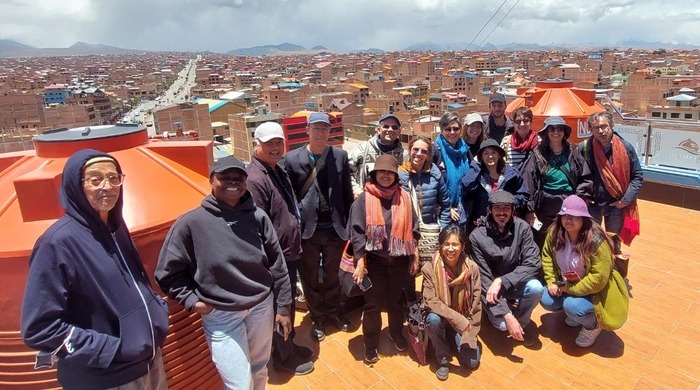
Still haunted by the echoes and resonances left by the Meeting “Urban Transitions and Popular Economies: How to live differently?” -during the first days of November between the cities of La Paz and El Alto- we share some images of the panels, conferences, discussions and drifts that we shared with the Collective of Popular and Urban Economies and the team of the Institute of Social Research of CIDES-UMSA.
Having the possibility of opening common areas of inquiry capable of examining the controversies and dilemmas that are resolved in the folds between popular economies and urban studies - on a tricontinental scale - starting from the ecologies of rubble that feed real estate speculation in Nairobi; the economies of the night in Lagos (Nigeria) and its night migrants; the not so unexpected affinities between the production of urban form between Mumbai and El Alto; or the verification of the coordinates that account for a global war against popular economies by the far right, were just some of the edges in which the debates took place.
We especially thank the host collective of IDIS-CIDES at the Universidad Mayor de San Andrés, including Nico Tassi, Alfonso Hinojosa and Hernán Pruden, and all the students for their infinite generosity and care during the days; to Abdoumaliq Simone and the extraordinary Urban Popular Economy Collective for the audacity of imagining a radically improbable meeting and for betting on thought as a collective task.

MEETING PROGRAM
November 8, 2024 | In-person format | La Paz, Bolivia
Hall of Honor, Central Monoblock of UMSA, Av. Villazón No. 1995
An initiative of the Urban Popular Economies Collective, the CLACSO Working Group on Popular Economies: theoretical and practical mapping and CIDES-IDIS / UMSA
We come together to build upon and expand questions that intersect with our research, concerns, and aspirations. We want to explore how grassroots economies develop political and institutional creativity and reconfigure the struggle for the commons into emerging institutions that are both possible and improbable. And even more profoundly: how do these frameworks confront capitalist accumulation, dispossession, and multiple forms of violence in their territories? What kinds of boundaries, resonances, collaborations, and forms of cooperation are practiced?
Urban economies are territories where contemporary crises are confronted daily—the anarcho-capitalist regime in Argentina, the drug wars in Ecuador, the fragile leftist recovery of the social economy in Colombia, the dissolution of economic life in post-Brexit England, the upheavals in the Middle East. And situated in the space where we gather: How do urban popular economies in Bolivia shape collective memories, imaginaries, histories of collective struggle, appropriations of global discourses and experiences, and the intricate details of localized livelihoods and cultural practices? How do urban inhabitants perceive the unraveling and reweaving of multiple times and geographies, and how do the polyrhythmic meanings generated by everything that might be happening in this place and everything that has happened or might be happening in distant places combine? Finally, we are interested in intertwining temporalities: How does the future act as a mode of production, as an incessant struggle in search of common elements to expand? How do pasts become present in the ways of inhabiting territories? How do we understand and act in the crises of the present?
WORKSHOPS – DRIFTS – PANELS
Participated
Abdou Maliq Simone | Veronica Gago | Cristina Cielo | Nico Tassi | Rupali Gupte | Prasad Devappa Shetty | Alfonso Hinojosa | Delia Colque | Connie Smith | Lana Salman | Chrystel Oloukoi | Prince Guma | Santiago Azzati | Felipe Magalhães | Alioscia Castronovo | Natalia Hernández Fajardo | Ana María Morales Troya | Ana Julia Bustos | Marcia Moreno Benitez | Hernan Pruden
They organized
CLACSO Working Group on Popular Economies: Theoretical and Practical Mapping
Collective of Urban Popular Economies
CIDES-IDIS / UMSA



