
Regarding the Napalpí Massacre in 1924
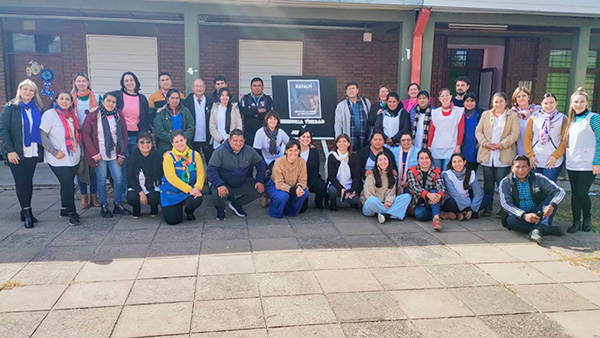

On June 30, at the Faculty of Humanities of the National University of the Northeast (Argentina), the educational material “ Napalpí, Napa´lpí, Napalyípí ” was presented with the objective of training teachers, directors and educational managers of the province of Chaco.

Present were the authors of the material: María Cristina Area, director of the CONICET NEA Scientific and Technological Center; Teresa Arteaga, head of projects at the CLACSO Research Directorate; Sofía Naidenoff, Minister of Education; Vilma Coria, Undersecretary of Interculturality and Plurilingualism; and Martín González, Secretary of Extension, Training and Services of the Faculty of Humanities.

This document is the result of the project “ Policies of indigenous violence of the Argentine State against indigenous populations of the Gran Chaco. War of conquest, expansion and crimes against humanity, 1870 – 1924 ” presented by the Center for Social Studies (UNNE) to the research call Democracy, human rights and peace: Crossroads and challenges from the State and social organizations of CLACSO.

Within the framework of this project, collaboration was fostered between the scientific community and other sectors of society to support local processes of building memory, truth, and justice regarding the Napalpí Massacre of 1924, in which hundreds of Qom and Moqoit Indigenous people died at the hands of security forces in the National Territory of Chaco (Argentina). This massacre was recognized by the Argentine State as a crime against humanity and genocide in the Napalpí Massacre Truth Trial held in 2022.

As a result of this process, the CLACSO publishing house published the educational material that is intended for teaching about the Napalpí Massacre and was developed in a participatory manner between the research team, teachers from School No. 14 (Colonia Aborigen Chaco- Ex reducción de Napalpí), indigenous leaders and translators.
This intercultural and trilingual (Spanish, Qom, and Moqoit) resource is designed for primary school students but can be adapted for preschool and secondary levels. It aims to integrate the knowledge of Indigenous communities with scientific research, local community wisdom, and the school's pedagogical experience. It incorporates content that fosters intercultural understanding and addresses elements of the Qom and Moqoit worldviews. This resource is intended to contribute to the implementation of the ruling from the Truth Commission's trial for the Napalpí Massacre, which mandated its inclusion in the curriculum nationwide.
For its part, the Ministry of Education, Culture, Science and Technology of the province of Chaco has mandated its teaching at all educational levels according to the school calendar and, with this objective, promotes the use of the Napalpí, Napa´lpí, Napalyípí educational material. Therefore, the team of authors of the material, in agreement with the provincial authorities, implemented the aforementioned training in order to provide pedagogical, didactic, and curricular tools.
These multi-sectoral agreements allow the results of academic work to be projected towards concrete actions of symbolic, educational and cultural reparation, thus expanding the scope and impact of the project in the public sphere.
If you would like to receive more information about CLACSO's training programs:
[widget id=”custom_html-57″]
to our email lists.

