
"In times of migration and democratic crises, ALAS returned to the Caribbean region"
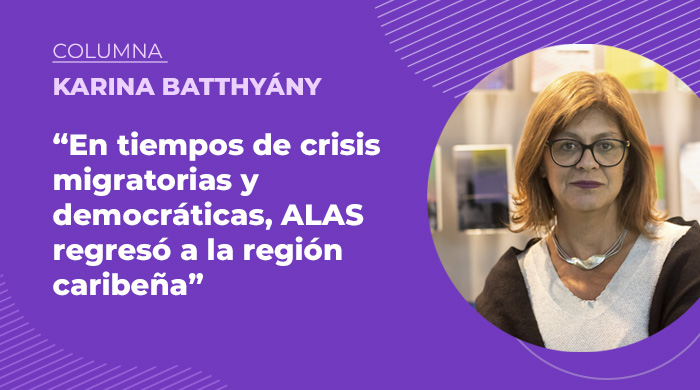
Transcript of Karina Batthyány's column
in InfoCLACSO – November 6, 2024
We are at the headquarters of the Autonomous University of Santo Domingo (UASD), Dominican Republic, for a new ALAS Congress alongside professors, researchers, students, and members of social movements and organizations. The goal is to build alternatives in a turbulent Latin America facing multiple challenges related to inequality.
In addition, we organized a Graduate School within the framework of Latin American and Caribbean critical thought studies in collaboration with ALAS, UASD and other institutions in this country.
For three days, 30 students from 11 countries in the region participated, interacting and discussing various thematic areas from a critical thinking perspective. This initiative is part of our broader project, Platforms for Social Dialogue.
We also held a forum on the different dimensions of the care issue and policy alternatives in Latin America and the Caribbean and presented the latest reports produced in partnership between CLACSO and UN Women on gender inequality.
We are preparing for the next Regional Conference on Women in Mexico City in 2025. There, we can see the progress made in many areas, as well as the challenges that remain in achieving gender equality. For this reason, we have continued our work through a workshop with social movements and organizations to collaborate with feminist and women's rights movements.
– Within the framework of ALAS, a panel on Scientific Evaluation was also held, and we know that this topic is very central for CLACSO-FOLEC and CLACSO-SILEU, right?
– Absolutely. Since 2019, we have been holding discussions and exchanges on what the Latin American Forum on Scientific Evaluation (FOLEC) and SILEU, the space specifically for university evaluation, represent today. These are two major initiatives that CLACSO is undertaking to effectively change how we evaluate research, knowledge, and university academic institutions, not only to obtain accurate diagnoses but also to develop proposals and alternatives for evaluation as a mainstream approach.
Today, some practices from our disciplines—the social sciences and humanities, as well as our languages—are being sidelined because assessment focuses on the parameters of the natural sciences and, moreover, on the English language. This is intensive work that CLACSO has been undertaking for some years now, more specifically since the creation of FOLEC in 2019, and it is now bearing fruit. There are already principles, declarations, and proposals for alternative forms of assessment, as well as other results from this assessment process. Finally, after many years, I want to emphasize that ALAS has returned to the Caribbean region during a time of crisis and uncertainty regarding democratic systems and migration.
If you would like to receive more information about CLACSO's training programs:
[widget id=”custom_html-57″]
to our email lists.

