
“In our region, the richest 10% have 22 times more national income than the poorest 10%”
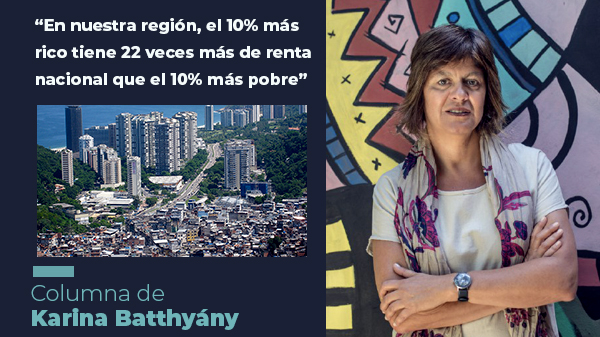
(Transcription of Karina Batthyány's Column)
(in InfoCLACSO – December 9, 2020)
The complexities of inequality will be the central theme of our Ninth Conference in Mexico next November (2021). It seems worthwhile, then, to consider the reasons why Latin America and the Caribbean are considered the most unequal region in the world. And when we ask ourselves why, there isn't a single, simple, or one-dimensional answer. We can discuss—and we have done so in all our columns—different dimensions of inequality, but let's try to summarize it in nine or ten points so that they resonate as we conclude this year.
First, it's important to understand that the main cause of inequality in our region is structural; it's a structural heterogeneity based primarily on the concentration of wealth in the hands of a few. And when we say "in the hands of a few," we mean both at the level of individuals and at the level of the productive structure—a small number of companies that generate wealth, that gross product, but don't necessarily generate equality.
Let's remember that, in terms of income, which is one of the first dimensions—not the most important, but certainly one of the first we look at when analyzing inequality—we find that in our region the richest 10% of the population has 22 times more national income than the poorest 10%. We're not talking about a small margin of inequality, but rather a scandalous inequality, where the wealthiest 1% also takes home 21% of the total income of the economy.
And this, for example, if we compare it to the average of the industrialized world, is double: that 1% that keeps 21% of the income. And in turn, the richest 10% of our region accumulates 71% of the region's total wealth and assets. If we look at the other side, the poorest 70% barely reach 10% of the wealth. This is truly scandalous. And it's a trend that persists despite some fluctuations over the years. And there's another point to consider, which is what has come to be called in our region the culture of privilege of the elites, these elites who are the ones who manage the income we were talking about.
Of course, when we return to the question of why inequality exists, we cannot forget the factors associated with race and ethnicity. We also know that Latin America and the Caribbean is one of the most multiethnic and multicultural regions in the world. And that Indigenous and Afro-descendant peoples continue to face profound disadvantages in terms of both economic well-being and access to social welfare in general. On average, 43% of the Indigenous population and 25% of the Afro-descendant population live in poverty, and the wage gaps compared to the rest of the population are very high. For example, if we compare them according to the same level of education, the wages of Afro-descendant people are almost 20% lower than those of the rest of the population. And in the case of Indigenous peoples, that "almost" reaches 30%.
Another important point is, of course, the issue of gender, the gender gaps that we have analyzed in considerable detail in these columns, so I won't dwell on them today, but we must keep them in mind. Because we also know that gender, race, and ethnicity, just like income, are determining factors in access to other aspects of social well-being such as health, education, employment, and much more.
Let's not forget to add violence as another worrying issue on the continent, and also as another factor linked to this inequality. Remember that, for example, the homicide rate in Latin America is currently the highest in the world, reaching almost 22% per 100.000 inhabitants. What does this determine? Organized crime, illegal economies, and so on. Also, and to conclude, it's worth mentioning that in the case of Latin America, everything that is happening in 2020 and will likely continue into early 2021—that is, the pandemic—we already know that our region will be the most affected, both in terms of its economy, its social structure, and its healthcare system. And the impact won't last two or three months; it will be a lasting, profound impact that will further exacerbate inequalities.
Let's not forget to add other dimensions we've analyzed in recent weeks, such as those related to climate change, migration, the environment in general, and also technology, which has created profound gaps in education and employment under these new conditions we are experiencing. It is for all these reasons, which I mentioned briefly, that we continue to emphasize the importance of understanding and overcoming these inequalities in Latin America. And that is also why this will be one of the main topics that will bring us together at our upcoming Latin American and Caribbean Conference on Social Sciences and Humanities.
-In Argentina, the legalization of abortion is currently being debated in Congress, an issue that was already discussed a few years ago but ultimately failed to pass. How important do you consider this debate in Argentina, and what is the regional context for this issue?
I believe this is a central issue not only in Argentina, but throughout Latin America and the Caribbean. In fact, there's a regional campaign to decriminalize abortion, where the foundation—and I think this is the important point to make here—is a democratic society. We've also discussed this topic in a previous column: the vision of a democratic society where women can decide about their bodies and their life plans, where these decisions are respected, and where states create the conditions to guarantee the exercise of these rights. As the Campaign in Argentina rightly points out, and I think it perfectly encapsulates the current situation, it's about sex education to make informed decisions, contraception to prevent unwanted pregnancies, and legal abortion to prevent deaths. Countries like Uruguay, which have already decriminalized abortion, have shown a decrease in maternal mortality precisely because of the possibility of accessing legal, safe, and free abortions for all women. I believe this is a very important moment, and I hope that next week in our regular column we can discuss this issue in more depth, and hopefully within the framework of a substantial step for Argentina, which would be the approval of this law, currently under discussion, in at least one of the Chambers.
If you would like to receive more information about CLACSO's training programs:
[widget id=”custom_html-57″]
to our email lists.

