
"In Mexico there is a reaffirmation of democracy, progressivism and feminism"
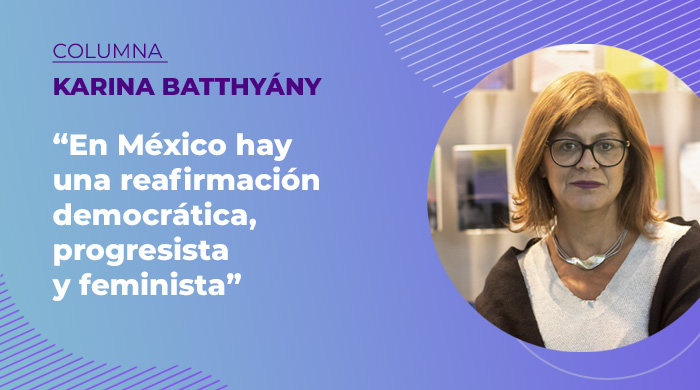
Transcript of Karina Batthyány's column
in InfoCLACSO – June 5, 2024
With the results of the 2024 presidential elections in Mexico, held on Sunday, June 2nd, more than 100 million Mexicans were called to the polls in the most important election in the country's history, in which candidate Claudia Sheinbaum won with almost 60% of the vote. A resounding and undeniable result, without a doubt.
As soon as the results were known, CLACSO sent its congratulations to the president-elect, with whom we shared activities and the stage at our 9th Latin American and Caribbean Conference at the National Autonomous University of Mexico (UNAM) in June 2022. At the opening ceremony, the then-Head of Government of Mexico City was present and was greeted by the Mexican public with shouts of “President, President!” We were both also welcomed by the Cuban singer-songwriter Silvio Rodríguez before his recital at the closing of #CLACSO2022 in a packed Zócalo in Mexico City. This event was made possible through the collaboration between Mexico City and our Latin American Council of Social Sciences.
This victory is extremely important for Mexico, but also for the entire Latin American and Caribbean region. In celebrating, Claudia Sheinbaum Pardo said: “For the first time in 200 years of the Republic, there will be a woman president, and she will be transformative. Thank you to all Mexican women and men. Today we demonstrated with our vote that we are a democratic people.” She added: “I didn't arrive alone; we all arrived together. We arrived with our heroines who gave us our homeland, with our ancestors, our mothers, daughters, and granddaughters.”
Elsewhere in his speech, he added: “We have come from a long way, this triumph is not from now, we owe it to many who have fought for our homeland, for freedoms and justice, to men and women who have given their lives for our country, to social, workers', students', doctors', teachers', peasants' and women's movements.”
In this way, she clearly outlined the profile of her government: one of continuity with the Fourth Transformation (4T), led by Mexico's first female president. Addressing her supporters on Sunday night, Claudia Sheinbaum also pledged "to support women aged 60 and 64, to provide scholarships for all children attending public schools and to create more scholarships, to build more high schools and universities, to strengthen the public health system, to build housing for young people, both men and women, to guarantee an increase in the minimum wage, and to continue with passenger rail services."
Here, it is important to emphasize the focus of this discourse on the well-being of all in Mexico, with a strong state presence. Currently in our region, some countries are experiencing significant challenges to the state and substantial setbacks in its role in providing basic services and rights.
Furthermore, the former head of government of Mexico City emphasized her commitment to the reform recently submitted by President Andrés Manuel López Obrador for the recognition of Indigenous and Afro-Mexican peoples and pledged to lead Mexico down “the path of peace, security, democracy, freedoms, equality, and justice, (…) to govern with humility, but with profound responsibility.” “This triumph, this triumph of the people of Mexico, is the triumph of the revolution of consciences,” she added.
Finally, on a topic that is always sensitive because they are neighboring countries, he said that "with the United States there will be a relationship of friendship, mutual respect and equality as it has been until now, and we will always defend the Mexicans who are on the other side of the border."
The victorious "Let's Continue Making History" alliance is comprised of Morena, the Labor Party (PT), and the Green Party of Mexico (PVEM). It not only won the presidential race, but also strengthened its positions in the Senate and the Chamber of Deputies, and triumphed in 7 of the 8 governorships up for election, as well as in Mexico City, where Clara Brugada won with nearly 50% of the vote. "Today, the majority of Mexico City's population decided to continue building the Fourth Transformation," Brugada stated.
– Given the magnitude of Claudia Sheinbaum's victory, the political landscape of Latin America is highly contested in terms of electoral complexity. We have two very different extremes or situations, as is happening today in Argentina and Mexico. What are your thoughts on this?
That is why Claudia Sheinbaum's victory is so significant for the entire region, because it strengthens the progressive bloc alongside Lula da Silva's Brazil, Gustavo Petro's Colombia, which will host our next #CLACSO2025 Conference, Xiomara Castro's Honduras, Bernardo Arévalo's recent Guatemalan government, and others, in the pursuit of justice and well-being for the peoples of Latin America and the Caribbean.
Furthermore, it will serve as a bulwark against the advances of the far right, as seen in Milei's Argentina, Bukele's El Salvador, Noboa's Ecuador, and Laurentino Cortizo's Panama. We will see how the electoral calendar unfolds in our Latin American and Caribbean region. Let us also remember that the electoral process has begun in Uruguay with primary elections followed by national elections, where the Broad Front has a chance of returning to power.
– What are your expectations regarding research and science in Mexico?
– At CLACSO, we have high hopes for the continuation of the Fourth Transformation (4T) in Mexico, especially given Claudia Sheinbaum's background, as she comes from the scientific field. She has always championed the advancement of knowledge and knowledge as a right for everyone, as a public good.
Together with our CLACSO Member Centers in Mexico, we will work, support and collaborate in everything necessary to give impetus to this ongoing transformation in Mexico.
Furthermore, we will reinforce our commitment, which began in 2019 in Mexico City, with the Latin American Forum on Scientific Evaluation (FOLEC), which has been making interesting progress in this idea of defending knowledge as a public good, as a right, and also in the way that knowledge is built and made available to society.
Claudia Sheinbaum and the future government of Mexico will find an ally in CLACSO. We are also delighted by this reaffirmation of progressive and feminist democracy in Mexico. I want to emphasize the term "feminist" because Claudia Sheinbaum's victory is historic and significant for a country like Mexico. Finally, I vividly recall the opening of our #CLACSO2022 Conference, when she was cheered by the then-Head of Government of Mexico City, now President-elect, with shouts of "President, President!"
Holberg Week 2024-CLACSO
CLACSO is participating in the Holberg Prize Week 2024, which is considered the Nobel Prize of the social sciences, humanities, law, and theology, and is awarded in Bergen, Norway. This Thursday, the prize will be awarded to Achille Mbembe, a Cameroonian philosopher, theorist, politician, and historian, whose critical theoretical perspective from Africa and the Global South has profoundly influenced social science and humanities studies.
Achille Mbembe introduced the term necropolitics, which is used to describe how states and other entities determine who can live and who must die. Mbembe offers an extensive and strong critique of Michel Foucault's famous concept of biopolitics and has made significant contributions to the understanding of colonialism and postcolonialism from his African and Global South perspective.
Furthermore, Mbembe has worked extensively on the technologies of violence—those ways in which modern technologies have transformed practices of violence and control over everyone, for example, how the use of drones, mass surveillance, and other technologies are imposed as mechanisms of power and oppression in the contemporary world. Achille Mbembe is a worthy recipient of the 2024 Holberg Prize, established by the Norwegian Parliament, which is similar to the Nobel Prize but in the field of social sciences.
Every year, this award is given to recognize various thinkers. The Holberg Prize recognizes exceptional work, but more importantly, it promotes, distinguishes, and acknowledges the importance of the social sciences and humanities for interdisciplinary thought and dialogue. That is why I am here, because I have been invited to give one of the keynote addresses for the 2024 Holberg Prize ceremony. I would like to remind you that the University of Bergen is also a CLACSO Member Center and a member of the International Science Council. Through CLACSO, we will expand the visibility of the Holberg Prize to our Latin American and Caribbean region, both in terms of participation and impact.
If you would like to receive more information about CLACSO's training programs:
[widget id=”custom_html-57″]
to our email lists.

